
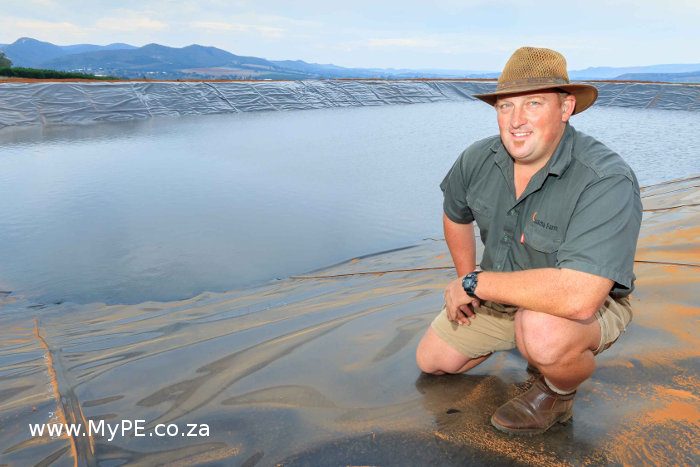
With eight of South Africa’s nine provinces declared drought disaster areas, the agricultural sector and other water-intensive industries are incorporating clever water conservation solutions to preserve this increasingly scarce commodity.
Among these solutions are the lining of dams and reservoirs to cut water losses from seepage into the soil, as well as covering water bodies to reduce losses from evaporation – requests which are increasingly being asked of water solutions company Rhino Water, the company says.
The latest weekly report released by the national Department of Water and Sanitation indicates that the country’s dams and reservoirs are currently operating at just over 52% capacity, compared with 74% last year.
In the Eastern Cape, with dams at an average capacity of 66%, farmers are not taking the availability of water for granted.
The Quacha Group, which operates farms in Patensie, Loerie and Addo, is one of the businesses which has asked Rhino Water for help. Chiefly a citrus producer, the group specialises in high value, intensive farming, which is built on smaller production units with higher yields.
According to Quacha’s Dirk Odendaal, the group needed to streamline costs and one solution had been to invest in water storage.
“We decided on water storage for two reasons. The first was to make use of the preferential night-time electricity prices by pumping ‘cheap’ water into the dam at night and then distributing it via gravitational feed during the day.
“The second reason was to secure water during the dry period. The Gamtoos has continuous water supply through a channel system that is always filled with water. But every year this system shuts down for two weeks for routine maintenance, so having a water store will allow the group to expand its fruit mix, despite this downtime, with crops such as berries that require constant watering and feeding.”
Although water security was not a problem in the Gamtoos region, Odendaal said it was nevertheless important to maximise the resource in the development of individual farming projects.
He said his group’s new dam would ensure water availability should any unforeseen circumstances arise, especially given the introduction of a dam liner which would contribute to conserving the stored water by minimising seepage-related losses.
According to water solutions expert Sarel Bam, MD of Rhino Water – the company responsible for the dam liner’s installation – the lining consists of high-density polyethylene (HDPE), which is one of the most chemically resistant materials available.
“It has high tensile strength with good impact, tear and puncture resistance and very good environmental stress cracking resistance,” said Bam, adding that the dam liners also had a variety of other applications for farmers and could be used to line sludge ponds for piggeries, dairies and abattoirs.
“Basically, anywhere where organic or industrial waste threatens to leach into the soil and contaminate the groundwater.”
Aside from its agricultural uses, Bam said HDPE was the preferred choice for lining landfills and the insulation of chemical plants, roads and petrol stations, as well as in mining operations.
Other water saving solutions asked of the company included woven geo-membranes that act as a protective cushion for liners in rocky soil, and floatation covers which prevent the growth of algae and water loss through evaporation, he said.
Some of Rhino Water’s recent projects included liners and floatation covers for six treated waste water ponds in the agri-zone at the Dube TradePort industrial development zone, as well as lining the waste water treatment works ponds in Nieu-Bethesda for Cacadu District Municipality.


Alan Straton
Latest posts by Alan Straton (see all)
- Samro brings senior Leadership team to Cape Town for #MEX26 - 2 October 2026
- Serious Social Investing Conference 2026 Focuses on Doing More With Less - 2 October 2026
- How AI Is Helping Detect Eye Problems Earlier - 2 October 2026
- What Are the Limits to Upload and Analyse an Audio File Using AI? - 2 October 2026
- St. Petersburg Hosts Information Tour for Tourism Industry and Media Representatives - 1 October 2026
