

Designed for children and adults alike, Happy Valley is ideal for family strolls in pleasant surroundings and offers a delightful fairy-tail and nursery rhyme setting of colored lights in the evenings.
There are lily ponds, rockeries, gigantic palms and peaceful retreats in which to sit. A large chessboard has been laid out in the valley on the lawn and visitors interested in playing the game may acquire the chess pieces from the Beach Manager’s Office.
Happy Valley is connected to Humewood Beach (Blue Flag Beach) via a sandy subway.
The Shark River meanders through the valley. Shark River gave rise to the name of Shark Rock and the Pier. The last time that the Shark River roared was during Port Elizabeth’s Great Flood on 1 September 1968. In September 1968 Port Elizabeth had 1032.6mm of rain, during the rest of the year only 36.4mm fell!
The first time Happy Valley enters into history is not on such a ‘happy’ occasion when on 27 February 1752, sailors from the Nécessaire where marooned in the Humewood, Happy Valley area, after attempting to find fresh water.
The hospital for infectious diseases used to be sited on the southern side of Happy Valley close to the old homestead of Mr William Brooksby Frames who, in 1851 under the trading name of W.B. Frames & Son, erected an extensive wool-washery on the south bank of the Shark River near his home. Wide open spaces enclosed by stone walls were cleared for the laying and drying of the scoured wool.
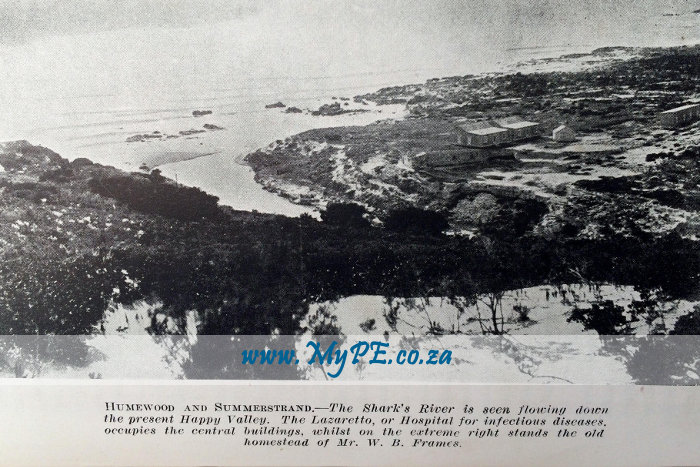
This enterprise carried on until the close of December 1857 when it was replaced by C.E. Frames.
The Shark River through Happy Valley was also the site of Port Elizabeth’s first Dam (reservoir) known as Frames Dam. Early residents used to collect clean water for drinking and household purposes from wells or shallow pools dotted about the settlement. Homes in upper town on the Hill, where most of the best houses had been built were dependent upon tanks in which the rain from roofs was stored.
The first small supply of water for Port Elizabeth came from a small stream in South End, then known as Papenbuitjesfntein, and was collected into a large brick tank erected on a solid base which stood on the foreshore about one hundred yards from the site of the present Dom Pedro Jetty.
Attention was focused on the Shark’s River in the area known as the ‘Springs’ that among the sand-hills on the Gomery Farm (present Summerstrand near to the old Boet Erasmus Stadium). In the early 1860′ Mr Frames formed a syndicate known as ‘The Shark’s River Water Supply Company’ which raised a capital amount of £10 000 in subscribed shared or £100 each. The idea was to throw a dam across the Shark River around three-quarters of a mile from it’s mouth and thus producing a a fine wide reservoir for the storage of it’s water.
This was officially completed and the reservoir had it’s official opening in 1864 with the official ‘Turning of the Tap”. Reports say that the depth of the water in the reservoir on that day was sixteen feet. The daughter of the Commissary-General, Miss Bennett broke the obligatory bottle of champ[agne before the tap was turned and named the reservoir, ‘Frames Reservoir’.
Mr Frames said at the time; “The pipes are now on their way from England, and when once the inhabitants have tasted the wholesome fresh water and enjoyed the great convenience of having it laid on in their homes, the name of Frames will become immortalised, and when we brush our teeth in the morning we will say – God bless Fishery Frames for this blessing.”
The first keeper of the waterworks at Shark’s River was Mr McAdam.
Pipes were duly laid from the reservoir across the sand dunes to Main Street (now Govan Mbeki Avenue) and as far as the North End Goal. A branch line, supported on trestles went across the beach to the end of the jetty for tank boats to draw a supply for ships. Taps were fitted at intervals along the supply line for the convenience of residents.
The water scheme suffered from a number of concerns – it only really benefited residents in the lower portion of the town as pressure was not sufficient for those in the Upper parts of the Hill; the water was of bad quality and contained lots of magnesia salts; the pressure was low as the intake was only sixty feet above sea level and the supply amounted to around 50 000 gallons per day.
In 1867 a scheme was proposed to convey water from the Van Stadens River – thirty miles west of Port Elizabeth. Four years later residents experienced water being laid on in their homes with the supply being augmented later by the Bulk, Palmiet and Sand Rivers. This led to the abandonment of Frames Reservoir and as the walls crumbled the Shark River continued it’s uninterrupted flow through Happy Valley.
Residents then began erecting small bungalows in the area which was seen as a suitable picnic spot.
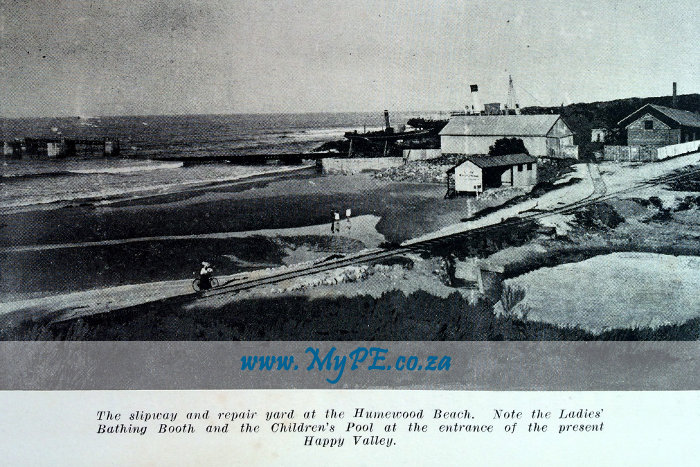
In time the Shark’s River Valley was leveled and the water diverted into a pool which became known as the ‘Children’s Pool’ with an overflow of water across the beach to the sea. Later the valley was embellished and was called Happy Valley.
In order to provide seating accommodation for the increasing number of people visiting the area on holidays and weekends sloping terraces were cut into the banks of the Shark River overlooking the children’s pool in Happy Valley on the one side, and the beach and the sea on the other side.
Experienced sailors racing in Algoa Bay known that when the Westerly wind blows at 25 knots or more, gusts will come racing down Happy Valley which can, sometimes, give an advantage.
The Summerwood Primary School connection to Happy Valley:
On 1 April 1945 a small wooden building in Port Elizabeth’s Happy Valley opened its doors as an English-medium school under the name Humewood-Summerstrand Preparatory School. The principal was Miss R Clementz.
The building burned down in 1953, and all that could be rescued was a piano and the inter-house shield which is still in the school’s possession.
For 18 months the school was accommodated in the Dollorico Café in Happy Valley, in premises that were also used as a nightclub. Each morning the signs of the previous evening’s partying had to be tidied away before school started.
A new school building in Second Avenue, Summerstrand, was taken into use in 1954, having been formally opened by Port Elizabeth School Board chairman Albert Jackson. At this time the school’s name formally became Summerwood Primary, incorporating elements of the names of both suburbs. There were at that stage 260 pupils and eight staff members.
The name Happy Valley is first recorded as having been used of the Shark River gorge, which today lies between Humewood and Summerstrand, in 1924 when the Humewood Café was opened alongside the gorge. The café building stood, although the business operated under a variety of names, until it was washed away in the flood of 1968.
The gorge is laid out with gardens and its lawns (at the lower end) are a popular venue for concerts and talent competitions. In the summer holiday season it is decorated with tableaus showing a variety of fantasy and TV show cartoon characters. These are illuminated at night for the entertainment of small children.
Previously the name Happy Valley was attached (from at least 1893) to the gorge next to which the Humewood Road railway station (terminus of the narrow-gauge line to Avontuur) was situated, when the line was built between 1903 and 1907.
Happy Valley Tragedy:
Stewart Wilken AKA “Boetie Boer” is a convicted serial killer from Port Elizabeth. Wilken is regarded as a highly unusual serial killer, having killed individuals from two distinct victim types, female prostitutes and young boys (he also killed his adolescent daughter). Wilken killed from 1990 until he was arrested in January 1997. His number of victimes could be more than 10.
Wuane, Wilken’s daughter from his first marriage was last seen on September 29, 1995, by her half-sister, who was Wilken’s first wife’s daughter from a previous relationship. Wilken, who had been married to his second wife for almost five years by now, was visiting with Wuane’s mother. Later that afternoon, the half-sister saw Wilken with Wuane, sitting on a sidewalk about 150 feet from their home. Wuane was never seen alive again.
It was reported at the trial that Wilken had taken 10 year-old Wuan to the Happy Valley garden filled with fairy-tale figures such as dwarves. Wilken had played there as a child and said they were some of his happiest memories. When he left his second wife’s home, he went to stay in the bushes near Happy Valley.
After killing Wuan, Wilken removed her clothes and kept her body, talking to it and sleeping next to it at night.
More Must See in PE suggestions.
CLICK HERE for: Budget PE Accommodation | PE Waterfront
Experience Magnificent Nelson Mandela Bay:


Alan Straton
Latest posts by Alan Straton (see all)
- The Countdown On – Mind Matters Is Taking Over Cape Town Before Taking the Conversation Global - 28 September 2026
- BurnesSEO Study Finds South African Small Businesses Invisible in AI Search Results - 28 September 2026
- BurnesSEO Study Finds South African Small Businesses Invisible in AI Search Results - 28 September 2026
- Why Digital Equity Is South Africa’s New Frontier for Women’s Empowerment – By Matebe Chisiza-Asukile and Natasha Mboyisa - 25 September 2026
- New Champions Rise at the 2026 Street Lines Skate Tournament - 23 September 2026

An emailed comment from Lance: Alan, that is the most comprehensive history on Happy Valley I have ever had the good fortune to read. I must differ on one point though….in the early sixties the Frame dam was still intact. I used to take a walk up to it at least on a monthly basis and always marveled at the fact that it was still in working order. A really wonderful read that made my day. The Frames of course became the famous Frame group and Philip Frame was eventually knighted for the families’ efforts in industry.