
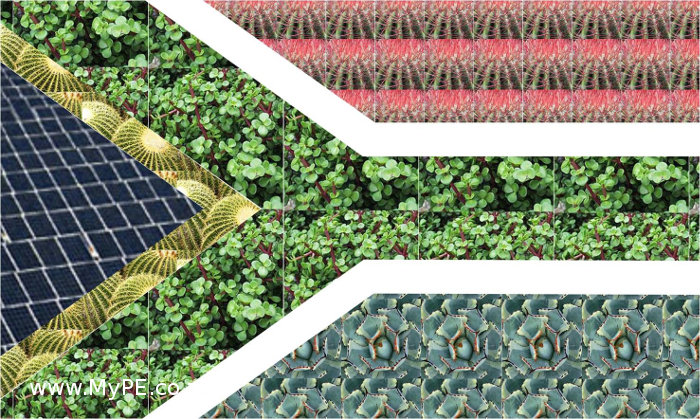
Development financier, the Eastern Cape Development Corporation (ECDC) has thrown its weight behind the launch of what will be a man-made phenomenon and a world-first – a R170 million Giant Flag project which will result in the construction of the world’s biggest flag in the small Karoo town of Graaf Reinet in the Eastern Cape.
Formally launched this evening by the Deputy Minister of Tourism Thokozile Xasa, at the Valley of Desolation in Graaf Reinet, the Giant Flag is a 66 hectare South African flag made up of 2,5 million coloured desert plants and a four megawatt solar field, established on the outskirts of Graff-Reinet. It will be viewable from the moon or when flying over the area. The Giant Flag is the idea of creative mind Guy Lieberman who wanted to build excitement around the South African flag and to foster nation-building after the 2010 Soccer World Cup. The Giant Flag Trust has been working on making this dream a reality since July 2010.
The Giant Flag is expected to be finalised in 2016 and it will be the size of 66 rugby fields and it will be a totally green off-grid flag. It should create about 700 jobs for the local Camdeboo municipality. All the jobs linked to the Giant Flag, either through direct employment, SMME incubation or contract, will be considered green collar. All public tenders will favour Camdeboo citizens and companies extending to the broader Eastern Cape.
“The red, blue, green and yellow parts of the flag will be plants, while the black part will be a solar field which will house a conference centre, boutique hotel, and SMME hub, a nursery and an underground reservoir for rainwater harvesting. The white part of the flag will be a road. The Giant Flag will be 1km long on either side and reach a height of 0,6km.
The Giant Flag will layer several streams of environmental, social and economic activity under one overarching project that will extend over decades. The concept takes one Karoo municipality, Camdeboo, made up of Graaff-Reinet, Aberdeen and Nieu-Bethesda to generate an economic shift so effective that it will change the course of that community forever,” says Giant Flag trustee Samantha Jankovich.
Jankovich says once complete, the solar field should generate 4 megawatts of power which will be sold to the local municipality and Montego Foods which both have already signed letters of intent. As a not-for-profit organisation, the Giant Flag Trust intends to use the proceeds from the power sales for social projects and to ensure that it is self-funding.
ECDC injected just over R1,2 million into the project made up of R899 000 for the acquisition of environmental authorisation and town planning services. ECDC has also provided a further R356,000 as a contribution toward the costs of launching the Giant Flag project.
“ECDC took a decision to support the project due to its strategic importance to the development of the tourism industry in the region. ECDC’s strategy puts more emphasis on support toward green economic initiatives and the Giant Flag became a perfect fit,” says ECDC risk capital specialist Phakamisa George.
The Development Bank of Southern Africa (DBSA) funded the business plan while the Camdeboo Local Municipality has shown its support by committing 100 hectares of municipal commonage for the project. The municipality’s chief finance officer sits on the board of the trust as an active participant.
The trust has been formed to oversee the running of the project, and it will do this through the creation of an endowment fund whose express aim is to generate further opportunities in the innovation, green and social sectors in the Camdeboo and Karoo.
Proudly South African, the International Marketing Council and South African Tourism have formed the Tourism Troika, on behest of the Minister of Tourism, and they have proactively reached out to the Giant Flag project to become their first initiative – they consider the project a ‘low-hanging fruit.’
She explains that R100 million is needed for the solar field and R71 million for the flag. A letter of intent has been signed with an Israeli company for funding and the DBSA has signed a letter of support for R50 million from its Green Fund. Princess Irene of Holland also provided seed capital for the project.
Jankovich adds that local labour will be used for the construction and planting of the flag, up to 60% of the employed will be women and over R5 million will go towards local labour in the 18 months leading up to the establishment of the botanical elements alone.
“There will be permanent and sustainable employment including new SMMEs based on the existence of the flag. This should also include the development of a conference facility and SMME precinct within the Flag, under the apex of the black triangle (the solar field), including green buildings and a large-scale water harvesting design.
Activities will include hot-air ballooning and microlight sky tours of the Giant Flag, flag honey from the many beehives to be established to pollinate the succulents and cacti, ‘plant your own flag’ take away succulent trays, ecotourism initiatives directly connected to the flag and the increased use of airport facilities. This should result in increased overnight stays and flag festivals,” Jankovich adds.


Alan Straton
Latest posts by Alan Straton (see all)
- TrueTech Readies South African Homes and Offices for a Year-End Tech Upgrade - 2 November 2026
- Now I Understand Why Investing Is Not for the Faint of Heart - 2 November 2026
- LED-Lightbox Rental in Midrand Delivers, Sets up and Collects Light-up Letters, Numbers and Neon-Style Signs for Gauteng Weddings and Year-End Functions - 2 November 2026
- Record Numbers Walk in Step With Those Affected by Cancer - 2 November 2026
- PrintEngine Sets up Web-To-Print Storefronts for South African Print Shops Still Taking Orders by Email and WhatsApp - 2 November 2026

Looks goooorgeous. I can only but imagine the buzz that this would create around iRhafu and the surroundings.
SA needs this.