
On Saturday 30 June NSRI Rescue 6, accompanied by Rescue 6 Alpha, took a patient out to sea. Onboard was Jared Harding from SAMREC and the patient – a juvenile giant Northern Petrel.
The Petrel had been brought into SAMREC by a concerned citizen after picking it up on the Maitlands Beach. Dehydrated and hungry the Petrel found warmth and comfort at the SAMREC rehabilitaion centre. Two weeks of fattening up on chicken necks – apparently the scavenger refused to eat pilchards and the budget couldn’t stretch to steak so a compromise was reached and chicken necks became the daily diet.
Ian Gray picked a point 2.5 nautical miles offshore for the release and we motored out in a flat calm sea with barely a breeze to speak off. In the balmy conditions Rescua 6 Alpha practised rough water handling in the wake of Rescue 6 whilst we consumed 41 litres of diesel per hour at a steady 18 knots. Past the Bell Buoy and just outside Algoa Bay the swell picked up and the wind began to blow. I was transferred to Rescue 6 Alpha to record this momentous occasion.
Jared lifted the Giant Northern Petrel out of his/her cage – the sex is undetermined – and gently lowered the passenger into the water off of the stern of Rescue 6 and then we waited for the Petrel to take flight. For a while we thought that maybe Jared had given the Petrel too much of a farewell meal as he/she seemed quite happy to bob on the briny. One short test flight proved to us that all was working well. A pair of Skua’s landed on the water next to the Petrel – lucky for them the Petrel was not hungry as Petrel’s are opportunistic feeders who have been known to kill an albatross.
The final flight of the Petrel happened soon after as it took off across the bow of Rescue 6, swooped towards Port Elizabeth in the distance, turned back for one last flight over Rescue 6 Alpha and then headed in a North Easterly Direction towards Bird Island.
I found myself finding the answer to; “Why do we spend so much money on rescuing birds and animals?” If we didn’t make such a fuss then other people would not be aware of the need to protect our planet, thereby contributing to the rapid decimation of many species.

Rescue 6a at speed

Rescue 6a

Giant Northern Petrel

Giant Northern Petrel takes off across the bow of NSRI Rescue 6

The Giant Northern Petrel swoops over Rescue 6 Alpha
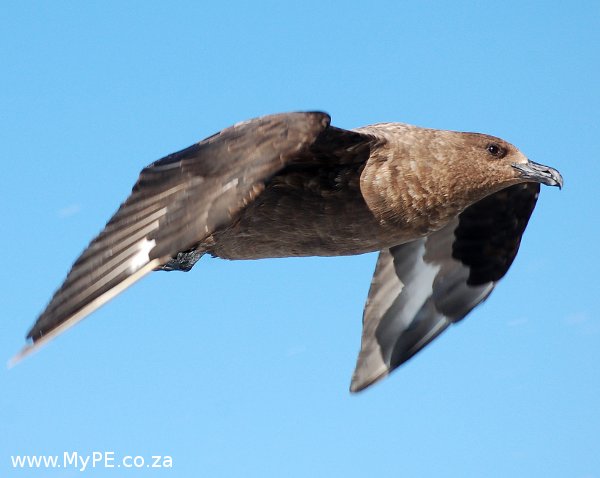
On the trip back to the harbour we had Skuas effortlessly keeping up with us at Twenty Knots

Rescue 6A with Port Elizabeth in the background

It is quite difficult to tell the two species of Giant Petrel apart. The Northern Giant Petrel can be differentiated from the similar coloured Southern Giant Petrel by the top of the bill, which on the southern is green. The Northern Giant Petrel averages 90cm in length. Its plumage consists of grey-brown body with lighter coloured forehead, sides of face, and chin. Its bill is between 90–105mm long and is pinkish yellow with a brown tip, and its eyes are grey. The juvenile of this species is completely dark brown and lightens as it ages.
The Giant Petrel, is a large seabird of the southern oceans. The Northern Giant Petrel’s habitat is further north than their counterpart the Southern Giant Petrel. Petrel refers to Saint Peter from the story of him walking on water, which refers to how they run on top of the water as they are getting airborne.
The Northern Giant Petrel feeds mainly on carrion from penguins and pinniped, as well as krill, offal, cephalopods, and discarded fish and waste from ships. During breeding season, males eat more carrion than females with the females feeding on pelagic sources.


Alan Straton
Latest posts by Alan Straton (see all)
- CDC: The ONLY Number You Require (For Now) - 30 September 2026
- Soccer Laduma Sets Out a Bonus and Deposit Guide for SA Punters This Spring - 30 September 2026
- Alu Door & Window Centre Readies Mpumalanga Homes for the Summer Storms - 30 September 2026
- If AI Can Now Do the Work, Who Checks the Work? - 29 September 2026
- UK Music Titans Marc Marot & Jeremy Marsh Join #MEX26 in Cape Town - 29 September 2026

That is just so awesome – that such a beautiful bird could be rescued. Wouldnt the world be a far better place if we ALL looked after it – and that includes every living thing, and not the stupid human way of looking at things as though animals are there for our abusive pleasure. Well done to SAMREC and NSRI. Nice to read a warm fuzzy good news story on a Monday morning – instead of murder, rape and politics.