
Dear Alan
This is what I was thinking about the red tide at 04h00 this morning…..
Maybe it is due to the seismic survey ship – which has chased the whales away. The red tide is caused by phytoplanktons which feed on nutrient rich water.
The whales would have eaten the nutrients but because they were chased away the phytoplanktons moved in.
OR the seismic survey released the blooms of the phytoplanktons which then just carried on multiplying.
I am sure there is some link between the damage done to the whales and dolphins and the recent seismic survey.
Glynnis
Editor: An intriguing thought so I did a modicum of research and think that the seismic survey could have been a contributing factor or a ‘trigger’ for the event.
Most scientists concur that the presence of a Harmful Algal Bloom (HAB, commonly known as a Red Tide) is formed as a result of a variety of factors.
Our old friend, Wikipedia says that the Causes of HAB‘s are unclear:
It is unclear what causes HABs; their occurrence in some locations appears to be entirely natural, while in others they appear to be a result of human activities. Furthermore, there are many different species of algae that can form HABs, each with different environmental requirements for optimal growth. The frequency and severity of HABs in some parts of the world have been linked to increased nutrient loading from human activities. In other areas, HABs are a predictable seasonal occurrence resulting from coastal upwelling, a natural result of the movement of certain ocean currents. The growth of marine phytoplankton (both non-toxic and toxic) is generally limited by the availability of nitrates and phosphates, which can be abundant in coastal upwelling zones as well as in agricultural run-off. The type of nitrates and phosphates available in the system are also a factor, since phytoplankton can grow at different rates depending on the relative abundance of these substances (e.g. ammonia, urea, nitrate ion). A variety of other nutrient sources can also play an important role in affecting algal bloom formation, including iron, silica or carbon. Coastal water pollution produced by humans and systematic increase in sea water temperature have also been suggested as possible contributing factors in HABs. Other factors such as iron-rich dust influx from large desert areas such as the Sahara are thought to play a role in causing HABs. It is unclear what initiates these blooms and how large a role anthropogenic and natural factors play in their development. It is also unclear whether the apparent increase in frequency and severity of HABs in various parts of the world is in fact a real increase or is due to increased observation effort and advances in species identification technology.
But, most interesting is that it is strongly suspected that the decline of filter-feeding shellfish populations, such as oysters, contributes to HAB occurrence.
These marine animals help limit or reduce phytoplankton populations by feeding on them. Filter-feeding oysters, scallops and sponges consume phytoplankton as they circulate seawater through their bodies, while microscopic crustaceans like copepods graze on phytoplankton in the water column.
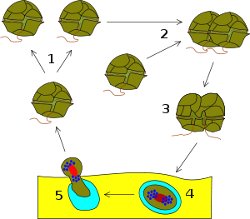
Whales do eat (absorb/ingest) phytoplankton – one group of which is the dinoflagellates. Dinoflagellates are able to reproduce rapidly and copiously on the back of abundant nutrients in the water. One of the poisons produced by the dinoflagellates is saxitoxin, a powerful paralytic neurotoxin.
Dinoflagellates are the second largest group of marine producers and are eaten by the smallest filter feeders such as clams, anemones and mackerel as well as the largest such as whales.
The David Suzuki Foundation sums the potential harmful effects of seismic surveys as follows; “The sonic waves used in seismic surveys can damage fish with air bladders, destroy marine wildlife eggs and larvae, and incite fish and other marine species to temporarily migrate away from the affected area.”
Lets put the above in perspective – Imagine what you would do if a UFO the size of the Nelson Mandela Bay Stadium had to hover over your home for weeks on end and you were subjected to a sound the magnitude of the Space Shuttle lifting off for weeks on end?
My theory goes as follows: The scramble by Algoa Bay’s filter feeding marine animals to escape the seismic noise could have lifted the dinoflagellates from the sea floor, other filter feeding fish and whales could have been chased away from the area, abnormally hot days could have contributed to upwellings and the greater presence of food for the phytoplankton which resulted in our red tides.
My limited research does then seem to support the theory that the seismic survey could have been the tipping point or trigger for our recent red tide – it would be interesting to see if those marine animals that were unable to escape the seismic boom overhead have been affected in terms of reproduction rates etc.
See also: Seismic Survey begins in Algoa Bay | Whales receive ONE day of peace and quiet

Port Elizabethan
Latest posts by Port Elizabethan (see all)
- Why Fewer People Are Being Convicted for Commercial Crimes - 15 May 2026
- Urgent Call for South Africa to Support and Join Global Efforts to Phase Out Fossil Fuels - 15 April 2026
- Unfenced 6 SAI Army Base Outside Makhanda Claims Another Life - 20 November 2025
- Death Toll Rises From Makhado Bus Crash - 21 October 2025
- Law Clinics Flooded as Home Affairs Blocks Asylum Seekers From the System - 15 October 2025

An emailed comment – The other HUGE advantage with the red tide is that all the perlemoen will now be poisonous – so either the poachers will move on or they will carry on stripping the coast and send it to China. Wonder if the Chinese will sue if some of them succumb?
Here is my two cents worth. From what I understand the survey ship, amongst all the other scary points listed above, also seriously disturbs the ocean floor. When the ocean floor is so violently agitated it would release all the sediments built up over centuries. These sediments surly contain vast amounts of nutrients that could have triggered the growth in plankton. With all the filter feeders gone their growth continues almost unabated.
Does this make sense?
Yes, that is the contention Roger. BUT the theory is a bit shaky when one sees that the Red Tide extended far down the coast and out of the Seismic Survey area.
It would be interesting to see whether currents could have had an impact.