
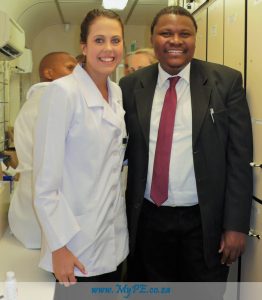
Since Monday 23 January 2017, hundreds of the Bay’s poorest residents have been flocking to Transnet Foundation’s Phelophepa II health care train, which has set up its on-board mobile clinic at Swartkops Station.
The train – which will be in Port Elizabeth until February 3, after which it will continue on its annual nine-month medical journey across the country – is staffed mainly by final-year or intern-level students from across the country, who work alongside the train’s resident professionals, to conduct visual, dental and general health screening, and provide counselling and various community outreach programmes. They assist between 300 and 400 patients a day.
Nelson Mandela Metropolitan University has been involved with Phelophepa for nearly 20 years, providing pharmacy, psychology and nursing students to work on the train. The university also manages Phelophepa’s social mobilisation function for the entire Eastern Cape, which involves setting up and coordinating local organising committees at each of the stations to be visited by the train, to prepare for its arrival.
A trip to the Phelophepa was among the first priorities of NMMU’s new Dean of Health Science, Prof Lungile Pepeta, who is passionate about finding solutions to the public health care gaps in the province and country, and hopes the students working on the train would be inspired to pursue careers in the places where they are needed the most.
“You can see the need – 300 to 400 patients a day says a lot about poor service delivery in the public health sector in this country,” said Pepeta, 42, a paediatric cardiologist, who headed up Dora Nginza’s Paediatric Unit for eight years before taking up his appointment at NMMU in January.
He was joined at Phelophepa by a delegation of NMMU pharmacy, psychology and nursing science staff, who were led on a tour of the extensive on-board facilities, by Phelophepa manager Lynette Flusk, who is a counselling psychologist by profession.
“The people started coming to the station before the train had even arrived,” she said.
Patients at the train pay R30 for spectacles, which they receive on the same day, R10 for dental work and R5 for medicine prescriptions. “It’s a small charge, but it’s to give the patients a sense of ownership.”
The students work on the train for an average of two weeks, before rotating with the next group of students. They see patients, from early morning until late at night – and they learn more about the discipline they have studied, and their role as carers of people.
“The students get a sense of where the real health care needs are in South Africa … It’s among the poor, in deep rural areas,” said Pepeta.
“There is a huge shortage of doctors across the country – the Eastern Cape and Limpopo being the two worst provinces, in terms of doctor to population ratios.
“There is also a huge need for other health practitioners in the Eastern Cape – pharmacists, nurses, psychologists, social workers and so on … Our faculty has a huge job to do in terms of producing these health professionals.”
It’s a responsibility the University has not taken lightly – and one that has led to a planned medical school for NMMU, which should be up and running by 2020.
The medical school is taking a non-traditional, integrated, community oriented and broad-based approach. In other words, it is identifying the greatest needs in the province – and then building the programmes and curricula, based on these needs.
Similar to Phelophepa’s philosophy, the hope is that Health Sciences students will conduct their practical training in deprived areas – and that these communities will become the ones they desire to serve.
“We will expect our students to work in clinics, health centres and district hospitals, to eventually fill the posts which are really lacking.
“We hope to draw people to the Eastern Cape, who will stay in the Eastern Cape.”
NMMU Pharmacy Professor Ilse Truter, who is a coordinator for Phelophepa, allocating weeks on Phelophepa I and II for the participating pharmacy schools to send their students, said: “The primary health care on the train is the epitome of the ideal clinic scenario … It is the best training ground for community service [a compulsory year for newly-qualified health sciences students].”


Alan Straton
Latest posts by Alan Straton (see all)
- Embroidery or Print? EMB Designs in Durban North Checks the Artwork and Runs a Sample Before a Full Staff, School or Club Order Is Stitched - 4 November 2026
- PrintAcademy 3D in Stellenbosch Trains Teachers First, Then Learners, so School 3D Printers Get Used Beyond the First Term - 4 November 2026
- From Estate Agency Posters to Museum Panels: Laminator in Kya Sand Lists Which Jobs Call for Cold or Hot Roll Wide-Format Laminating - 4 November 2026
- Spice Jars, Sauce Bottles and Pharma Packs: Bottle Sealers in Jacobs Matches Induction Sealers and Foil Liners to the Product on the Line - 4 November 2026
- Before You Sign an ERP Quote: Bizmatics in Centurion Publishes Plain Guides on Budgets, Data Clean-up and Go-Live Week for SA SMEs - 4 November 2026

An emailed comment:
Hi Alan,
Your article about the Phelophepa health trains criss-crossing the country to attend to 400,000 needy citizens at 40 stations highlights two opposites.
One is the good-will of all who participate in the scheme versus what health facilities should normally be in place at the cities and larger towns where the train stops for the local residents.
The train should go to remote places where none of these facilities are not in easy reach.
Maybe that could also be a problem due to the state of the railways and once good network with stolen and non-maintained railway tracks.
The railways keep mum on all this, but it is an eye opener if one talks to railway enthusiasts and hears what really has happened to our once well-oiled railway service which I myself used extensively for many years.