
The most recent monthly trend cycle data for the NMB BCI is suggesting a consolidation in the rate of growth of economic activity in the Metro. While not as yet indicating a decline in the NMB BCI, the performance of key indicators such as new car sales in the Metro and the local rate of inflation are beginning to suppress the rate of recovery in the index.
To receive the Nelson Mandela Bay Business Confidence Index (formerly the Porth Elizabeth Business Confidence Index) compiled by Dr Neil Bruton of RGT Smart Ltd, contact the Nelson Mandela Bay Chamber of Business.
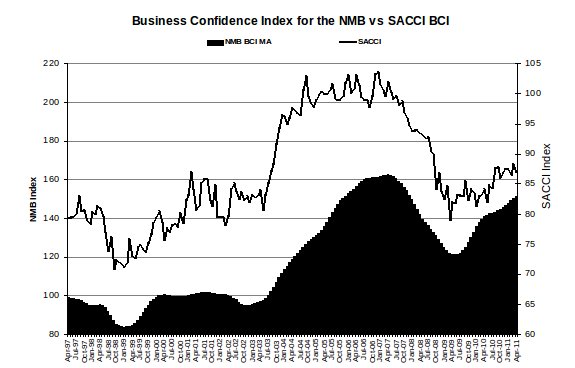
With the recovery in the South African economy now nearly two years old an understanding of the nature of the recovery is important to developing a view going forward. The recovery has been led by export revival, inventory normalization and strong growth in household, specifically income led, consumption spending. High international commodity prices have boosted the country’s terms of trade and strong foreign capital inflows have assisted in rand strength, suppressing inflation and allowing interest rates to decline to a thirty six year low. The growth in consumption spending of households that has fuelled economic recovery has relied on growth in household disposable income which has grown at around five percent per annum in real terms and ten percent in nominal terms on an annual basis for the past eighteen months. The fact that the growth in consumption spending has relied primarily on income is also reflected by the fact that credit extension to the private sector, after actually declining for seven months to mid 2010, is currently only growing at a weak 5.1 percent per annum. Furthermore, it appears that households have not utilised growth in disposable income to significantly reduce debt with the household debt to disposable income ratio remaining high at around 78 percent, only a small reduction from the peak of 82 percent recorded in mid year 2008. Business has, furthermore, remained cautious and unwilling to commit either to incurring significant additional debt or expanding investment with annual growth in fixed capital formation at a low 1.5 percent.
While retail trade sales for the first quarter of 2011 reflected an increase of 5.6 percent when compared with the first quarter of 2010, and retail trade sales in real terms increased by 5.1 percent year-on-year in March 2011, there is the possibility, given the current environment which includes increasing general inflation, administered price increases and fuel and food price increases, that free disposable income of households is steadily coming under growing pressure which is in turn likely to put pressure on the consumption led upturn that the country has experienced to date. This pressure on household budgets will intensify in the second half of 2011 should interest rates begin increasing as is widely expected by analysts. Under these circumstances the trend cycle of the NMB BCI could struggle to post improvement from current levels during the second half of the year.
With regard to the details of the PEBCI, the trend cycles in eleven of the sub-indices reflected improvement, three reflected deterioration, and one moved sideways.
The indicators that supported the PEBCI through April included the trend cycles in the real value of both exports and imports which once again reflected growth, the trend cycle in the national new vehicle market which reflected marginal growth and the trend in consumer confidence in the Eastern Cape which also reflected some growth through the month. The trend cycle in the price of gold also assisted the index. Furthermore, the underlying trend cycle in the real seasonally adjusted value of manufacturing continues reflecting slow growth as do the trend cycles in real retail sales in the Eastern Cape and in the real value of new building plans passed and in new buildings completed, with both of the latter reflecting very marginal improvement from a very low base. The trend in the number of passengers arriving at the PE airport showed some improvement as did the trend cycle in the JSE all share index through April.
On the downside, the trend cycle in the local rate of inflation weighed on the index, the trend in the rand US dollar exchange rate weakened marginally, and the trend cycle of new car sales in the Metro weakened, raising some questions regarding the underlying strength of the local economy.
The trend cycle in the prime interest rate moved sideways through April having no meaningful effect on the overall index.


Alan Straton
Latest posts by Alan Straton (see all)
- Am I Missing Something Here Facebook/Google? - 27 October 2026
- Fish Moths in the Cupboard? True Clean Looks for Moisture - 27 October 2026
- The Programme for Music Exchange #MEX26 Is Out, Conference Is Hosted by DJ Eazy - 26 October 2026
- The Programme for Music Exchange #MEX26 Is Out, Conference Is Hosted by DJ Eazy - 26 October 2026
- The Household Pest Mystery That Starts in the Roof - 25 October 2026
