
Over the past five months the NMB BCI has largely moved sideways reflecting little growth momentum. The development in the BCI is in line with more subdued levels of economic activity during the second quarter of 2011 which appears to have continued into the beginning of the third quarter of the year.
To receive the Nelson Mandela Bay Business Confidence Index (formerly the Porth Elizabeth Business Confidence Index) compiled by Dr Neil Bruton of RGT Smart Ltd, contact the Nelson Mandela Bay Business Chamber.
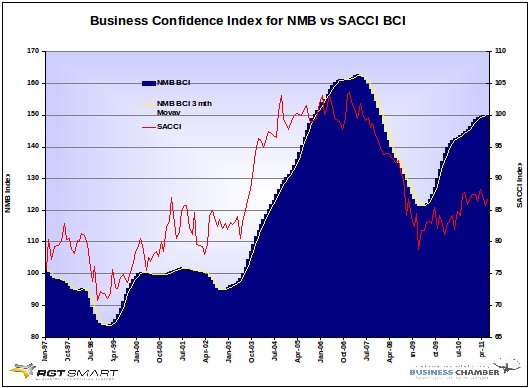
After unexpectedly high GDP growth of 4.8 percent during the first quarter of 2011 the pace of economic activity appears to have slowed during the second quarter. Annual growth in real retail sales after posting robust growth of 10 percent during April fell to zero in May and manufacturing production after growing at a low annual rate of 0.2 percent in April only recorded annual growth of 0.6 percent in May. Furthermore, the Kagiso PMI declined for the third consecutive month in June and the RNB/BER business confidence index for the second quarter fell back quite sharply to 47, below the break-even 50 level. Money supply growth and overall credit extension continue at low levels from an historical perspective and the annual change in credit extension to the private sector is also reflecting only hesitant recovery and is expected to remain in single digits for the remainder of 2011. With household consumption spending providing the driving force behind current economic performance the outlook for the economy in coming months is therefore, probably relatively fragile given low levels of credit extension, a sustained high level of household debt and growing pressure on the free disposable income of households. Lack luster performance of the JSE and stagnant house price growth will furthermore keep pressure on the household wealth to income ratio and on consumer sentiment in general.
Slowing global economic growth, ongoing major economic challenges, particularly in the USA and Eurozone, and the development of widespread strike action during July are further reasons to expect a slower pace of economic activity in coming months and provide little motivation for accelerated growth in fixed investment which in the first quarter grew by a low 3.1 percent on an annual basis.
Furthermore, with inflation likely to challenge the six percent upper limit of the target range by year end the possibility of an interest rate increase before the end of 2011 cannot be discounted, however, a slowing pace of economic activity during the second half of the year may well result in the Reserve bank holding off on interest rate increases until 2012.
With regard to the details of the NMB BCI, the trend cycles in seven of the sub-indices reflected improvement, seven reflected deterioration, and one moved sideways.
The indicators that supported the NMB BCI through June included the trend cycle in the real value of imports which once again reflected slow growth and the trend cycle in the price of gold which also assisted the index. The underlying trend cycle in the real seasonally adjusted value of manufacturing continues reflecting slow growth as do the trend cycles in the real value of new building plans passed and in new buildings completed, with both of the latter reflecting very marginal improvement from a very low base. In June the index was also assisted by a slight fall in the local rate of inflation and by a return to trend cycle growth of the new car market in the Metro.
On the downside, the trend in the rand US dollar exchange rate weakened marginally, as did the trend cycle of the JSE all share index. The trend cycle in the real value of exports also moved into decline through June and the trend in total new vehicle sales in the country has also begun weakening. Of concern is the deterioration in the level of consumer confidence in the Eastern Cape which dropped from 14 in the first quarter to 13 in second as measured by the BER, primarily as the result of a big drop in how respondents in the Eastern Cape expect the general economic position in SA to develop over the next 12 months, the rating of which fell from 21 in the first quarter of 2011 to 11 in second. The underlying trend in the real value of retail sales in the Eastern Cape moved into slow decline in June and the trend in passengers arriving at the PE airport declined quite sharply through the month.
The trend cycle in the prime interest rate moved sideways through May having no meaningful effect on the overall index.
Dr Neal Bruton of RGT Smart Ltd., has compiled the NMB BCI on behalf of NMBBC.


Alan Straton
Latest posts by Alan Straton (see all)
- NEXA Audio Readies South African Musicians for Festive Gig Season With IEMs - 22 October 2026
- Calling All Business Owners: Tell Us How You Made It Happen - 22 October 2026
- What Happens When Your Most Experienced Excel Employee Leaves? - 22 October 2026
- What Happens When Your Most Experienced Excel Employee Leaves? - 22 October 2026
- What Happens When Your Most Experienced Excel Employee Leaves? - 22 October 2026
