
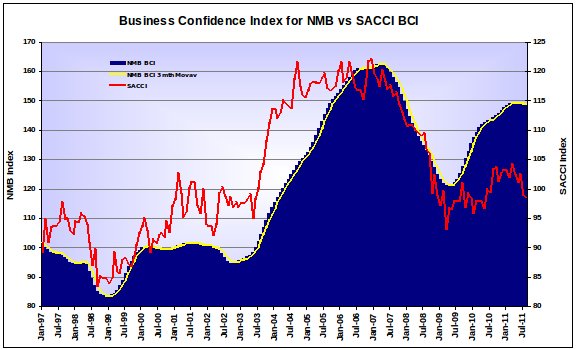
As expected the trend in the NMB BCI continued declining slowly through August coming under pressure from a range of weaker indicators while receiving some minimal support from the new car market in the Metro, the total national new vehicle market, and real retail sales in the Eastern Cape.
While the dramatic volatility on global equity and currency markets in September, coming as a result of a sharp deterioration in both the performance and outlook for the economies of the US and EU, compounded by the possibility and resultant far reaching impact of fears of sovereign debt default in the Eurozone, are not yet reflected in the performance of the NMB BCI, the index is beginning to capture the slowing current trend in the rate of growth in the South African economy. The slowing pace of economic activity in the country is reflected in the sharp decline in the rate of GDP growth during the second quarter of 2011 which saw the GDP growth rate fall from 4.5 percent in the first quarter to 1.3 percent in the second.
To receive the Nelson Mandela Bay Business Confidence Index (formerly the Porth Elizabeth Business Confidence Index) compiled by Dr Neil Bruton of RGT Smart Ltd, contact the Nelson Mandela Bay Chamber of Business.
Under pressure from exchange rate strength, slowing growth in the economies of major export destination countries and the impact of strike action towards the end of the second quarter, manufacturing declined by seven percent in the second quarter on a seasonally adjusted and annualised basis. The weak performance of manufacturing during the second quarter continued into July with the month down 6 percent on July 2010 and given the ongoing poor performance of the Kagiso PMI, which continued below 50 at the beginning of August, the outlook for manufacturing remains challenging. In this regard the Bureau of Economic Research noted that; “From a GDP growth perspective, the most concerning part of the latest PMI numbers is the sharp deterioration in near-term demand, as well as the downbeat expectations for future business conditions.”
The rate of growth in real retail sales has also slowed as disposable income of households has come under pressure from rising inflation, administered price increases and the impact on household budgets of food and fuel price increases. The annual rate of change in real retail sales did, however, improve marginally in July 2011 registering a growth rate of 2.8 percent over July 2010.
With the annual rate of growth in the ratio of private sector fixed capital formation to GDP still in decline, a situation that has persisted since the second quarter of 2009, with business and consumer confidence having declined sharply in the second quarter and with the growing likelihood of negative fallout for the South African economy from global developments, the possibility of an interest rate cut in coming months cannot be ruled out, a development that will certainly assist the demand side of the economy into 2012.
With regard to the details of the NMB BCI, the trend cycles in five of the sub-indices reflected improvement, nine reflected deterioration, and one moved sideways.
The indicators that supported the NMB BCI through August included the trend cycle in the price of gold which continues to assist the index. The underlying trend cycle in the new car market in the Metro is also growing slowly as is the trend cycle in the value of real retail sales in the Eastern Cape. The trend cycle in the real value of new buildings completed in the Metro, is also reflecting some tenuous improvement but with the actual values at a very low level and the trend cycle in the total national new vehicle market is reflecting marginal growth having been supported by higher than expected sales in August.
On the downside, the trend in the rand US dollar exchange rate weakened marginally through August, as did the trend cycle of the JSE all share index, a negative development that will again accelerate through September. The trend cycles in the real value of both exports and imports also continued in decline through August. The trend in the level of consumer confidence in the Eastern Cape is declining and trend in the local rate of inflation is accelerating weighing on the index. The underlying trend in the real value of building plans passed in the Metro is declining and the trend in passengers arriving at the PE airport continued declining through the month. The trend in the real value of manufacturing sales is now also declining at an accelerating pace.
The trend cycle in the prime interest rate moved sideways through August having no meaningful effect on the overall index.


Alan Straton
Latest posts by Alan Straton (see all)
- Why Digital Equity Is South Africa’s New Frontier for Women’s Empowerment – By Matebe Chisiza-Asukile and Natasha Mboyisa - 25 September 2026
- New Champions Rise at the 2026 Street Lines Skate Tournament - 23 September 2026
- When Manufacturers Have a ‘Beef’ Then Both Suffer - 23 September 2026
- How Much Are You Worth per Year to Your Bank? - 23 September 2026
- Better Business Processes. Stronger Workplace Skills. Smarter AI. Greater Business Productivity. - 23 September 2026
