
Artist and PE SAAF Museum magazine editor, Don Bell, recently uncovered a wonderful link between the Royal Airforce during World War II and a local Port Elizabeth pilot.
Don says; “I was visiting my brother-in-law, Tony Douglas-Jones, recently and as usual, got talking about aviation. Tony, a retired local businessman and active pilot, related how he had an uncle in the RAF during WW2. This immediately piqued my interest because I have been trying to find an interesting story about a locally born Port Elizabethan who was a pilot in the WW2.”
The article below contains extracts from Eric Douglas-Jones’s diary after research by Don:
Eric Alfred Douglas-Jones was born on the 1st February 1906, a small municipality of Walmer near Port Elizabeth South Africa and matriculated at St Andrews College Grahamstown in 1924.
He worked in the Port Elizabeth branch of The Vacuum Oil Company and joined the Prince Alfred’s Guard Regiment.
After an O.T.C at Roberts Heights Military headquarters at Pretoria in 1929 he was commissioned, and as a second lieutenant took his first flight in a D.H 9a aircraft and joined the local Aero Club. In 1930 he sailed in S.S. Trafford Hall to England and arrived in Plymouth on 31st October 1930.
He stayed as a guest with Flying Officer Bryce Meyers at the Officers’ Mess, RAF Station North Weald no.29 & no. 26 squadrons and later with relatives of his parents in England.
Eric applied to join the Royal Air Force on 4th November 1930 and was accepted by the Selection Board at RAF Air Ministry and was commissioned as Pilot Officer at Uxbridge No.2 Flying Training School and RAF Station Digby in Lincolnshire.
He took his first Instructional Flight in an Aerolynx in January 1931 and his First Solo Flight in February 1931.
In December 1931 he was transferred to No.25 B.Flight Fighter Squadron, Hawkinge, Folkstone, Kent flying Siskin single seater fighters.
In March 1932 the squadron was equipped with Hawker Furies and on 21st June 1923, under Squadron Leader Paxton, Eric participated in a group of 9 Furies roped together wing to wing in threes to do aerobatics in formation at Hendon Air Display.

Eric Douglas-Jones married Marjorie Santall in 1933 and his son Ian was born in September 1935 just prior to his embarkation to Sudan, Central Africa, after Mussolini’s declaration of war against Abyssinia. He was posted to No.35 Bomber Squadron and shipped on the S.S Carmaromia together with aircraft and arrived in Alexandria on 8th December 1935.
Eric became ill in Heliopolis and only joined his squadron in Atbara at RAF Air Station El Damar on 12 January 1936 and was welcomed by Squadron leader C.W.Hill (of “Road to Endor” fame). They were equipped with two seater Fairy Gordons which carried a pilot and gunner. There immediate duty was to patrol the border between Abyssinia and Sudan to repel Italian troops that were threatening invasion.
On the 1st March 1936 Eric was promoted to Flight Lieutenant then was transferred back to Group Fighter Command in England and stationed at Upavon.
After passing a Flying Instructors course he was transferred to No.6 Flying Training School, RAF Netheravon on 1st April 1937.
On the 1st December 1938 he was promoted to Squadron Leader and transferred to No.11 Group Fighter Command under Air Vice Marshall E.L. Gossage with the title “Squadron Leader Operations.”
Eric took a short war course at RAF Staff College. At this time the Group’s new Operations Room was constructed underground and he participated in planning the layout incorporating a large table plan of Southern England with wall panels of communications with all aircraft etc.
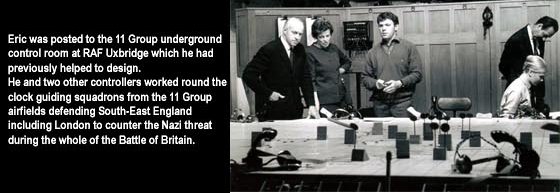
He flew in Group Communications aircraft consisting of Hawker Hurricanes and Supermarine Spitfires to various other fighter stations from RAF Northholt. He attended the King’s Levee in July 1939.
On 3 September 1939, War was declared with Germany and Eric became a Controller in the operations Room with two other officers. They alternated watch over 24 hours a day receiving information, contact with all fighter squadrons on stand by ready to intercept German air attacks.
In 1940 large scale enemy air raids took place and later that year Eric took command of No.54 Fighter Squadron stationed at RAF Hornchurch, Esex. This squadron flew Hurricanes ad Spitfires and at this juncture the first use of VHF radio gave pilots greater range and clearer reception.
In May 1940 the Germans outflanked Allied forces at the Maginot Line via Belgium and Holland. The British Expeditionary Force (BEF) of 9 Divisions advance to meet the attack but could not hold and were pushed back to Dunkirk.
RAF squadrons went to meet and intercept enemy aircraft attacking Allied ground forces. Hornchurch was one of the nearest stations to the English Channel coast and Air Marshall Dowding ordered the testing of Spitfire’s ability to cross the Channel and after combat to return with enough fuel.
Eric took off with his squadron on 16th May 1940, crossed the Channel and patrolled the French coastline from Ostend to Dunkirk and then returned to Hornchurch.
He was able to report that the test was a success and opened the way to further missions to protect British & French Forces at Dunkirk.
During this period they regularly engaged with German Stuka, Messerschmitt and Heinkel.
On Eric’s second mission, Flying Officer Al Deere who he had trained at No.6 Fighter School, shot down the first German ME-109.
On one flight, Eric lost consciousness at 32 000ft due to oxygen failure but regained consciousness again at 5000 ft in time to save himself and the aircraft.
After the evacuation of Dunkirk Eric was transferred back to Headquarters No.11 Group as Wing Commander for specific duties as Group Controller in Fighter Group Operations Room and handed over his command of No.54 Squadron to Squadron Leader J. Leatheart.
He shared watch duties with Wing Commander T.W.F. Lang and Wing Commander Lord Willoughby de Broke, in watches of four hours on, eight hours off, twenty-four-seven throughout the Battle of Britain.
Prime Minister Winston Churchill visited No.11 Group underground for the first time while Eric was on duty. Air Vice Marshall Keith Park brought Mr Churchill to Eric’s workstation and he had to explain the intricacies of the system to him. After this Mr. Churchill made numerous other visits to keep himself up to date with air warfare progress and situations.
SETTING THE RECORD STRAIGHT: On the decisive day during the Battle of Britain – 15th September 1940, Eric was on duty at 10h30 (Sunday morning) when Mr. Churchill arrived. Air Vice Marshall Park had to accompany Churchill because there was very large German formations activity and Eric was instructed not to observe the courtesy of standing up and to ignore the Prime Minister’s presence.
The incidents relating to this occasion were incorrectly told in Winston Churchill’s book “The Second World War.” He wrote that Lord Willoughby de Broke had been on duty during that time; however Eric was unable to hand over at 12h00 as it was too hectic. This incident was corrected in Richard Collier’s book “Eagle Day.”
On 15th January 1941 Wing Commander E.A. Douglas-Jones was posted to Headquarters Fighter Command Stanmore, Middlesex.
As the enemy failed to break RAF air defence of Britain in daylight raids, Hitler’s intended invasion of England had to be abandoned for night-bombing raids. RAF Fighter Command had anticipated this and had already formed night fighter squadrons.
Eric’s duty was to ensure that night-fighter airfields were equipped to operate Blenheim and Beaufort twin engined night-fighters by introducing concealed runway lighting only visible to in-line RAF aircraft take offs and landings and the design of special control towers and methods for controllers.
Eric’s proposals were approved by Air Commodore Elliott and came to adopted as standard methods and procedures.

Wing Commander Eric Douglas-Jones was mentioned in despatches for work at headquarters Fighter Command and on 14th July 1942 went on a War Course at RAF Staff College, Gerrards Cross and passed.
Posted Officer Commanding, RAF Station High Ercall from 13th July 1942. It had a squadron of Havoc night fighters.
A squadron of fighter pilots from the USA was posted to High Ercall for training. They had lost all their Aero Cobra aircraft in the Atlantic Ocean when the boat was torpedoed by a German U-Boat.
At the end of July 1942 King George and the Queen paid a surprise and secret visit to the Fighter Command station. Eric had to provide entertainment so he put on a display of air fighting by the Typhoon Squadron and an inspection of havocs with experimental equipment.
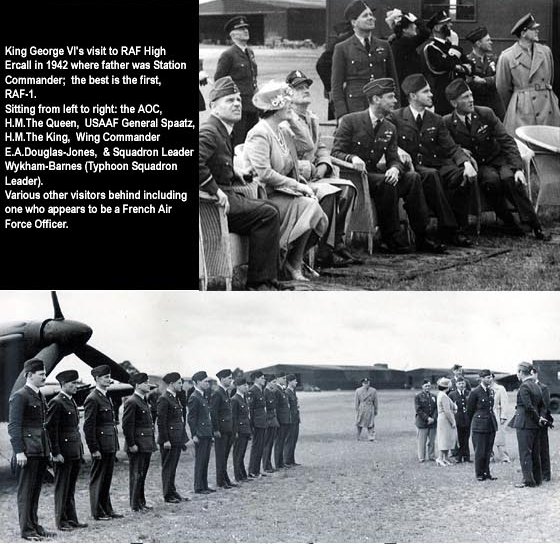
In 1943 Eric was made Commander of Comberton Sector, RAF Station, Honiley comprising 1500 airmen, 50 Offices, 60 Air Women of WAAF. Eric was mentioned in dispatches for his services here. His second son Andrew was born in 1943.
On 3rd August 1943 Eric was posted to RAF Training Mission China with Wing Commanders Allen and Bounet. They travelled via Southern Ireland and Lisbon in a B.O.A.C flying boat stationed at Poole Harbour. Their vast 3 week trip took them through Gambia, Lagos, Libreville, Leopoldville, Coquilhatville, Laropi, Uganda, Malakal, Khartum, Cairo, Habbaniyh, Jawani, Karachi, Calcutta, Assam, over the Himalaya mountains, the “Hump” (in Dakotas) to Kunning in China! Their end destination was Chengtu where they were met by Group Captain E.S. Burnes and Squadron Leader Hancock.
On 1st July 1944 Eric was promoted to Group Captain.
On 1st February 1945 Eric and Allen were decorated with a Chinese medal for service to the Chinese Air Force.
After the cessation of the Second World War Eric returned to England on 15th August 1945 and was posted to Headquarters Fighter Operations at Stanmore.
In February 1946 he was asked to provide advice to the artist Hugh Easton in the design of the stain glass windows for Westminster Abbey Memorial to Battle of Britain pilots in Henry VII’s Chapel. He paid several visits to the artist’s studio supplying authentic pieces of equipment worn by pilots in 1940.
On the 8th November 1946 he was posted to Station Commander of Southern Sector at Middlewallop, Southern Sector Operations Room at Sopley.
On 14th January 1948 Eric accompanied Air Marshall Gibbs on a mission to South Africa in a York transport plane
On 1st April 1948 he was appointed Senior Air Staff Officer at Headquarters No.22 Group at Buntingsdale Hall under Vice Marshall P.E. Maitland C.B. training national servicemen.
On 3rd October 1949 he was posted to Air Ministry in Whitehall as Deputy Director of Operations Air Defence (D.D Ops. A.D) under Chief of Air Staff, Air Chief Marshall Hon. Sir Ralph Cochrane, K.B.E. and Air Vice Marshall C.E.N. Guest, C.B.E.
Eric was at this stage was appointed Chairman Air Defence Sub-Committee N.A.T.O. responsible for the standardization of equipment etc. On 22nd March 1951 Eric travelled to a meeting at the Pentagon in Washington.
On 12th September 1952 he was posted as Senior Officer in charge of administration at No.83 Group Headquarters RAF Station at Wahn in West Germany.
On 30th December 1954 Group Captain E.A. Douglas-Jones retired from the Royal Air Force after 34 years of service. Eric worked for a short period in the Nigerian Civil Service and then with Gold Fields South Africa in the London head office.
He became ill in March 1982 and died on 29th January 1984 at the age of 78 Years.


Alan Straton
Latest posts by Alan Straton (see all)
- The Countdown On – Mind Matters Is Taking Over Cape Town Before Taking the Conversation Global - 28 September 2026
- BurnesSEO Study Finds South African Small Businesses Invisible in AI Search Results - 28 September 2026
- BurnesSEO Study Finds South African Small Businesses Invisible in AI Search Results - 28 September 2026
- What Causes Petechiae? When Tiny Red Spots Could Be a Sign of Something Serious - 28 September 2026
- Why Digital Equity Is South Africa’s New Frontier for Women’s Empowerment – By Matebe Chisiza-Asukile and Natasha Mboyisa - 25 September 2026
