
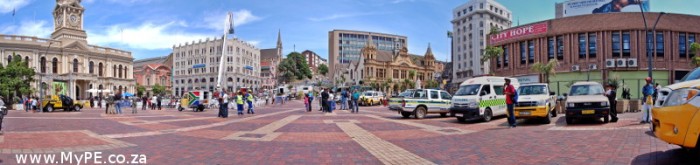
The Vuyisile Mini Square – formerly known as Market Square – is to be found in front of the City Hall in Central, Port Elizabeth.
The Square is one of the most noteworthy landmarks of Port Elizabeth. The ships landing beach was nearby in the early days and the handling of most of the goods in and out of the city was done through the Square, turning the square into a busy trading ground for local farmers.
The naming of Market Square is a bit of a misnomer as history tells us that the original Market Square, then known as the Commissariat Yard was situated behind the present City Hall on the site of the Old Post Office Building. In the early 1800’s the Commissariat Yard was under the control of the British Military authorities for the store of the animals, vehicles and stores requisitioned for troops on the frontier.
The Commissary-General in charge at the time of the frontier wars was William Joe Smith. the whole block was enclosed by a high stone wall and facing the market buildings were dwellings for officials and soldiers under the charge of Sergeant-Major Fowler.
In one corner of Market Square stood the old bell, suspended between two stout poles and roofed with sloping boards to protect it from the rain. It would be rung every morning early as a signal that the sale of produce was about to begin. Ringing of the bell at any other time indicated that assistance was needed to quell a fire that had broken out in the town.
The Commissariat Yard disappeared to make way for the Post Office Buildings.
The Town Hall foundation stone was laid by then Governor-General of the Colony, Sir George Grey on 18 October 1858. A sealed bottle laid beneath the stone contained a document with the following on; “In the Year of Our Lord 1858 and in the 22nd reign of Victoria, Queen of the United Kingdom of Great Britain and Ireland, this foundation stone of a building to be erected for the three-fold object of a Town Hall, a Library and Athenaeum is now laid with all honours this 18th day of October 1858 by His Excellency Sir George Grey, Governor of the Colony of the Cape of Good Hope in the presence of Messrs. J. Paterson, W. Smith, A. Wares, H, von Ronn, J.C. Kemsley, Jas. Williams, E. Slater, J. Miller – Commissioners of the Municipality. William Fleming, J.O. Smith, C. Andrews, Rev. J. Harsant, R. Hallack, H.W. Pearson, J. Paterson, Thomas Wormald – Committee of the Library. Capt. Rocke, Dr. Davis, Dr. Rubidge, Dr. Dunsterville, Rev. J. Harsant, T. Wormald, J. Paterson, R. Hallack, H.W. Pearson – Committee of the Athenaeum. F. Hutchinson – secretary to the Building Committee, R. Archibald – Architect.”
Upon completion of the Town Hall in 1862 a monument known as the Obelisk was erected on the Market Square now in front of the Town Hall. A Mr. John Paterson had bough the Obelisk at the British Empire Exhibition intending for it to be a monument for the grave of his departed friend and partner – Mr. G.T. Kemp but it’s colossal size and weight preclude it from being hauled up to the Russel Road cemetery.
It stood on the square for nearly 50 years before it broke into pieces and was removed.
The Municipal Regulations of 1861 decreed that; “A morning market shall be held on every day of the year, excepting Sundays, Christmas Day, New Years Day and Good Friday, in th epresent market place and in any other place that may be hereafter appointed for that purpose.
The market shall commence at 7 o’clock in the morning from 1st September to 31st March, and at 8 o’clock from 1st April to 31st August.
No article shall be sold on the market which is not actually the produce of South Africa or of colonial manufacture.”
The attractive Town Hall clock tower was added in 1883.
The Obelisk was replaced with a cannon which, in turn was removed and replaced with lawns and flower beds during the Mayorship of Mr. W.F. Caulfield. These were replaced with a paved area after the fire and under Mayor N. Faku recently acted as a parking area for Councillors vehicles. Under Mayor D. Jordaan the vehicles were banished and it was decreed that the area once again be made available to the public as an open forum and relaxation area.
In 1903 the Unveiling of the Queen Victoria statue in the Square took place. The statue stands guard to the entrance of the Public Library (built 1835), an excellent example of Victorian Gothic architecture. Its striking terra-cotta facade was manufactured in England and re-assembled, piece by piece, on the present site.
Market Square was the spot where the 23 black workers were killed by police and a white vigilante in 1920. The victims were workers in the Industrial and Commercial Workers Union in the city. They were demanding the release of Samuel Masabalala, their leader, who had been arrested for fighting for 10 shillings per day for workers.
Under the old National Monuments Council legislation on 7 December 1973 the City Hall was declared a national monument only for it to succumb to a fire in 1977 and to be rebuilt in 1981 by Vos and Philip. This City Hall is viewed as being of great historic importance and it’s Victorian Neo-Classical Architectural style forms the focus of Market Square.
On 29 November 1974 the area in front of the City Hall – a landscaped urban space paved in a geometric patterned facebrick – was also declared a National Monument. The new design isolated the Market Square from its immediate urban context and from the link to the quay side of the harbour. Elevating the surface of the square resulted in the loss of historic facades as well as staircases leading up to the City Hall.
On Saturday 6 November 2010 Market Square was officially renamed Vuyisile Mini Square. The square was renamed in memory of Vuyisile Mini who sacrificed his life in the fight for the freedom of South Africa.
The naming of the Vuyisile Mini Square tied in with the 25th anniversary celebrations of the Congress of South African Trade Unions (COSATU). Mini, a trade unionist, was one of the first anti-apartheid activists to be hanged by the Nationalist government in 1964.
Nelson Mandela Bay Deputy Executive Mayor, Cllr Nancy Sihlwayi, said the renaming of the surrounding areas of the Vuyisile Mini Square would still take place to pay a humble tribute to the heroes of the struggle; “Renaming our heritage sites is about the memory of the struggle. It will also be an education tool for future generations, who can learn from the extra ordinary example of people such as Vuyisile Mini,” said Cllr Sihlwayi.
The City Hall until the advent of the Nelson Mandela Bay Metropolitan Municipality served as a Council Chamber. Now the hall is utilised as a concert hall, a lecture hall and offices for city council employees and the Mayor.
Also in the Square, is a replica of the Diaz Cross, donated by the Portuguese Government to commemorate the arrival of Bartholomew Diaz in Algoa Bay in 1488.
Vuyisile Mini Square is a stop on Route 67 which consists of 67 Public Art Works symbolising Nelson Mandela’s 67 years of work dedicated to the Freedom of South Africa and includes 67 steps leading up the second largest flag in Africa.
Related: Vuyisile Mini Square Panorama | Vuyisile Mini statue approved by Council | Market Square in the Old Days | 1880: Market Square | 1860 Market Square and Castle Hill | The Market Square and Main Street
More Must See in PE suggestions.
CLICK HERE for: Budget PE Accommodation | PE Waterfront
Experience Magnificent Nelson Mandela Bay:


Alan Straton
Latest posts by Alan Straton (see all)
- The Household Pest Mystery That Starts in the Roof - 25 October 2026
- The Holiday Souvenir Nobody Wants: Bed Bugs in the Luggage - 25 October 2026
- What Comes Out of a Rug Before the Washing Starts? - 25 October 2026
- Desktop Pop-Ups Become the Compliance Channel Email Cannot Deliver - 23 October 2026
- Desktop Pop-Ups Become the Compliance Channel Email Cannot Deliver - 23 October 2026
