
The Mendi Memorial and Mendi Road in New Brighton, Port Elizabeth have been named in tribute to those 600 brave non combatants who went down and lost their lives on 21 February 1917 when the SS Mendi was struck by the 11 000 ton Darro.
On 23 February 2014, WM Bartie from the Port Elizabeth branch of the South African Legion paid tribute to fellow South Africans who lost their lives on the SS Mendi, HMSAS Southern Floe and the SAS President Kruger.
Bartie said:
The year 2014 should be a happy year and yet it will be tinged with the sad memories of the World War 1! This year marks the centenary of World War 1, the global war centred in Europe. Known as the “First World War” and the ”Great War” it was also touted as the war to end all wars.
It all started because on the 28th June 1914 Archduke Franz Ferdinand of Austria was assassinated by Yugoslav nationalist Gavrilo Princip in Sarajevo. This set off a diplomatic crisis when Austro-Hungary delivered an ultimatum to the Kingdom of Serbia and international alliances formed over the previous decades were invoked. On 28 July, the Austro-Hungarians fired the first shots in preparation for the invasion of Serbia.
This war was a war of firsts; it was the first time gas was used, the first time aeroplanes were use; the first time tank warfare was introduced; the first time the feared U-boats were used. It was largely a war of attrition with neither side making any significant gains once the opening gambit had been played. It was a war of deep mud, heroism – Delville Wood is a prime example – and prolonged trench warfare; where many soldiers simply vanished – the Great Menin Gate Memorial records the names of 55,000 soldiers, including many South Africans of the 1st, 2nd and 3rd infantry battalions, who have no known graves. In all 16 million military and civilian deaths and 20 million wounded were recorded, of which 9477 South African died. 6 Million troops had been killed but their remains were never found.
On 11 November, at 5:00 am, an armistice with Germany was signed in a railroad carriage at the French town of Compiègne. At 11 am on 11 November 1918 – “the eleventh hour of the eleventh day of the eleventh month” – a ceasefire came into effect.
What you might wonder has this to do with Mendi? Last year I recalled that because too many troops were being tied up with menial tasks such as stevedores in harbours, looking after stores, digging trenches, looking after the cavalry horses etc, the British Government introduced the Labour Corps. Formed in January 1917, the Corps grew to some 389,900 men by the Armistice. Of this total, around 175,000 were working in the United Kingdom and the rest in the theatres of war. The Corps was manned by officers and other ranks who had been medically rated below the “A1” condition needed for front line service. With the shortage of manpower for labouring work continuing, Sir Douglas Haig requested an increase in the force of an additional 21,000 men. This demand was filled by importing men from China, India, South Africa, Egypt and other places within the British Empire.
When the request was received by the South African government, it considered its position, it did not wish to involve “natives” in what was considered to be a white man’s European war. However early experiences in German South West Africa showed that a large labour contingent was needed to cope with logistical problems in the vast spaces of Africa that the South Africans planned to occupy. Thus the government decided that non-whites needed to be enlisted into the South African army and the South African Native Labour Corps (SANLC) was formed.
SANLC men were “non-combatants”employed as transport and artillery drivers, pack-animal leaders, in remount depots, on dock duties and on railway and trolley-line construction work. The first men left South Africa in late October 1916 and arrived in France about 3 weeks later. In all some 21000 men of the SANLC left from Cape Town for France between October 1916 and January 1918 and around 1100 died whilst in service, including the 607 men drowned when the SS Mendi was sunk in the English Channel.
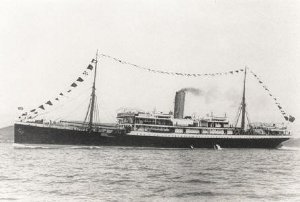
The SS Mendi, a ship of 4300 tons, was chartered to convey the last contingent of the Native Labour Corps to Europe, some 823 person were aboard the Mendi as she left Cape Town on the January 25th, 1917. All onboard were mindful of the potential u-boat threat. But she made it safely to Plymouth on the 19th February and sailed on the 20th February for France. This was really going to be the scary part of the voyage because the u-boat threat was much more intense than during the voyage from South Africa.
The sea conditions were calm but after midnight thick fog surrounded the Mendi. She had to slow down until she was barely creeping forward. As German U-boat submarines hunted in the area, slowing down was dangerous. By 04:57 a.m. on the 21st February 1917 the SS Mendi was 11 nautical miles (20 km) off the southern tip of the Isle of Wight when disaster struck. She was rammed by the 11,000 tons Darro. The Darro was travelling at high speed because of the u-boat scare. Mendi was almost cleaved in half, the Darro cutting into hold where men lay asleep. Mendi sank in 20 minutes taking with her over 600 South African men.
And so one of the great heroic deeds of the war played out on the tilting sinking deck of the Mendi, where the Rev Isaac Wauchope Dyobha intervened, sensing that the men facing death on the sinking ship – many had never seen the sea nor been on a ship – would panic, he made his now famous plea for them to “die like the warriors they were, drilling the death drill.”. They danced their Death Dance on the deck as the ship slid below the waves of the Channel.
Whilst the main Mendi Memorial, Hollybrook Memorial in Southampton, bears the names of the men of the SS Mendi who had no known graves, more recently a number of graves have been discovered in Littlehampton Cemetery, Milton Cemetery Portsmouth, and more recently records show that 4 bodies were washed up in Noordwijk, Netherlands, in all some 15 bodies!
On this Sunday we also remember the heroism of the HMSAS Southern Floe and SAS President Kruger.
The Southern Floe was a converted whaler which was serving as a minesweeper/anti-submarine vessel in the Mediterranean Sea during World War 2. Like all these little ships, she was not designed for war and had scant armouring. She was one of a small flotilla of ships tasked with keeping the swept channel into Tobruck, clear of mines and enemy submarines. She sailed from Tobruck on the evening of the 10th February 1941 to carry out an anti-submarine patrol off the swept channel. It is surmised that sometime in the early hours of the morning of the 11th February she hit a mine and sank almost immediately with the loss of all but one of her crew, Stoker C J Jones – he was not even one of her permanent crew but had been drafted in the place of a stoker who was ill. He clung to some flotsam for 12 hours before being rescued by an inbound warship.
SAS President Kruger is the last of the vessel that fall into this service. On the 15th February 1982, the President Kruger and President Pretorius in company with SAS Tafelberg, the Navy replenishment vessel, sailed for a 5 day exercise with the submarine SAS Emily Hobhouse.
Part of the exercise was for the two frigates to “screen” the Tafelberg from the Emily Hobhouse.
But because the speed of the frigates was such that they out-ran the Tafelberg, they carrier out a manoeuvre which reversed their course. The President Kruger chose a more dangerous manoeuvre of turning inwards, ie towards the SAS Tafelberg. The inward turn was much more delicate and would if executed correctly bring her close past the Tafelberg. The manoeuvre did not go according to plan and at at 03.56 on the morning of the 18th February 1982, the ice reinforced bows of the Tafelberg cut deeply into the President Kruger, mortally injuring her. The collision took place directly above mess 12, where most of those who lost their lives were sleeping. At 04.40 the Captain took the decision to abandon ship. At 05.29 the President Kruger plunged beneath the waves to the bottom of the South Atlantic nearly 4000 metres below. Again we witness the heroism for which South Africans are becoming well known with Able Seaman Whyte who swam back to assist one of his mates and for which he received the Honoris Crux. Incidentally Able Seaman Whyte had been a Sea Cadet of the Cape Town Unit when he was a school boy.
We must marvel at the heroism shown in these three fateful tragedies. But what is heroism? One dictionary records heroism as “those characters who, in the face of danger and adversity or from a position of weakness, display courage and the will for self sacrifice for some greater good of all humanity”. Arthur Ashe defined heroism as “True heroism is remarkably sober, very undramatic. It is not the urge to surpass all others at whatever cost, but the urge to serve others at whatever cost.
Indeed the heroism displayed by the people involved with these tragedies has becomesynonymous with South Africans, who have carried on the tradition of Wolrade Woltemade. Today we are gathered here to pay homage to those gallant sons of South Africa who showed great heroism, who paid the supreme price so many years ago in the name of Freedom – those South Africans who perished, in the savagery of sea in time of war and in time of peace.
But we also pay homage to the survivors who showed such great heroism, and who in some cases, may even have experienced suffering worse than death. It was John F Kennedy who said “For without belittling the courage with which men have died, we should not forget those acts of courage with which men have lived”. Indeed, it is these young people sitting in front, who in the fullness of time when we are gone, who will have to pick up the Torch of Remembrance and continue this service into the future.
This service, friends, is our commemoration of those who perished and our celebration of those who survived the tragedies of the SS Mendi, HMSAS Southern Floe and SAS President Kruger, those men of courage, those men of valour, all sons of South Africa. I ask the Legionnaires and MOTHs to please stand and salute as we say together that wonderful poem by Laurence Binyon:
“They shall grow not old, as we who are left behind grow old,
Age shall not weary them nor the years condemn,
At the Going Down of the Sun and in the Morning,
We Will Remember them”.
Thank you
W M Bartie
23rd February 2014
Editor: Hat tip to Warwick Owen for forwarding this on to me.
[streetview width=”100%” height=”250px” lat=”-33.906421″ lng=”25.597710000000006″ heading=”-320.28467694708274″ pitch=”-9.870967741935482″ zoom=”1″][/streetview]


Alan Straton
Latest posts by Alan Straton (see all)
- Why Digital Equity Is South Africa’s New Frontier for Women’s Empowerment – By Matebe Chisiza-Asukile and Natasha Mboyisa - 25 September 2026
- New Champions Rise at the 2026 Street Lines Skate Tournament - 23 September 2026
- When Manufacturers Have a ‘Beef’ Then Both Suffer - 23 September 2026
- How Much Are You Worth per Year to Your Bank? - 23 September 2026
- Better Business Processes. Stronger Workplace Skills. Smarter AI. Greater Business Productivity. - 23 September 2026
