
Business confidence in Nelson Mandela Bay is continuing to improve slowly, the latest regional economic survey shows.
Of 15 indicators measured by the Port Elizabeth-based RGT Smart group on behalf of the Nelson Mandela Bay Business Chamber, seven indicators reflected improvement through January, six deteriorated, and two moved sideways.
Report compiler Dr Neal Bruton said the results continued “reflecting slowly improving general economic circumstances led by an ongoing recovery in the demand side of the economy”.
But Bruton added: “Ongoing high levels of household debt, cautious and uncertain business confidence and very slow growth in fixed investment will probably limit the rate of improvement in economic circumstances during 2011.”
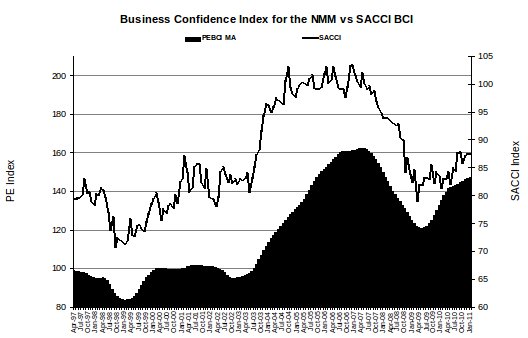
With regard to the PEBCI, seven indicators reflected improvement through January, six deteriorated and two moved sideways.
- The JSE All-Share Index. After weakening throughout the second quarter of 2010, the trend cycle for the JSE All-Share Index has displayed encouraging levels of positive growth since July 2010, providing support for the overall index.
- Exchange Rate. The rand weakened sharply against the US dollar in January, but continued to average under R7.00/$. The currency fell from an average of R6.80/$ in December to an average of R6.91/$ in January, marking the fourth consecutive month below the R7.00/$ level.
- Prime Rate. With the Reserve Bank electing to leave the repo rate unchanged at its January Monetary Policy Committee meeting, the prime rate remains at 9%, its lowest level in thirty six years.
- Real seasonally adjusted value of Manufacturing. After suffering a minor dip between February and August 2010, the trend cycle for the real seasonally adjusted value of sales in the manufacturing sector has picked up over the past four months.
- Total Vehicle Market as reported by Autostats. The trend cycle in the total vehicle market, which includes the sales nationally of passenger cars, and light, medium and heavy commercial vehicles, reflects a cycle that weakened for the 34 months between September 2006 and June 2009, but has shown improvement since July 2009, a trend which should continue in the coming months as lower interest rates, improving income levels and declining levels of inflation continue to have a positive impact on sales.
- New Car Sales in the PE/Uitenhage Region. After slowing between July 2006 and July 2009, the trend cycle in new passenger vehicle sales in the Nelson Mandela Bay Metro turned positive in August 2009, a situation which continued throughout 2010, despite a slight flattening of the cycle in the final quarter. The growth in the cycle has been supported by the cuts in interest rates over the last 26 months.
- Real Value of Exports. After experiencing a slump between August 2008 and July 2009, the trend cycle for the real value of exports accelerated for the first time in thirteen months in August 2009, a trend which has continued in the months thereafter
The indicators that negatively influenced levels of business confidence in the region were:
- The Real Value of Building Plans Passed. After falling through the three months to May 2009, the trend cycle in the real value of building plans passed reflected growth between June 2009 and February 2010. March of 2010, however, once again saw the trend cycle of this indicator move into negative territory.
- The Real Value of Buildings Completed. The trend cycle in the real value of buildings completed in the Nelson Mandela Bay metro is presently in its seventh month of a contraction. The slump currently being experienced by this factor comes after nine months of gains.
- Consumer Confidence in the Eastern Cape as measured by the Bureau for Economic Research. Consumer confidence in the Eastern Cape continued to slip in the fourth quarter of 2010. The regional index dropped below the national index for the first time since the third quarter of 2007. The Bureau for Economic Research’s Consumer Confidence Index for the Eastern Cape returned a reading of 12, falling to its lowest level in five quarters, and three index points down on the third quarter. National consumer confidence, as measured by the FNB/BER Consumer Confidence Index, dropped the one point gained in the third quarter, coming in at 14 for the fourth quarter. The first quarter index figure is due for release in March.
- PE rate of inflation. The headline PE/Uitenhage rate of inflation came in ahead of the national figure in December for the fourth month in a row. The local rate of inflation declined to 3.9% from 4% in November. National headline inflation fell from 3.6% to 3.5% in December.
- Passenger Arrivals at PE Airport. The trend cycle in the number of passengers arriving at the PE Airport has been gently contracting for the last four months, negatively impacting the PEBCI.
- Real Retail Sales in the Eastern Cape. After enjoying a mild upswing between August 2009 and August 2010, the trend cycle for real retail sales in the Eastern Cape has been gradually declining for the past three months. This weakening is projected to be short-term, as the economic circumstances of households slowly improves on the back of growing income, lower levels of inflation and interest rate cuts.
The indicators that remained neutral in their influence of business confidence in the region to end-January 2011:
- The Price of Gold. In January the average price of gold fell to a three-month low, dropping from $1 392/oz in December to $1 356/oz in January. The trend cycle for this series, after enjoying 25 months of expansion, showed zero growth, neither positive nor negative, in January.
- Real Value of Imports. The trend cycle in the real value of imports, after declining between June and November 2010, is now moving sideways.
Dr Neal Bruton of RGT Smart Ltd compiled the PEBCI on behalf of NMBBC.


Alan Straton
Latest posts by Alan Straton (see all)
- Desktop Pop-Ups Become the Compliance Channel Email Cannot Deliver - 23 October 2026
- Desktop Pop-Ups Become the Compliance Channel Email Cannot Deliver - 23 October 2026
- Reasons Why You Shouldn’t Use Your Company/Brand Name in a Press Release Title - 23 October 2026
- Reasons Why You Shouldn’t Use Your Company/Brand Name in a Press Release Title - 23 October 2026
- Reasons Why You Shouldn’t Use Your Company/Brand Name in a Press Release Title - 23 October 2026
