
The Nelson Mandela Metropolitan University’s physics’ research profile has been further raised thanks to the acquisition of a key instrument for material analysis, valued at R5.3m.
The Fourier Transform Infrared (FTIR) and Raman spectrometer is the only model of its kind in the world, and will drastically improve and speed up research processes in various materials at the university. Its arrival follows the launch of the R120m High Resolution Transmission Electron Microscopy Centre – the only place in Africa where scientists can do research at an atomic level – at the university last year.
The new instrument has been funded by the National Nanotechnology Equipment Programme (NNEP), administered by the National Research Foundation.
“Infrared spectroscopy is used for obtaining information about the molecular structure of compounds,” said NMMU physicist Prof Japie Engelbrecht, who facilitated the recent arrival of the instrument.
He said both techniques – infrared spectroscopy and Raman spectroscopy – are used for optimal characterization of most materials (solids, liquids and gases) and are especially used in chemistry departments. However, other disciplines, like materials science and physics, have also recognised the value of infrared and Raman spectroscopy.
Prof Engelbrecht explained that optical characterization had the advantage of being a non-destructive technique, and was therefore the preferred method for obtaining the relevant research information.
“This particular FTIR and Raman spectrometer covers the widest spectral range available in South Africa and is capable of analyzing samples using infrared and Raman microscopy. It includes a liquid helium cryostat (-263 Degrees Centigrade) for analyzing extremely low temperatures.
“The optical range and its temperature control ability make this the only model of its kind in the world,” he said.
An official launch of the new acquisition will take place Thursday 17 May. However, the instrument is already in use on a number of research projects including analysis of semiconductor materials, natural and synthetic fibres, mineral samples, mammal teeth, proteins and chemical compounds such as polymers and rubbers.
Other interesting research for scientists using it is forensic work such as ink identification in forgery cases and paint identification in accident reports.
“We trust that the instrument will stimulate further research outputs and training of students across disciplines within science, engineering and health sciences,” said Prof Engelbrecht.
Professor Japie Engelbrecht, outgoing head of department, will manage the activities of the FTIR/Raman Spectroscopy Unit at NMMU.
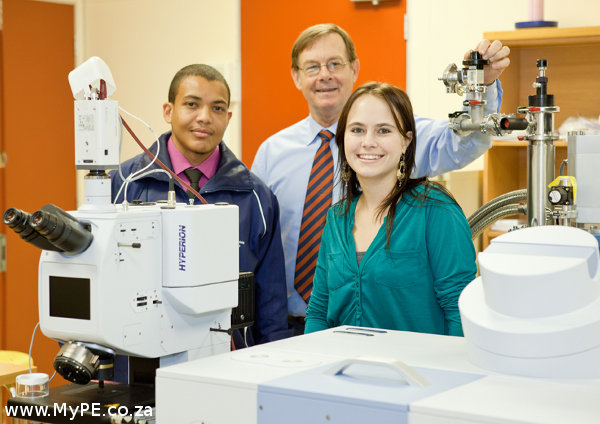
Ettienne Minnaar is helping out with the instrument at this stage, and his techniques might be incorporated into his PhD project. Geneve’ve has been assisting Prof Engelbrecht with research during holidays, and will be presenting her results at the upcoming SA Institute of Physics Conference in July at the University of Pretoria.


Alan Straton
Latest posts by Alan Straton (see all)
- Decor Handles Spotlights Its Solid Brass Door Handles From Portugal and Italy - 14 November 2026
- PaperTrail Puts a Risk Score on Every Contract With Scout AI - 14 November 2026
- Pay@ Puts Automatic Reconciliation at the Centre of Year-End Collections - 13 November 2026
- Renal Supplies Water Systems Plans Dialysis RO Plants From Tap to Drain - 13 November 2026
- MoreCut Saws in Alrode Welds Bandsaw Blades to the Length Your Saw Needs - 13 November 2026

As far as i know, the Infrared spectroscopy is design as specific synthetic routes to produce compounds from starting materials. It could then be used also to determine the functional groups present in the compound. I hope my comment will help! Thanks!