
From 13 to 16 June 2015 teams from Western Province, Eastern Province and Gauteng will be in Port Elizabeth to take part in the South African Freediving Nationals. This is the first time that the Freediving Nationals will take place in Port Elizabeth, and it will be held in conjunction with the ever popular Wildside Dive Fest.
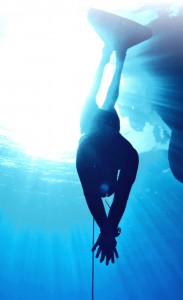
The Freediving Nationals is scheduled to take place off of Noordhoek on 15 June and in the Newton Park Indoor Swimming Pool on 13 and 14 June – subject to weather of course.
The Pool events will start at 10:30 am and the sea event is scheduled to take place starting at 8:00 am on Monday, but the sequence of events may be changed if the weather conditions are forecast to be adverse on the Monday. The sea event will get preference based on the sea conditions forecast in the week before the competition.
The pool events comprise these disciplines: Static breath hold, where the diver lies face down in the water, and competes for the longest breath hold, and Dynamic swimming, where the diver swims underwater on one breath and competes for the longest distance. The sea events are split into two main discplines: Constant weight, where the diver dives with or without fins to a pre chosen depth carrying a set weight down and back up again; and Free Immersion, where the diver pulls himself along a rope down to a certain depth, and back up again.
Carrying Eastern Province’s hopes is well known diver and record holder for the deepest dive in SA waters, Gletwyn Rubidge. During the EP trials, on the 27 April, Rubidge dived to a depth of 74m and set a new record for the deepest Constant Weight dive in SA waters.
Diving to such great depths and holding your breath for long periods does present dangers, with the biggest danger of Freediving being a shallow water black out – diving with a dedicated safety diver or a buddy will avert much of the dangers. In the 20 years of competitive Freediving, there have only been two deaths, and both were in extreme cases where safety procedures were not followed.
Freediving courses are available to help make a diver aware of the dangers and equip him with means to avert dangerous situations. During pool events divers are accompanied by a safety diver and quickly pulled out of the pool in the case of a black out – vital for divers wishing to test their limits. Despite this black outs and convulsions do occasionally occur during pool events and make for dramatic viewing for spectators.
Freediving is a relatively new sport, especially in Port Elizabeth, and has received some lottery funding through the Gullyjumpers club to use towards development when club equipment may be used by divers during training sessions, which take place on a regular basis at the Newton Park Swimming Pool.
Thobani Ngwenda learning to freedive with Gullyjumpers – NLDTF funded
Freedivers need to possess extraordinary willpower and dedication as holding ones breath does not come naturally and is a completely uncomfortable sensation which takes perseverance and willpower to overcome. The freediver’s brain will indicate the need to breathe way in advance of the body actually needing the oxygen. Holding one’s breath for a long time can be extended with practice.
Training for Freediving does not have to take place in the water, and breath hold training can form part of daily chores or gym training. One of the local freedivers uses his time mowing the lawn to practice his breath holding. He says that the mower offers a bit of stability during the latter part of the holds, when one can get a bit dizzy. Some of the more experienced divers train to black out on dry land so that they learn to recognise the impending blackout feelings and signs. Sometimes after a blackout, the diver will convulse, and this is known in Freediving as a “Samba”. During Pool competitions, it is common to have a special prize for the most spectacular black out and those lucky recipients then become part of the “Samba Club”.
Diving off Nordhoek Port Elizabeth, South Africa, Gletwyn Rubidge tests a trailcam system for following him when he dives.
Unencumbered by weights and breathing apparatus allows freedivers to get really close to marine life. Recently two of our local Freedivers, Gletwyn Rubidge and Mark Jackson, spotted a whale in distress which had become entangled in a rope attached to a buoy. They were able to approach the Humpback Whale and free it of the rope. Being a freediver helps in a situation like this, as the divers were able to dive under and around the whale with grace and freedom of movement, unencumbered by scuba equipment and noisy bubbles, thus ensuring minimum stress for the animal . Once the Whale had been freed, it started to swim away, but then turned around, approached the boat and rose out of the water until it made eye contact with the divers, before slowly and gracefully sinking down and swimming away. Freedivers, with their stealth and grace are more likely to be approached by seals, whales, Manta rays, sharks and fish than scuba divers, whose noisy bubbles can scare them away.


Alan Straton
Latest posts by Alan Straton (see all)
- Alu Door & Window Centre Readies Mpumalanga Homes for the Summer Storms - 30 September 2026
- If AI Can Now Do the Work, Who Checks the Work? - 29 September 2026
- UK Music Titans Marc Marot & Jeremy Marsh Join #MEX26 in Cape Town - 29 September 2026
- The Countdown On – Mind Matters Is Taking Over Cape Town Before Taking the Conversation Global - 28 September 2026
- BurnesSEO Study Finds South African Small Businesses Invisible in AI Search Results - 28 September 2026

This article is very damaging to the sport of freediving, and inaccurate. We NEVER promote blackouts or LMCs(Sambas) in any way, shape or form. Who wrote this nonsense making a joke of our sport? LMCs and blackouts are very dangerous and safety and preventing them is number one in the sport. Holding breath while mowing the lawn could only be done by someone who has never done a real freediving course. This is utter madness. Obviously written by an un-qualified, non freediver who got information from an un-qualified, non freediver.
Thanks for commenting Ant – in the interests of discourse I have also shared your comment here: https://twitter.com/MyPE/status/601614498491957248
Ant – if you do a search in YouTube for the keywords “freediving samba” you get over 4 100 VIDEOS of the occurrence – https://www.youtube.com/results?search_query=freediving+samba – that is a whole lot of people “bringing your sport into disrepute”. Could those people really be ‘promoting’ blackouts. Maybe they are showing others how to avoid the dangers?
In all the competitions & training I’ve done in SA and overseas with many of the top freedivers in the world, none of them ever spoke like this about LMCs or BOs, or even show them in competition videos sold to competitors. Its a subject we don’t joke about or promote to increase “spectators”. Its well known and taught in all the recognized freediving organizations like AIDA, Pure Apnea & SSI. Some cowboy organizations feel they can make up their own rules and ignore international standards & safety rules and regulations, therefore putting lives at risk and encouraging things like ‘pushing until BO or LMC in training”(Highly discouraged form of training in all recognized organizations), or encouraging under age freediving (with children as young as 8 years old), which is not allowed in the above organizations, yet encouraged by the Gullyjumpers club above. There are very real reasons snorkeling is okay to teach children, but NOT freediving.
You have a comment “make for dramatic viewing for spectators.” Is this to try encourage spectators to come watch people go threw this or is it to teach the spectators of the dangers?
& this comment….”During Pool competitions, it is common to have a special prize for the
most spectacular black out and those lucky recipients then become part
of the “Samba Club”……really??….”Luck”….What makes them lucky for having an LMC or BO?????
I’ve never heard of this happening in any serious/recognized freediving competitions in the world and its very irresponsible and dangerous to try promote freediving like this.
This is a very safe sport if the international rules and regulations are followed, and divers are properly trained and certified by certified instructors of recognized organizations, but its obviously a very dangerous sport if rules and safety protocols are ignored or divers are trained by unqualified “instructors”
“Carrying Eastern Province’s hopes is well known diver and record holder for the deepest dive in SA waters, Gletwyn Rubidge. During the EP trials, on the 27 April, Rubidge dived to a depth of 74m and set a new record for the deepest Constant Weight dive in SA waters”
The quote above from the article seems to be incorrect? Accodring to the facts and footage that dive was a yellow card????. So unfortunately no record was recorded. ????Maybe next time. It deserves a lot of respect and true potential is shown, but let’s keep it in the spitit of good sportsmanship character( ouch) and accurate reporting of the facts before records are broadcasted in future.