
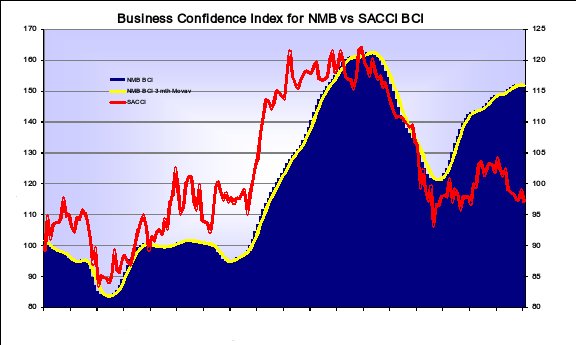
For the past six months the NMB BCI has largely moved sideways but with a slight weakening trend beginning to emerge in the trend cycle of the index. It will, however, require more data going forward to confirm this apparent slowing taking place in the index.
While ongoing real concerns regarding global economic stability and growth continue, particularly with regard to the Eurozone, where, inter alia, the emergence of recessionary conditions have contributed to the reduction of the growth forecast for South Africa in 2012 with the Treasury now predicting 2.7 percent GDP growth for the year, down from 3.1 percent for 2011, there are, however, some interesting and more positive developments taking place in early 2012.
To receive the Nelson Mandela Bay Business Confidence Index (formerly the Port Elizabeth Business Confidence Index) compiled by Dr Neil Bruton of RGT Smart Ltd, contact the Nelson Mandela Bay Chamber of Business.
Growth in GDP during the last quarter of 2011 registered a higher than expected rate of 3.2 percent, strongly supported by growth in the demand side of the economy, a trend which appears to have continued through December 2011 with growth in real retail sales for the month coming in at a robust 8.7 percent up on an annual basis, and with growth real retail sales in the last quarter of 2011 up 7.9 percent on 2010. Furthermore, growth in demand for instalment sales credit appears to be reviving growing by 11.4 percent in January 2012, after 10.7 percent growth in December, with both rates of growth well above the average 2011 growth rate of 8.5 percent. Corporate borrowing also reflected more positive growth in January improving by 8.7 percent year on year, the strongest pace of expansion in almost three years. Also creating a more positive environment during the first two months of 2012 has been the performance of the JSE with the average all share index in January and February up 7.2 percent on the full year average for 2011.
There are also, however, some positive developments taking place on the supply side of the economy with manufacturing making a positive contribution to improved GDP growth during the fourth quarter of 2011, and with manufacturing production up 2.4 percent year-on-year in December 2011. The Kagiso PMI has also reflected an encouraging improvement in the manufacturing sector so far during 2012, having shown positive growth in January and then having jumped by a significant 4.7 points in February to level of 57.9, the highest since February 2010. The business activity index made the largest positive contribution to this improvement growing by 11.6 points to a five and a half year high of 65.2. The new sales orders index also gained an encouraging 7.5 points to a level of 64.8.
Despite these more positive developments, however, it is probable that economic growth will slow during 2012, as is also suggested by developments in the Reserve bank’s leading indicator of economic activity.
With regard to the details of the NMB BCI, the trend cycles in seven of the sub-indices reflected improvement, six reflected deterioration, and two moved sideways.
The indicators that supported the NMB BCI through January included the trend cycle in the price of gold which continued to assist the index and the trend cycle of the JSE all-share index which continued improving. The underlying trend cycle in the value of real retail sales in the Eastern Cape also reflected improvement as did the trend cycle in the number of passengers arriving at the PE airport. The trend cycles in the real value of both exports and imports are also reflecting growth and the trend in the real value of manufacturing sales also supported the index.
On the downside, the trend in the rand US dollar exchange rate continued weakening through January, and the trend in the level of consumer confidence in the Eastern Cape continues in decline despite a marginal improvement in the actual data in the fourth quarter. The underlying trend in the real value of buildings completed in the Metro continues declining and after showing signs of some stability, the trend cycle in the real value of building plans passed in the Metro has once again moved into decline. The trend cycles in the new car market in the Metro and in the total new vehicle market in the country are also both declining bur have reflected uncertainty during the past months as the markets have reacted to volatility in economic circumstances.
The trend cycle in the prime interest rate moved sideways through January having no meaningful effect on the overall index and the trend in the local rate of inflation has largely moved sideways for the past number of months.


Alan Straton
Latest posts by Alan Straton (see all)
- SmashDown Lists Its Woodstock Rage Room Packages for Cape Town Friends, Couples and Staff Teams - 29 October 2026
- SmashDown Lists Its Woodstock Rage Room Packages for Cape Town Friends, Couples and Staff Teams - 29 October 2026
- RentThisWall Lists Billboard and Wall Space From Braamfontein to Bloemfontein for Advertisers and Property Owners - 29 October 2026
- RentThisWall Lists Billboard and Wall Space From Braamfontein to Bloemfontein for Advertisers and Property Owners - 29 October 2026
- Psycho Bunny Brings Summer Polo Shirts and Swim Shorts to South Africa - 28 October 2026
