
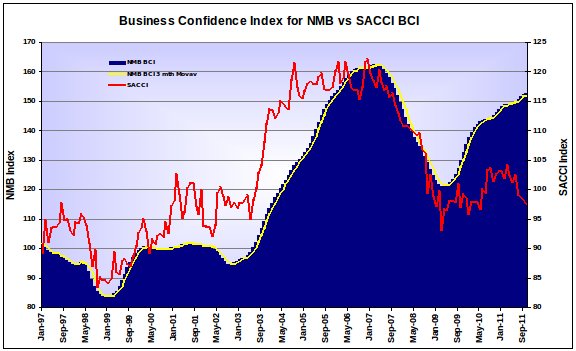
The NMB BCI continued reflecting slow improvement through October supported predominantly by the unexpectedly robust performance of the new vehicle markets over the August to October period, being of particular importance to the local economy, ongoing slow growth in the real value of retail sales in the Eastern Cape, and growth in the trend cycles of the real value of both imports and exports during the period.
Supported by steady growth in real disposable income of households the demand side of the economy continues performing reasonably well reflected by real retail sales in the country improving 8.3 percent year-on-year in September after growth of 7.1 percent year-on-year in August. Furthermore, consumer confidence while having deteriorated sharply in the past two quarters, remains firmly in positive territory and business confidence in the retail and wholesale sectors, as measured by the RMB BER Business Confidence Index, improved notably during the fourth quarter of 2011.
To receive the Nelson Mandela Bay Business Confidence Index (formerly the Porth Elizabeth Business Confidence Index) compiled by Dr Neil Bruton of RGT Smart Ltd, contact the Nelson Mandela Bay Chamber of Business.
The manufacturing sector, however, remains subdued after having contracted sharply during the second quarter and moved sideways in the third quarter with a marginal contraction of -0.1 percent when compared to the second quarter. Looking ahead, while the BER manufacturing business confidence for the fourth quarter stabilized at relatively low levels, edging down from 36 to 35 index points, the BER noted that the stable confidence hid the underlying improvement in manufacturing activity as the combination of strong improvements in the domestic and export demand indicators had led to a notable rise in the production volumes indicator.
The hesitant and unbalanced recovery in the South African economy is likely to continue into 2012, with 2011 probably finally yielding GDP growth of around 3 percent. As the country moves into 2012 the most relevant risks and challenges facing the economy include, externally, the continuing financial problems of the major western economies and in particular at present, developments in the Eurozone, and internally, in creating circumstances that will encourage growth in long term direct fixed investment without which vitally required higher levels of long term economic growth is not possible. In this regard of significance and concern during November was the change in the outlook for South Africa’s A3 local and foreign currency government debt ratings by Moody’s Investors Service, to negative from stable, with Moody’s citing heightened political risk in the context of more constrained public finances.
With regard to the details of the NMB BCI, the trend cycles in seven of the sub-indices reflected improvement, six reflected deterioration, and two moved sideways.
The indicators that supported the NMB BCI through October included the trend cycle in the price of gold which continued to assist the index. The underlying trend cycle in the new car market in the Metro also supported the index, as did the trend cycle in the total new vehicle market in the country. The trend cycle in the value of real retail sales in the Eastern Cape also reflected some improvement as did the trend cycle in the number of passengers arriving at the PE airport which appears to have begun improving. The trend cycles in the real value of both exports and imports are also reflecting growth and while performance is volatile and levels remain well below those achieved during the middle of the previous decade the trend cycles are reflecting moderate but steady improvement.
On the downside, the trend in the rand US dollar exchange rate continued weakening through October, and the trend cycle of the JSE all share index continued deteriorating. The trend in the level of consumer confidence in the Eastern Cape is declining despite a marginal improvement in the actual data in the fourth quarter, and the trend in the local rate of inflation is accelerating, weighing on the index. The underlying trend in the real value of building plans passed in the Metro continues declining at a slowly accelerating rate, and the trend in real value of buildings completed in the Metro is now also declining.
The trend cycle in the prime interest rate moved sideways through August having no meaningful effect on the overall index and the trend in the real value of manufacturing sales in the country moved sideways through October 2011.


Alan Straton
Latest posts by Alan Straton (see all)
- The Holiday Souvenir Nobody Wants: Bed Bugs in the Luggage - 25 October 2026
- Desktop Pop-Ups Become the Compliance Channel Email Cannot Deliver - 23 October 2026
- Desktop Pop-Ups Become the Compliance Channel Email Cannot Deliver - 23 October 2026
- Reasons Why You Shouldn’t Use Your Company/Brand Name in a Press Release Title - 23 October 2026
- Reasons Why You Shouldn’t Use Your Company/Brand Name in a Press Release Title - 23 October 2026
