
I recently visited the Mbashe Senior Primary School in Dutywa. What I witnessed was yet another example of how children in the Eastern Cape are denied their basic right to quality education because the provincial Department of Education continues to force rural learners to attend school in dilapidated structures.
This department has only spent 8.5% of its capital budget of R1,2 billion in the first quarter of the current financial year. The evidence of the neglect by the department is not only evident in the mud schools which have featured in the media. There are many similar examples.
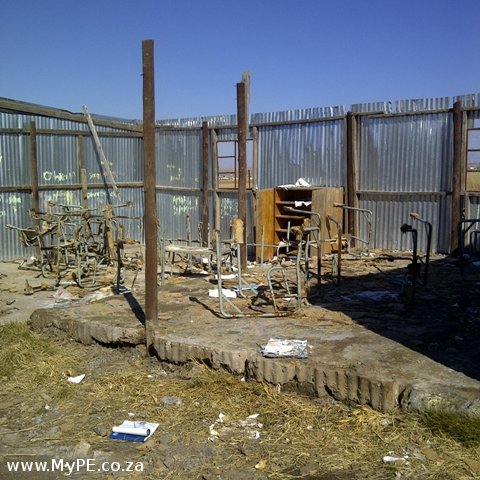
Classrooms at Mbashe Senior Primary School consist of corrugated iron sheeting and books are piled on the floor because of a lack of furniture. Teachers use a single stand-alone pit latrine and the young learners relieve themselves in the veld.
This school, which consisted of a temporary structure, was erected in 2007 by the department for learners up to Grade 8. A tornado destroyed the (still) temporary school buildings in December 2010 whereafter the department saw fit to downgrade the school to take learners up to Grade 7. When another tornado struck in May this year, the department downgraded the school again, to Grade 5 to accommodate children who are too young to go to school far from home. The department has not spent any money on repairing the damage to the school.
It is hard to understand why the department saw fit to remove the children rather than fixing the school, especially when there is money available in its capital budget. Surely this is not what our government had in mind when guaranteeing the right to a basic education?
Receiving quality education in a properly maintained building is a fundamental aspect of a solid education system.
The DA believes that a quality learning environment depends on healthy and comfortable surroundings.
Every child has the right to learn. The extremely poor levels of schools infrastructure have a negative effect on this right. It is essential that the department develops the will to address the massive backlogs that face this province.
I have submitted parliamentary questions for reply by the MEC for Education, Mandla Makapula, to explain what plans he has in place to spend the department’s capital budget allocation and what the department will be doing about repairs to Mbashe Senior Primary School.
Independent commentators have suggested options for the department to get its act right: this includes creating a Special Purpose Vehicle in keeping with the Public Finance Management Act to ensure spending on capital priorities.
In June 2010, the Department of Basic Education (DBE) adopted a policy, called the National Policy for an Equitable Provision of an Enabling School Physical Teaching and Learning Environment (NPEP).
Key aspects of the policy are:
- Development of the minimum norms and standards for school infrastructure to ensure equity in the provisioning of school infrastructure;
- The establishment of the nationally standardised criteria and procedures for the identification and prioritisation of the teaching and learning environment.
We cannot sit back. We must demand at provincial and district level that schools are provided with the infrastructure necessary to create an environment that is conducive to quality teaching and learning.
This can be achieved if the Eastern Cape Department can get its act together and starts implementing proper plans.
Veliswa Mvenya, MPL


Alan Straton
Latest posts by Alan Straton (see all)
- The Household Pest Mystery That Starts in the Roof - 25 October 2026
- The Holiday Souvenir Nobody Wants: Bed Bugs in the Luggage - 25 October 2026
- Desktop Pop-Ups Become the Compliance Channel Email Cannot Deliver - 23 October 2026
- Desktop Pop-Ups Become the Compliance Channel Email Cannot Deliver - 23 October 2026
- Reasons Why You Shouldn’t Use Your Company/Brand Name in a Press Release Title - 23 October 2026
