
Certain diesel/oil burning ships can produce as much pollutants as 700 trucks.
Add that amount of pollutants to the 55 trucks per hour hauling manganese ore into the Port of Port Elizabeth and you have a huge amount of pollutants on our roads and in confined areas close to the Port such as Strand Street.
90% of world transport is done by ships, mostly driven by fossil fuel engines. A sustainable solution for these vessels is necessary. Ships often stay in service for 25-30 years.
Rotterdam based Skoon Energy are confident that they have the solution to eliminating ship pollutants.
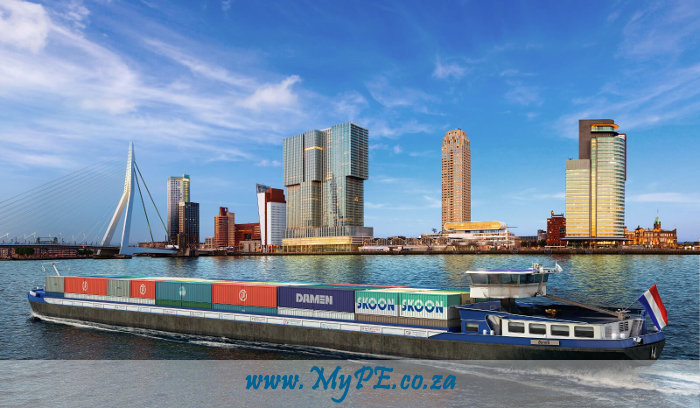
The first focus of Skoon Energy is to introduce electric propulsion in the maritime industry on a large scale, through offering the service of electric sailing. This includes, but is not limited to, engineering and performing refit of existing vessels, to continue as electric vessels in Skoon’s infrastructure of swappable batteries.
Skoon Energy will manage the infrastructure of swappable batteries through a digital platform, enabling customers to view, order and track their Skoonboxes in real-time. Providing a safe network of reliable batteries, charged with 100% green energy, Skoon will contribute to the transition to clean energy.
Most ship engines are electric engines using generators to provide electricity.
At the World Port Days 2018, the first Skoonbox was introduced to the public.
For those concerned about electric ships not having enough ‘grunt’ to run on batteries consider this:
The HH Ferries Group’s two ferries, the Tycho Brahe and the Aurora, operate a 4-km (2.5 miles) ferry route between Helsingborg (Sweden) and Helsingör (Denmark). Both ferries are converting to all-electric transport and the actual ships themselves are impressive.
They are 238 meters long and weight 8,414 tonnes. They carry 7.4 million passengers and 1.9 million vehicles annually.
640 batteries of 6.5 kWh are installed on top of each ferry along with two deckhouses for transformers, converters and cooling of the batteries. Cables run from the deckhouses to connecting points at each end of the ship, so that the batteries can be quick-charged – to provide the power of 70 electric cars.
When at the docks to unload passenger and take new ones on board, the ferries will be able to take a quick charge to top off before returning. The system is built to be completely automated and operate even in the worst conditions.
And for those skeptical about running trucks in and out of the Port of Port Elizabeth on electricity consider this:
On a slightly ‘smaller’ scale two Swiss companies converted a 110 ton Komatsu dumper truck with a 700 kWh battery pack into an electric powertrain.
A typical dumper truck consumes between 50,000 and 100,000 liters of diesel per year, depending on its application, and it can emit between 131 and 262 tonnes of CO2.
Lithium Storage GmbH and Kuhn Schweiz AG disassembled the Komatsu 605-7 and replaced the diesel engine with a synchronous electric motor capable of 590kW (800hp) of continuous power and up to 9,500 Nm torque.
The 700 kWh battery pack fits on the chassis of the vehicle by using 1,440 prismatic NMC cells for a total battery pack weight of 4.5 tons.
You can help the quiet revolution along by installing an EV Charging station outside your Guest House, Hotel, Coffee Shop, Restaurant, Shopping Centre or in your forecourt. Contact Straton Electrical for EV Charging Station options.
Read More articles about EV’s and Renewable Energy here: Join the Quiet Revolution and here: MyNMB.
Submit your Renewables/Electric Vehicle news and links on MyNMB
Tell MyPE your sentiments around Electric Vehicles:


Alan Straton
Latest posts by Alan Straton (see all)
- Freeman House Recovery Explains the Path From First Call to Admission - 11 November 2026
- Kaelo Destinations Details the Solar Power and Conservation Behind Its Stays - 11 November 2026
- USN SA Pairs Protein and Hydration for Hot Summer Training Days - 10 November 2026
- Vanstippen Returns to the Top at 2026 Ducati King of the Whip - 10 November 2026
- The Gold Avenue Tells Rolex Owners to Skip the Polish Before Selling - 10 November 2026
