
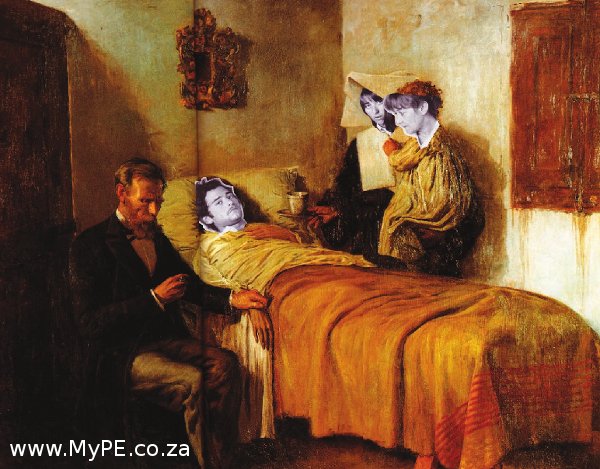
Missing The Boat, an exhibition by Nicholas P. Hauser opens Tuesday 1 February and runs until 11 February 2011 at the EPSAC Gallery, 36 Bird street, Central, Port Elizabeth, South Africa.
“Hauser defiantly maintains that he has no career.”
Missing the Boat is about the indispensable qualities of failure as an engine for productivity and discovery.
Physically, the work on show comprises of selected drawings, paintings, ceramics and digital collages produced between 1978 and 2011.
The exhibition is also by default a collected statement on nostalgia, wishing for a temporary transportation to an earlier time – even if that happens to be twenty minutes ago. Stereotypical curators, using the language of the day, might label it a mid-career retrospective. Hauser defiantly maintains that he has no career.
Nicholas Hauser (b.1958) has lived through at least two critical cycles which have rumoured that painting is dead and that there is no longer abundant merit in the two dimensional visual experience.
“My view is that making marks on paper, clay or canvas is – beyond the obvious therapeutic, philosophical and spiritual benefits – the most fundamental way of making one’s presence and one’s opinion material in this performance we call life.”
“My opinions, theories and interests have altered over the years and my output shows that. For many, my ouvre has been vilified as being too diversified (as if diversity were an indicator of the degree of commitment). But surely, inasmuch as a stoic adherence to, for example, ‘the landscape’ demonstrates evidence of a certain single-mindedness; so surely a diversity of scratchings, scribblings and stagings suggests an incurable propensity for curiosity?”
Perhaps the title is appropriate given that Port Elizabeth’s first attraction was that of a harbour? “I arrived in Southern Africa by ship. We ‘came out on the boat’ as it was colloquially referred to back then. One life was lost leaving Europe, but another life significantly gained arriving in Africa.”
“The boat was the medium, the means of transport, the vessel and the precarious symbol of transition. The boat possibly represents the semi-conscious alpha-state between wakefulness and sleep.”
If a life in Europe was meant to be the deliberate life, Hauser’s biography in Africa became the accidental journey, the temporary turned permanent. And like many dislocated children misguided by distracted, bewildered, uninformed adults (domestically, institutionally and nationally) he made sense of it by turning to the refuges of music, literature and art.
“For the record, I proudly defy the canker of cliché by categorically stating that my work is, to my knowledge, in no important private or public collections, museums or galleries. I have neither entered nor won any international awards. I have no ambitions for my work to be acquired by any banks, mobile phone companies, autocrats, megalomaniacs or despots. Neither will I be flattered by academics or critics pontificating over my work.”
“If people are drawn to what I make, let it be so. If my work transports anyone deeply or superficially for any length of time, then this is happy evidence of the imponderable mystery of image, mind and spirit colliding/ mingling.”
To the viewer then, beware.


Alan Straton
Latest posts by Alan Straton (see all)
- Why Digital Equity Is South Africa’s New Frontier for Women’s Empowerment – By Matebe Chisiza-Asukile and Natasha Mboyisa - 25 September 2026
- New Champions Rise at the 2026 Street Lines Skate Tournament - 23 September 2026
- When Manufacturers Have a ‘Beef’ Then Both Suffer - 23 September 2026
- How Much Are You Worth per Year to Your Bank? - 23 September 2026
- Better Business Processes. Stronger Workplace Skills. Smarter AI. Greater Business Productivity. - 23 September 2026
