
It is a given that the state of BASIC EDUCATION is in a mess.
It is a given that sacrifice is a top-down, parent-child, teacher-student, old-young equation.
It is a given that a pyramid is only as strong as it’s base.
It is a given that the educational infrastructure is a finite resource dependant upon taxpayer money to survive.
The real concern is that in order to appease the protesting students large amounts of money will need to be shifted from one area of our countries budget to tertiary education.
This is where the contention by University students that this present #FeesMustFall / #NationalShutDown action is like the 1976 resistance campaign* comes unstuck. That campaign was about Basic Education and the right to be taught in ones own first language – it was not about fees which, at the time, were either non-existent or a mere pittance.
This resistance to fees is born out of the no-fee schools policy. All of a sudden a small minority of parents and students have to take the brunt of a steep rise in the cost of education – one that hits all parents whose children do not qualify for any form of financial assistance.
My suggestion is a simple one:
There must be some way that the students can horse trade their way to getting relief on their fees and the first thought that comes to mind is this; “Surely the students can be employed or rewarded with lower fees to help make the state of BASIC EDUCATION better, to help make the schools stronger? In return we could then justify the ‘lost money’ in the interests of making our country stronger?”
Strengthen the base and your case and society becomes stronger. Act like the money grabbing people at the top and you will cut off your own nose to spite your own face!
The country would have a lot more sympathy for protesting students if they are seen to be creative in helping solve the problem whilst at the same time contributing immeasurably to the growth and strength of the country we love.
And, by the way, join the Race Free Month movement.
Section 29 of our constitution says:
Education
29. (1) Everyone has the right—
(a) to a basic education, including adult basic education; and
(b) to further education, which the state, through reasonable measures, must make progressively available and accessible.
(2) Everyone has the right to receive education in the official language or languages of their choice in public educational institutions where that education is reasonably practicable. In order to ensure the effective access to, and implementation of, this right, the state must consider all reasonable educational alternatives, including single medium institutions, taking into account—
(a) equity;
(b) practicability; and
(c) the need to redress the results of past racially discriminatory laws and practices.
(3) Everyone has the right to establish and maintain, at their own expense, independent educational institutions that—
(a) do not discriminate on the basis of race;
(b) are registered with the state; and
(c) maintain standards that are not inferior to standards at comparable public educational institutions.
(4) Subsection (3) does not preclude state subsidies for independent educational institutions.
* Youth Day – 16 June 1976:
The Soweto Uprising, also known as 16 June or Youth Day, was a series of protests led by high school students in South Africa that began on the morning of 16 June 1976. Students from numerous Sowetan schools began to protest in the streets of Soweto in response to the introduction of Afrikaans as the medium of instruction in local schools. An estimated 20,000 students took part in the protests. They were met with fierce police brutality. The number of protesters who police killed is usually given as 176, with estimates of up to 700. 16 June is now a public holiday, Youth Day, in South Africa, in remembrance of the events of 1976.
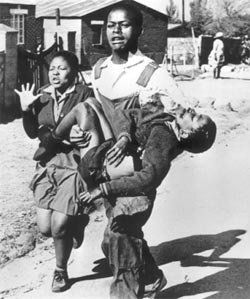
Hector Pieterson being carried by Mbuyisa Makhubo after being shot by South African police. His sister, Antoinette Sithole, runs beside them. Pieterson was rushed to a local clinic and declared dead on arrival. Photo: Sam Nzima
Black high school students in Soweto protested against the Afrikaans Medium Decree of 1974, which forced all black schools to use Afrikaans and English in a 50–50 mix as languages of instruction. The Regional Director of Bantu Education (Northern Transvaal Region), J.G. Erasmus, told Circuit Inspectors and Principals of Schools that from 1 January 1975, Afrikaans had to be used for mathematics, arithmetic, and social studies from standard five (7th grade), according to the Afrikaans Medium Decree; English would be the medium of instruction for general science and practical subjects (homecraft, needlework, woodwork, metalwork, art, agricultural science). Indigenous languages would only be used for religion instruction, music, and physical culture.
In the late 1960s and early 1970s, the system began to weaken.
The association of Afrikaans with apartheid prompted black South Africans to prefer English. Even the homeland regimes chose English and an indigenous African language as official languages. In addition, English was gaining prominence as the language most often used in commerce and industry. The 1974 decree was intended to forcibly reverse the decline of Afrikaans among black Africans. The Afrikaner-dominated government used the clause of the 1909 Union of South Africa Act that recognised only English and Dutch (the latter being replaced by Afrikaans in 1925) as official languages as pretext to do so. While all schools had to provide instruction in both Afrikaans and English as languages, white students learned other subjects in their home language.
Punt Janson, the Deputy Minister of Bantu Education at the time, was quoted as saying: “A Black man may be trained to work on a farm or in a factory. He may work for an employer who is either English-speaking or Afrikaans-speaking and the man who has to give him instructions may be either English-speaking or Afrikaans-speaking. Why should we now start quarrelling about the medium of instruction among the Black people as well? … No, I have not consulted them and I am not going to consult them. I have consulted the Constitution of the Republic of South Africa …”
The decree was resented deeply by blacks, because Afrikaans was widely viewed—in the words of Desmond Tutu, bishop of Lesotho and later Dean of Johannesburg—as “the language of the oppressor”. Teacher organisations such as the African Teachers Association of South Africa objected to the decree. A change in language of instruction forced the students to focus on understanding the language instead of the subject material. This made critical analysis of the content difficult and discouraged critical thinking.
The resentment grew until 30 April 1976, when children at Orlando West Junior School in Soweto went on strike, refusing to go to school. Their rebellion then spread to many other schools in Soweto. Black South African students protested because they believed that they deserved to be treated and taught equally to White South Africans. A student from Morris Isaacson High School, Teboho “Tsietsi” Mashinini, proposed a meeting on 13 June 1976 to discuss what should be done. Students formed an Action Committee (later known as the Soweto Students’ Representative Council) that organised a mass rally for 16 June to make themselves heard.
Read more on Wikipedia


Alan Straton
Latest posts by Alan Straton (see all)
- Cockroach Problems in Flats Can Need a Building-Wide Response - 18 October 2026
- Urine Odours Feature in Gqeberha Carpet/Rug Cleaning Work Throughout the Year - 18 October 2026
- Top Click Explains Who Its SEO and Google Ads Service Is For - 17 October 2026
- Sky Dental Helps Sandton Plan Cosmetic Care Before December - 17 October 2026
- H2O Guru Offers SANS1657 Bottled Water Testing for Summer - 16 October 2026
