
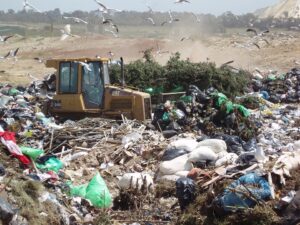
ADDRESSING Africa’s growing plastic pollution problem requires an urgent and comprehensive systems response by governments, businesses, sustainability experts, and civil society if countries are to avoid drowning in a sea of plastic waste, while also unlocking the economic benefits of proper waste management.
This is the goal of the pan-African “Towards Zero Plastics to the Seas of Africa” conference (May 23-27), which is set to bring together top decision-makers across the plastics value chain, public and private sectors to formulate concrete action plans for Africa’s 54 continental and island states.
Hosted by the Sustainable Seas Trust’s African Marine Waste Network in Nelson Mandela Bay, South Africa, the five-day conference is an outcomes-oriented event, where delegates will have the opportunity to contribute to a clear decision-making framework for the management of plastics. The Guide to the Development of National and Regional Action Plans is intended for publication by October this year.
This pan-African conference comes in the wake of the UN Environmental Assembly’s (UNEA) resolution to develop a legally binding global treaty on plastic waste by 2024.
“As the second most polluted continent, it’s important for us to take proactive steps and find uniquely African solutions for our own challenges,” said Dr Tony Ribbink, founding trustee and current CEO of Sustainable Seas Trust, and director of its African Marine Waste Network programme.
No single-solution strategy
“Strategies that work in other parts of the world don’t necessarily apply to Africa,” Ribbink said.
“The draft decision-making framework also recognises that all African countries are not the same and that, for example, investing in recycling plants may not make economic sense for some island states or smaller, landlocked countries.
“The developing guidebook spells out the alternatives and actions that need to be taken at every step of the value chain.”
Ribbink said delegates would have the opportunity to examine specific chapters of the draft guidebook in detail, and contribute facts and proof-of-concept case studies from their region or country, as well as make corrections.
CSIR principal scientist, and one of the conference’s keynote speakers, Professor Linda Godfrey agreed no single-solution strategy would solve the problem.
“It’s going to require everything from upstream interventions by brand owners and retailers to downstream solutions by municipalities and businesses to drive improved waste management and recycling. For this reason, we must have all stakeholders pulling in the same direction if we want to solve the waste problem in Africa.”
Dire outlook for Africa
As lead author of the CSIR and UN Environment Programme’s (UNEP) Africa Waste Management Outlook, Godfrey described Africa’s current approach as dire, and said the continental and island states could not continue with their business-as-usual outlook towards development and waste management challenges.
“With most ‘landfills’ in Africa simply uncontrolled or controlled dumpsites, with an average waste collection rate of only 55% and an estimated recycling rate of only 4%, significant quantities of waste are being burnt or are leaking into our environment. This has serious economic, social and environmental impacts. The cost of inaction for Africa will be significant,” she said.
“Our current waste management systems cannot cope with the types and tonnages of waste currently being generated. We have poor waste collection and disposal, and, increasingly, uncontrolled dumping and open burning of waste.”
In addition, with Africa’s population of 1.3 billion expected to double by 2050, rapid urbanisation and increasing consumption by a growing middle class, Godfrey said Africa was likely to experience a significant growth in waste generation on the back of a broken system.
“All of this results in the leakage of waste, and the pollution of our land, water and air. We cannot continue with business-as-usual.”
Time’s up on talking
Ribbink said many previous attempts to formulate a response to the plastic waste problem had been superficial or theoretical at best, and lacking in concrete action plans and practical steps.
Godfrey added: “We no longer have the luxury, or time, of just talking. Conferences such as this must be directed to finding practical, appropriate solutions for addressing waste, especially plastic waste, in Africa.
“This conference also provides an opportunity to present the latest thinking on various solutions, from regulatory, to technology, and education and awareness.”
Godfrey said all role-players in the plastics value chain, local and national government, academics and other stakeholders had an important part to play in making sure these issues could be addressed.
“We need people to come together to solve these problems: Decision-makers who can practically implement solutions; researchers who are critical to providing evidence-based solutions; civil society groups who are at the coalface of addressing these issues in communities.”
As a focused opportunity, the conference provides an accelerated mechanism for Africa to meet UNEA and UNEP goals, which, through the action plans, will further support countries in meeting the 2030 agenda for sustainable development and UN Sustainable Development Goals (SDG). In addition, representatives of UNEP will be in attendance to promote the Global Commitment, which has united more than 500 organisations behind a common vision of building a circular economy for plastics.
Led by the Ellen MacArthur Foundation, in collaboration with UNEP, the initiative has seen businesses and governments worldwide committing to tackling the problem of plastic pollution at its source, with ambitious targets to be achieved by 2025. Measures include eliminating unnecessary plastics, and redesigning those that are needed so that they can be safely reused, recycled or composted.
CLICK HERE to submit your press release to MyPR.co.za.
Post Views: 20
Gqeberha’s Latest News and Events can be accessed on MyGqeberha.com.
The following two tabs change content below.


Alan Straton
Chief Cook, Bottle Washer and Broom Mechanic at MyPE
Passionate about Port Elizabeth and definitely NOT packing for Perth.
Alan's ethos is epitomised in the words of Nelson Mandela; "I have fought against white domination and I have fought against black domination. I have cherished the idea of a democratic and free society. If need be, it is an ideal for which I am prepared to die."
See more articles by Alan.
Latest posts by Alan Straton (see all)
-
South African Artist MARTHINUS Releases Debut Single - 6 November 2026
-
MARTHINUS Releases Heartfelt Debut ‘i miss us not trying’ - 6 November 2026
-
LaserWeeder Hire Runs Laser Units for SA Vegetable Growers - 6 November 2026
-
HandPrinter Art Runs Linocut Workshops and Beginner Kits - 6 November 2026
-
Feature Equipment Adds AM.CO.ZA Tooling and Laser Spares Shelf - 6 November 2026
Alan Straton
Latest posts by Alan Straton (see all)
- South African Artist MARTHINUS Releases Debut Single - 6 November 2026
- MARTHINUS Releases Heartfelt Debut ‘i miss us not trying’ - 6 November 2026
- LaserWeeder Hire Runs Laser Units for SA Vegetable Growers - 6 November 2026
- HandPrinter Art Runs Linocut Workshops and Beginner Kits - 6 November 2026
- Feature Equipment Adds AM.CO.ZA Tooling and Laser Spares Shelf - 6 November 2026
