
The June exam marks of participating Grade 11 and 12 learners, compared to their December 2016 marks, showed that half the learners had improved by 10%, while some 20% of Grade 11s and nearly 10% of Grade 12s had improved by as much as 30%. The top-achieving Grade 11 learner shot up by 80%, and the top Grade 11 learner by 60%.
The Old Mutual Flagship Education Programme’s (OMEFP’s) maths and science development project, launched at the start of 2015, is geared towards 21st century learners, with an innovative teaching and learning model, packaged at TouchTutor®, that was developed by the Govan Mbeki Mathematics Development Centre (GMMDC) at Nelson Mandela University.
“This project has afforded us the opportunity to test, refine and demonstrate the impact of a technology-blended model in a rural context,” said GMMDC head Prof Werner Olivier, who previously tested the model in an urban context, with similar improved results.
The project, which runs in close collaboration with the provincial Department of Basic Education, focuses on improving Grade 8 to 12 teachers’ skills and Grade 10 to 12 learners’ achievements, with a laptop-based model for teachers – for use as a classroom resource – and a tablet- and desktop-based model for learners (the latter placed in resource centres at the schools), for use after school hours as an offline tutor.
Offline and curriculum-aligned, TouchTutor® makes use of video content lessons, animated PowerPoint lessons, open-source GeoGebra software, self-tests, language support and various other digital support material, to enhance understanding in maths and science.
The project took the form of a centralised Incubator School Programme, run on Saturdays for 120 learners with potential from the 18 different project schools, as well as Tablet-assisted After-school Peer Support (TAPS) maths sessions for 200 learners from 10 of the schools.
“We invest in education so as to effect societal change,” said Old Mutual Senior Project Manager Kanyisa Diamond. “The investment in education through the OMEFP’s maths and science component as well as combining mentoring and training initiatives will enable leaders to lead and learners to learn.”
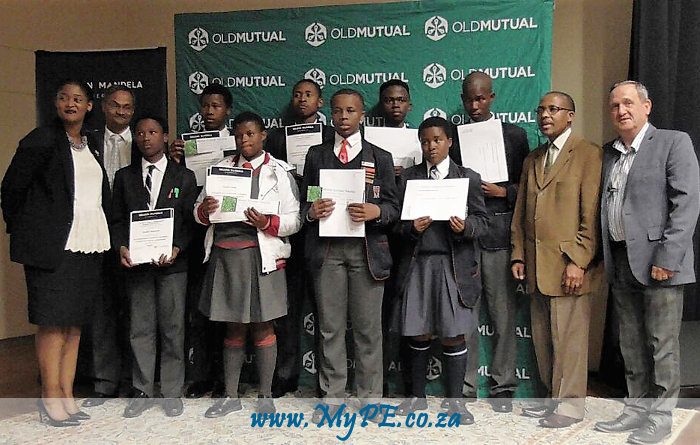
The extension of the project, which has cost R6m to date, was announced at the project’s end-of-year certification function at the Steve Biko Centre in King Williams’ Town, where the top ISP learners were Hector Peterson High’s Yonela Oliphant (Grade 11) and Richard Varha High’s Mhlali Blekiwe (Grade 12), and the top TAPS learners were Hector Petersen’s Khanya Jurie (Grade 11) and Bhisho High’s Nanda Ndamase (Grade 12).
“Over the next two years, we are hoping to boost the impact of the programme even more by adding Science, Technology, Engineering, Arts and Mathematics (STEAM) activities as well as a mobile app for inter-school maths competition purposes and free maths curriculum support via mobile phones,” said Olivier.
“STEAM is an attempt to demystify maths (by linking it to nature, art, etc.) and demonstrate its central role in science, technology and even art.”


Alan Straton
Latest posts by Alan Straton (see all)
- Sky Dental Helps Sandton Plan Cosmetic Care Before December - 17 October 2026
- H2O Guru Offers SANS1657 Bottled Water Testing for Summer - 16 October 2026
- The Gold Avenue Flags the 91.67% Krugerrand Seller Mistake - 16 October 2026
- Does Your Finance Team Spend More Time Preparing Reports Than Analysing Them? - 16 October 2026
- Acepak Showcases Pouch Fillers for Liquid and Food Producers - 16 October 2026
