
Port Elizabeth – Renowned journalist and author Humphrey Tyler, 83, was left dazed and disoriented after he and his wife Pat, 82, were attacked on Friday at their Bedford home in the Eastern Cape.
The couple had returned from shopping in the small village and parked their car when a man appeared in front of their garage.
“I got out of the car. When I turned around there was a man right in front on me – I thought I was hallucinating,” Pat said.
The man pushed her aside and lunged at Tyler, head-butting him on his temple. Tyler, who has had a hip and knee replacement, tried fending off the attacker with his walking stick.
The man grabbed Tyler’s wallet and cellphone and ran.
“I’m feeling very woozy,” said Tyler, “but I am having a medicinal brandy.”
Police found a hole cut into the fence where it appears the attacker entered and left the property. A docket has been opened.
Tyler was the only journalist in the crowd at Sharpeville on March 21 1960 and wrote a book ‘Life in the Time of Sharpeville’.
On the day of the Sharpeville massacre – 21 March 1960 – Humphrey Tyler, was the assistant editor of Drum magazine.
After the massacre he wrote:
“We went into Sharpeville the back way, behind a grey police car and three Saracens. As we drove through the fringes of the township many people shouted the Pan-Africanist slogan ‘Izwe Lethu’, which means ‘Our Land’, or gave the thumbs-up ‘freedom’ salute and shouted ‘Afrika!’.
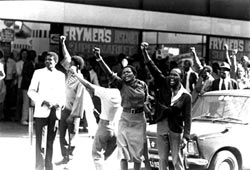
They were grinning, cheerful, and nobody seemed to be afraid… There were crowds in the streets as we approached the police station. There were plenty of police, too, wearing more guns and ammunition than uniforms…An African approached… and said he was the local Pan-Africanist leader. He told (us) his organisation was against violence and that the crowd was there for a peaceful demonstration…The crowd seemed perfectly amiable. It certainly never crossed our minds that they would attack us or anybody…
There were sudden shrill cries of ‘Izwe Lethu’ – women’s voices it sounded – from near the police, and I could see a small section of the crowd swirl around the Saracens and hands went up in the Africanist salute. Then the shooting started. We heard the chatter of a machine gun, then another, then another. There were hundreds of women, some of them laughing. They must have thought the police were firing blanks. One woman was hit about ten yards from our car. Her companion, a young man, went back when she fell. He thought she had stumbled. Then he turned her over and saw that her chest had been shot away. He looked at the blood on his hand and said: ‘My God, she’s gone!’ Hundreds of kids were running, too.
One little boy had on an old blanket coat, which he held up behind his head, thinking, perhaps, that it might save him from the bullets. Some of the children, hardly as tall as the grass, were leaping like rabbits. Some were shot, too. Still the shooting went on. One of the policemen was standing on top of a Saracen, and it looked as though he was firing his gun into the crowd. He was swinging it around in a wide arc from his hip as though he were panning a movie camera. Two other officers were with him, and it looked as if they were firing pistols. Most of the bodies were strewn on the road running through the field in which we were. One man, who had been lying still, dazedly got to his feet, staggered a few yards, then fell in a heap. A woman sat with her head cupped in her hands.
One by one the guns stopped.
Before the shooting, I heard no warning to the crowd to disperse. There was no warning volley. When the shooting started it did not stop until there was no living thing in the huge compound in front of the police station. The police have claimed they were in desperate danger because the crowd was stoning them. Yet only three policemen were reported to have been hit by stones – and more than 200 Africans were shot down. The police also have said that the crowd was armed with ‘ferocious weapons’, which littered the compound after they fled.
I saw no weapons, although I looked very carefully, and afterwards studied the photographs of the death scene. While I was there I saw only shoes, hats and a few bicycles left among the bodies. The crowd gave me no reason to feel scared, though I moved among them without any distinguishing mark to protect me, quite obvious with my white skin. I think the police were scared though, and I think the crowd knew it.”
Read more of Humphrey Tyler’s articles on the Mail and Guardian.


Alan Straton
Latest posts by Alan Straton (see all)
- Top Click Explains Who Its SEO and Google Ads Service Is For - 17 October 2026
- Sky Dental Helps Sandton Plan Cosmetic Care Before December - 17 October 2026
- H2O Guru Offers SANS1657 Bottled Water Testing for Summer - 16 October 2026
- The Gold Avenue Flags the 91.67% Krugerrand Seller Mistake - 16 October 2026
- Does Your Finance Team Spend More Time Preparing Reports Than Analysing Them? - 16 October 2026
