
A long, angry, tumultuous winter that was to last almost 40 years until 30 June 1991 as South Africa slipped the shackles of AEE and Afrikaner Nationalist Party Rule.
The Group Areas Act No. 41 of 1950 was an apartheid era act to provide for the establishment of group areas, for the control of the acquisition of immovable property and the occupation of land and premises, and for matters incidental thereto.
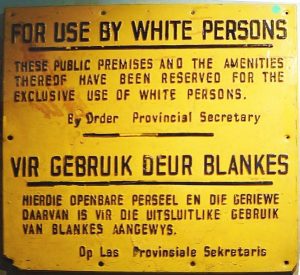
This Act was passed by the then Parliament of South Africa under the majority party of the time – the National Party (NP) on 7 July 1950 after a royal assent on 24 June 1950 with a commencement date of 30 March 1951 in the Cape, Transvaal, Natal Provinces. The Orange Free State followed on 31 October 1952.
The National Party (Nasionale Party) was originally an Afrikaner ethnic nationalist party that promoted Afrikaner interests in South Africa. Founded by JBM Hertzog on 2 July 1915 the NP ceased operations on 9 April 2005.
On 1 November 1957 the first Group Areas Act was repealed and replaced by the Group Areas Act No. 77 of 1957 which commenced on 1 November 1957 and was repealed on 26 October 1966.
Act No. 77 was finally replaced by Group Areas Act Act No. 36 which commenced on 26 October 1966 and was repealed on 30 June 1991.
These three Group Areas Acts empowered the Governor-General to declare certain geographical areas to be for the exclusive occupation of specific racial groups. In particular the statute identified three such racial groups: whites, coloureds and natives. This authority was exercised on the advice of the Minister of the Interior and the Group Areas Board.
Once an area had been designated for sole occupation by certain racial groups the proclamation would not become legally effective for at least one year. Once this time had expired it became a criminal offence to remain in occupation of property in that area with the punishment potentially being a fine and two years’ imprisonment.
The Act also applied to businesses with racial designation being applied on the basis of the individuals who held a controlling interest in the company.
In the parlance of today one could conceivably call the Grand Apartheid Era Acts, AEE – Afrikaner Economic Empowerment…
The first Group Areas Act, the Group Areas Act, 1950 was promulgated on 7 July 1950, and it was implemented over a period of several years. It was amended by Parliament in 1952, 1955 (twice), 1956 and 1957. Later in 1957 it was repealed and re-enacted in consolidated form as the Group Areas Act, 1957, which was amended in 1961, 1962, and 1965. In 1966 this version was in turn repealed and re-enacted as the Group Areas Act, 1966, which was subsequently amended in 1969, 1972, 1974, 1975, 1977, 1978, 1979, 1982, and 1984. It was repealed (along with many other discriminatory laws) on 30 June 1991 by the Abolition of Racially Based Land Measures Act, 1991.
All the apartheid era Acts were enacted under the ruling party of the time – the National Party.
The National Party (NP) was a political party in South Africa founded in 1914 and disbanded in 1997. The party was originally an Afrikaner ethnic nationalist party that promoted Afrikaner interests in South Africa. The NP first became the governing party of the country in 1924. It was in opposition during World War II but returned to power and was again the majority party in government for just short of 45 years from 4 June 1948 until 9 May 1994.
Beginning in 1948, the National Party under Daniel François Malan, the first apartheid-era prime minister (1948–1954), began implementing its policy of racial segregation, known as apartheid (Afrikaans: “separateness”). Although White-minority rule and racial segregation based on White supremacy were already in existence in South Africa, with non-Whites not having voting rights and efforts made to encourage segregation, apartheid intensified the segregation, with stern penalties for non-Whites entering into areas designated for Whites-only without having a pass to permit them to do so (known as the pass laws), interracial marriage and sexual relationships were illegal and punishable offences, and blacks faced significant restrictions on property rights. Upon South Africa being condemned in the British Commonwealth for its policies of apartheid, the NP-led government had South Africa leave the Commonwealth, abandon its monarchy led by the British monarch and become a republic.
Preceding the Group Areas Act was the Prohibition of Mixed Marriages Act (Act No. 55 of 1949) which was one of the first pieces of apartheid legislation enacted after the National Party came to power in South Africa in 1948. The Act banned marriages between “Europeans and non-Europeans”, which, in the language of the time, meant that white people could not marry people of other races.
The Prohibition of Mixed Marriages Act did not, however, prevent so-called Mixed Marriages between non-white people. Unlike some other key pieces of apartheid legislation, this act was designed to protect the “purity” of the white race rather than the separation of all races. The law, along with the related Immorality Acts, which prohibited extra-marital, interracial sexual relations, was repealed in 1985.
During the 1989 South African general election, the party National Party under F. W. de Klerk’s leadership declared that it intended to negotiate with the Black South African community for a political solution to accommodate Black South Africans. This resulted in De Klerk declaring in February 1990 the decision to transition South Africa out of apartheid, and permitted the release of Mandela from prison and ending South Africa’s ban on the ANC and other anti-apartheid movements, and began negotiations with the ANC for a post-apartheid political system. With support for ending apartheid secured among White South Africans, the party opened up its membership to all racial groups and rebranded itself as no longer being an ethnic nationalist party only representing Afrikaners, but would henceforth be a civic nationalist and conservative party representing all South Africans. In the 1994 elections it managed to expand its base to include many non-Whites including significant support from Coloured and Indian South Africans. It participated in the Government of National Unity between 1994 and 1996. In an attempt to distance itself from its past, the party was renamed the New National Party in 1997. The attempt was largely unsuccessful and the new party was decided to merge with the ANC.
The apartheid government passed laws that paved the way for “grand apartheid”, which was centred on separating races on a large scale, by compelling people to live in separate places defined by race. This strategy was in part adopted from “left-over” British rule that separated different racial groups after they took control of the Boer republics in the Anglo-Boer war. This created the black-only “townships” or “locations”, where blacks were relocated to their own towns. In addition, “petty apartheid” laws were passed.
Timeline of the principal apartheid laws:
- 1949 – The Prohibition of Mixed Marriages Act which prohibited marriage between persons of different races
- 1950 – The Immorality Act made sexual relations with a person of a different race a criminal offence.
- 1950 – The Population Registration Act formalised racial classification and introduced an identity card for all persons over the age of 18, specifying their racial group.
- 1950 – The Group Areas Act of 1950 put an end to diverse areas where people of different races lived side by side and determined where one lived according to race. Each race was allotted its own area, which was used in later years as a basis of forced removal.
- 1951 – The Prevention of Illegal Squatting Act allowed the government to demolish black shanty town slums and forced white employers to pay for the construction of housing for those black workers who were permitted to reside in cities otherwise reserved for whites.
- 1951 – The Bantu Authorities Act created separate government structures for blacks and whites and was the first piece of legislation to support the government’s plan of separate development in the bantustans.
- 1953 – The Reservation of Separate Amenities Act reserved municipal grounds for a particular race, creating, among other things, separate beaches, buses, hospitals, schools and universities. Signboards such as “whites only” applied to public areas, even including park benches.
- 1950 – The Suppression of Communism Act of 1950 banned any party subscribing to Communism.
- 1953 – The 1953 Bantu Education Act crafted a separate system of education for black South African students and was designed to prepare black people for lives as a labouring class.
- 1959 – Separate universities were created for black, Coloured and Indian people. Existing universities were not permitted to enroll new black students.
- 1959 – The Promotion of Black Self-Government Act entrenched the NP policy of nominally independent “homelands” for blacks. So-called “self–governing Bantu units” were proposed, which would have devolved administrative powers, with the promise later of autonomy and self-government.
- 1959 – The Bantu Investment Corporation Act set up a mechanism to transfer capital to the homelands to create employment there.
- 1967 – Legislation allowed the government to stop industrial development in “white” cities and redirect such development to the “homelands”.
- 1970 – The Black Homeland Citizenship Act marked a new phase in the Bantustan strategy. It changed the status of blacks to citizens of one of the ten autonomous territories. The aim was to ensure a demographic majority of white people within South Africa by having all ten Bantustans achieve full independence. *
- 1974 – The Afrikaans Medium Decree required the use of Afrikaans and English on an equal basis in high schools outside the homelands.
* Ten homelands were allocated to different black ethnic groups: Lebowa (North Sotho, also referred to as Pedi), QwaQwa (South Sotho), Bophuthatswana (Tswana), KwaZulu (Zulu), KaNgwane (Swazi), Transkei and Ciskei (Xhosa), Gazankulu (Tsonga), Venda (Venda) and KwaNdebele (Ndebele). Four of these were declared independent by the South African government: Transkei in 1976, Bophuthatswana in 1977, Venda in 1979, and Ciskei in 1981 (known as the TBVC states).
A new Era for South Africa:
The first democratic elections in South Africa were held on 27 April 1994 as 20 Million South Africans cast their votes. An extra voting day was added to give everyone a chance to vote. International observers agreed that the elections were free and fair. The European Union’s report on the election compiled at the end of May 1994, published two years after the election, criticised the Independent Electoral Commission’s lack of preparedness for the polls, the shortages of voting materials at many voting stations, and the absence of effective safeguards against fraud in the counting process. In particular, it expressed disquiet that “no international observers had been allowed to be present at the crucial stage of the count when party representatives negotiated over disputed ballots.” This meant that both the electorate and the world were “simply left to guess at the way the final result was achieved.”
The ANC won 62.65% of the vote, less than the 66.7 percent that would have allowed it to rewrite the constitution. 252 of the 400 seats went to members of the African National Congress. The NP captured most of the White and Coloured votes and became the official opposition party. As well as deciding the national government, the election decided the provincial governments, and the ANC won in seven of the nine provinces, with the NP winning in the Western Cape and the IFP in KwaZulu-Natal. On 10 May 1994, Mandela was sworn in as the new President of South Africa. The Government of National Unity was established, it’s Cabinet made up of 12 ANC representatives, six from the NP, and three from the IFP. Thabo Mbeki and de Klerk were made deputy presidents.
The anniversary of the elections, 27 April, is celebrated as a public holiday known as Freedom Day.
What will we be writing about the ANC government in 2034 – 40 years after they took power?


Alan Straton
Latest posts by Alan Straton (see all)
- Blackrock Towing Readies Gauteng Drivers for Spring Storm Season Breakdowns - 21 October 2026
- SAFRA Marks 15 Years and Nearly 500,000 Moving Quotes - 19 October 2026
- SAFRA Unveils Exciting Website Upgrade for Easier Moving Quotes - 19 October 2026
- SAFRA Launches Powerful New Furniture Volume Calculator - 19 October 2026
- What Parents Need to Know about Polio - 19 October 2026
