
If your acceptance speech begins with the above words then you know your accolade is deserving of the company.

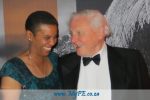
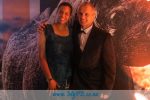

For Cathy Dreyer the accolade was receiving the Tusk Award for Conservation in Africa in front of Prince William. The Prince is the Royal Patron of Tusk and was joined this year by Sir David Attenborough at the fourth annual Tusk Awards to announce the winners of three of the conservation world’s most prestigious accolades.
This is the first time that a South African has received this award and fitting that it should go to a person who cut her teeth and started her career at the age of twenty-two with South African National Parks (SANParks) as a nature conservation student in the Addo Elephant National Park. During the course of her practical year she assisted Dr Pete Morkel with the capture and Boma training of black rhino that were being relocated between parks. This was to became a turning point in her life as she developed a deep, lifelong passion for the species which has since carved her career in conservation.
As Cathy said on the night; “I would like to thank Dr. Pete Morkel who introduced me to my first Black Rhino and in many ways shaped the path my career and life would take. I am forever grateful to him for sharing all his knowledge and experience with me and for always having faith in my abilities.”
Acknowledging her roots Dreyer said of Dr David Zimmerman and the entire SANPARKS Veterinary Wildlife Services Unit; “I am forever grateful for everything each and every member of the team taught me. It was an incredible experience to have worked alongside them capturing and relocating wildlife all across Africa. Thei passion and teamwork will not be easily matched.”
Reflecting on a tough year after having seven Rhino fall victim to poaching with one survivor and an eleven month old-calf orphaned Cathy acknowledged her present colleagues saying; “In many ways it has made us stronger and more determined to protect our Rhino and I am proud to be able to fight alongside you all. To Gavin, your integrity, passion, commitment and drive set an amazing example for us all and it has been a privilege to work alongside you.”
“In recent time I have come face to face wit hthe brutality and suffering that Rhino have to endure as a result of poaching and it’s easy to think that you are sometimes alone in this fight. It’s moments like Tusk and being able to look around a room filled with so many great people that have made incredible contributions in their lifetime that one realises that there are so many others fighting the same battle and there is a great amount of comfort in knowing that you are not alone,” said Dreyer in conclusion of her acceptance speech.
Acknowledging the nominees, Prince William said; “As ever, tonight I have been humbled by the sheer dedication and commitment that all of our 2016 nominees have shown, in preserving – against the odds – our precious natural world. Their work is dangerous but vitally important – and we are immensely grateful for it.”
“Let’s remember,” he added “that the illegal wildlife trade is the fourth biggest illegal trade in the world after drugs, weapons and human slavery,” continued the Duke.
Sir David declared Angola’s Manuel Sacaia the winner of the Tusk Wildlife Ranger Award, in recognition of his fearless dedication to protecting the critically endangered giant sable antelope from extinction.
The Tusk Award for Conservation in Africa, sponsored by Land Rover, also presented by Sir David Attenborough, went to Cathy Dreyer from South Africa, for her commitment to, and remarkable success in protecting black rhino, work vital to the survival of this iconic species.
The Prince William Award for Conservation in Africa, sponsored by Investec Asset Management, was presented by The Duke to John Kahekwa from the Democratic Republic of Congo for a life lived in pursuit of a future for the Grauer’s gorilla within the Congo’s war zones.
Charlie Mayhew, Tusk CEO, said “Whilst the illegal wildlife trade continues to flourish, we must not lose sight of the remarkable achievements of these five extraordinary men and women, whose lives are threatened daily on Africa’s conservation front line”.
The ceremony was attended by many of the charity’s high profile supporters including Ronnie Wood, Deborah Meaden, Katherine Jenkins and Bear Grylls. The awards ceremony was hosted by broadcaster, Kate Silverton, a Patron of the Charity. Among the guests were the Chinese, Rwandan and Angolan Ambassadors.
Hendrik du Toit, CEO of Investec Asset Management, added, “We live in unprecedented times. Over the last 40 years the world’s wildlife population has decreased by more than half and some of the planet’s most iconic species, many of which count the continent of Africa as their home, are on the brink of extinction. Now is the time to act if we are to reverse this. The awards are not only a celebration of the achievements of the nominees; they are also about inspiring all of us for the ongoing battle to preserve our natural heritage for the generations to come.”
Cathy Dreyer was nominated by Dr David Zimmerman, Wildlife Vet for SANParks in Port Elizabeth, for the Tusk Award for Conservation in Africa. The first time a South African has won this prestigious award and a great achievement for the Eastern Cape.
Cathy Dreyer started her career at the age of twenty-two with South African National Parks (SANParks) as a nature conservation student in the Addo Elephant National Park. During the course of her practical year she assisted Dr Pete Morkel with the capture and Boma training of black rhino that were being relocated between parks. This was to became a turning point in her life as she developed a deep, lifelong passion for the species which has since carved her career in conservation.
Seeing the potential in the young student SANParks Veterinary Wildlife Services unit offered Cathy a permanent position as a Veterinary Technologist. Although this was a profession in which she was not formally trained, Cathy took the opportunity with open arms and excelled in both the veterinary and operational side of the capture unit, becoming a stalwart of the team. The work ranged from general maintenance of the equipment to building capture bomas; animal husbandry to assisting with laboratory and clinical work. She was one of the pivots in the mass capture team which moved over 30,000 plains game during her period of employment. During this time she became actively involved in the veterinary aspects of various conservation and breeding projects such as the Kruger buffalo breeding project and the Back To Africa sable antelope project.
It was a great loss to the organisation when, in 2012 Cathy decided to leave after 14 years with SANParks, to take up a position with Eastern Cape Parks and Tourism Agency as the Conservation Manager for Great Fish River Nature Reserve. Her role is as the custodian of one of the world’s most significant rhino populations – here her passion and drive to protect rhino has found a worthy home.
During her relatively short career Cathy has been an integral part of many successful wildlife relocation projects, both nationally and internationally, including the translocation and reintroduction of black rhino to North Luangwa, Zambia, Okavango delta, Botswana, Majete Game Reserve, Malawi and Mkomazi Game Reserve, Tanzania. She was instrumental in the Black Rhino Range Expansion Project (BRREP) where black rhino have been relocated out of the Great Fish River Game Reserve and the transfrontier relocation of game from Kruger National Park to Limpopo National Park, Mozambique.
Cathy’s success has been totally through her own efforts and as a woman she has had far greater challenges than most. She has never asked to be treated differently or more leniently than others and her approach to life is very much “the harder the battle the sweeter the victory”. It is her understated, modest and charming character that has endeared her to everyone she works with.
A sponsor of the event was the local Mantis Group together with Investec, the headline sponsor. Dreyer’s work is supported by the Wilderness Foundation and many others, including Dr William Fowlds.


Alan Straton
Latest posts by Alan Straton (see all)
- South African Conquers Rats on the World Stage - 30 October 2026
- Old JPG on a Memory Stick? Vectorization Studio in Observatory Redraws Faded and Low-Resolution Logos by Hand - 30 October 2026
- ReAutomated Adds Robot Palletising and Case Packing Cells to Existing South African Packing Lines Without Stripping Out the Conveyors - 30 October 2026
- From a 5 KM Sprint to an Ultra: Punisher Sets Out Its Magaliesberg Obstacle Race Formats for First Timers, Teams and Fitness Clubs - 30 October 2026
- Rotary or Dual Action? Germiston’s Polisher Lists Its Machines, Buffs and Compounds for Car Paint and Metal Finishing - 30 October 2026
