
Why South Africa’s plans to militarise humanitarian work are misguided by Nelson Mandela Metropolitan University:
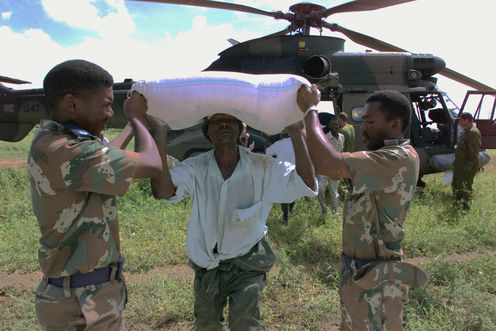
The South African Defence Review, the country’s new defence policy, was approved in March 2014. It guides policy-making for the next two to three decades.
The promotion of stability and peace in Africa is a priority for South Africa. The Defence Review says it will contribute to the prevention and resolution of conflict by integrating its diplomatic, military and other efforts. In some instances this will be supported by appropriate military capabilities that strengthen the country’s capacity to influence international developments.
South Africa’s involvement is informed by a desire to support conflict management, peace-building and reconstruction in Africa. There are also geopolitical, security and economic interests at play.
The Defence Review took three years to complete. One would expect this to have been enough time to come up with a sound policy document. But there are two major problems with the role envisaged for the South African National Defence Force in relation to African peace and stability.
“Armed” humanitarian assistance
The first is the plan to involve the country’s military in providing
critical humanitarian assistance and reconstruction capabilities during and immediately after military operations.
The four principles which guide humanitarian activities in conflict zones are:
-
humanity,
-
neutrality,
-
impartiality, and
-
independence.
Using armed forces to distribute humanitarian assistance in conflict or complex post-conflict areas violates the humanitarian principles. This includes foreign peacekeepers. The review does not even acknowledge humanitarian principles. This is an odd omission as they have been endorsed by the government. And they are crucial in any debate about engagement in conflict zones.
Humanitarian and military actors differ profoundly in terms of their training. This includes differences in skills, aims, mandates, agendas, operational methods and institutional cultures. Because of this, the responsibility for providing humanitarian assistance rests primarily with humanitarian and aid organisations.
The role of peacekeepers is to contribute to creating stability and security. They are also tasked with ensuring freedom of movement for local and international humanitarian aid workers.
South African peacekeepers will endanger humanitarian efforts if they get involved in humanitarian work. Instead of helping bring peace, stability and relief, they will compromise the work of humanitarian organisations.
Developmental peacekeeping
The second problem with South Africa’s new defence policy is the plan to engage in “developmental peacekeeping.” The review notes that the defence force
can contribute greatly to socio-economic development by employing its diverse capabilities, such as its planning capability, in line with peace-operation forces.
The SANDF’s capabilities for socio-economic development are questionable. The force is in a critical state of decline. Its myriad problems include high HIV/Aids infection rates, skills and equipment shortages, indiscipline and an ageing force.
The army has limited capacity to meaningfully assist South Africa’s own development and growth, let alone post-conflict reconstruction and development in Africa’s conflict zones.
But the real problem is the envisaged involvement of the military in socio-economic development in war torn countries. Post-conflict reconstruction takes place
in synergy with peacekeeping and peace-enforcement. On a practical level this would mean that post-conflict reconstruction practitioners and resources are deployed alongside peacekeepers.
In short, peacekeepers are supposed to contribute to the establishment of stability and security that enables reconstruction and development.
Irresponsible and misguided policy-making
South Africa needs to do more to help Africa’s war-torn countries stabilise and recover. But it is puzzling that the new policy would envisage the defence force being involved in humanitarian assistance and reconstruction and development in complex crises.
It is even more puzzling that this irresponsible and misguided thinking is part of a defence policy that will steer the defence force in the next few decades.
This could have been avoided if the defence review committee had consulted the literature on aid and development in conflict and post-conflict settings, and particularly these two documents:
-
the UN’s Civil-Military Guidelines and Reference for Complex Emergencies, and
-
South Africa’s own Revised White Paper on South African Participation in International Peace Missions.
South Africa needs to engage in Africa in a strategic and pragmatic way. It also needs to ensure that tasks and responsibilities are delegated correctly. The defence force’s modest peacekeeping capabilities must be used properly. Most importantly, the guiding principle of any engagement should be “do no harm”.
Humanitarian work in Africa should be left to humanitarian and aid agencies. Reconstruction and development should be left to the New Partnership for Africa’s Development, development organisations and local actors.
This article is based on my paper published in African Security Review.

Savo Heleta does not work for, consult, own shares in or receive funding from any company or organization that would benefit from this article, and has disclosed no relevant affiliations beyond the academic appointment above.
Read more here: http://theconversation.com/why-south-africas-plans-to-militarise-humanitarian-work-are-misguided-53391.

Port Elizabethan
Latest posts by Port Elizabethan (see all)
- Why Fewer People Are Being Convicted for Commercial Crimes - 15 May 2026
- Urgent Call for South Africa to Support and Join Global Efforts to Phase Out Fossil Fuels - 15 April 2026
- Unfenced 6 SAI Army Base Outside Makhanda Claims Another Life - 20 November 2025
- Death Toll Rises From Makhado Bus Crash - 21 October 2025
- Law Clinics Flooded as Home Affairs Blocks Asylum Seekers From the System - 15 October 2025
