
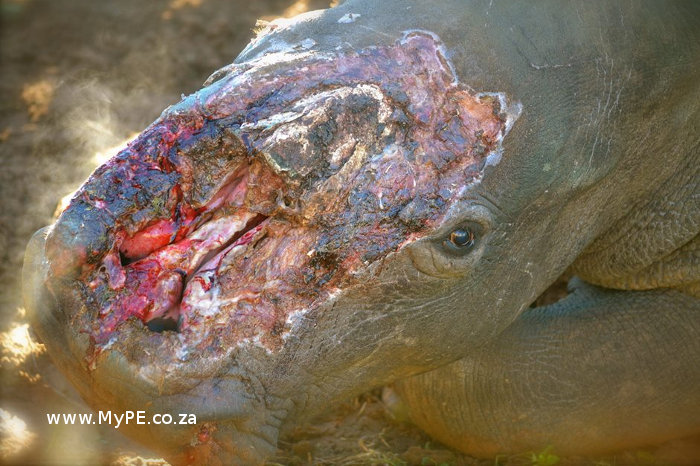
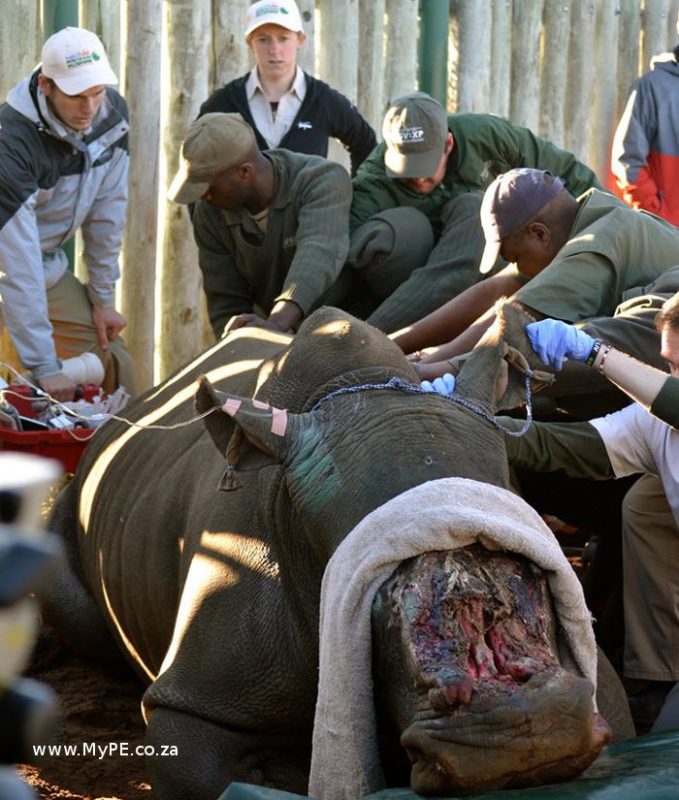
On the 8th of June 2015 “Hope”, the rhino survivor from a recent poaching incident in the Eastern Cape, underwent her third procedure to repair the catastrophic damage done to her by poachers who left her for dead. Hope, the four year old female white rhino, who has become the international symbol for the rhino crisis, was treated by Saving the Survivors, a team of vets dedicated to saving the victims of poaching.
The operation which took two hours and twenty minutes, was another procedure in a series of ground breaking treatments undertaken by Saving the Survivors. Dr Gerhard Steenkamp, from the University of Pretoria and co-founder of Saving the Survivors explains “Our first procedure was on the 18th of May to repair as much of the wound as we could. Our priority was to assess the extent of the damage to Hope’s face and if she could in fact, be saved. We have treated many victims of poaching and through our experience we were confident that Hope could survive these horrific injuries inflicted on her by poachers.”
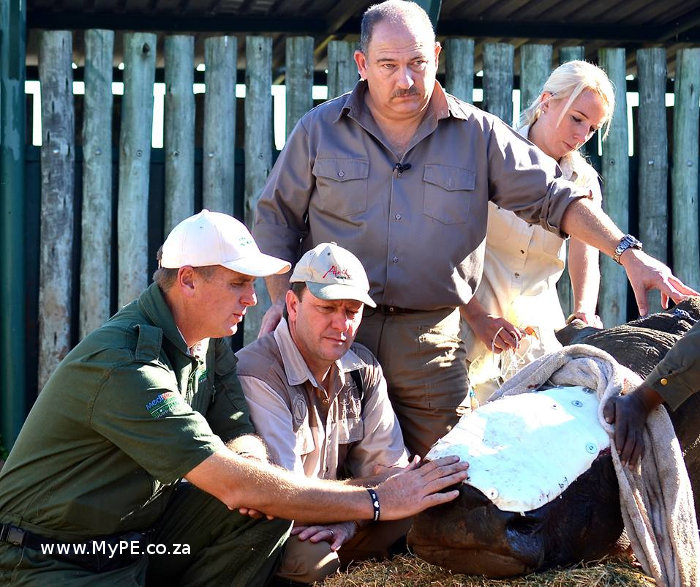
“The previous procedure involved removing the first face shield which had come loose after she rubbed her face up against the boma (enclosure). Leaving this wound exposed has inhibited the healing process by allowing these tissues to dry out and so we took the decision to place a new shield over the wound to keep it moist and assist with the repair process,” explains Dr Steenkamp.
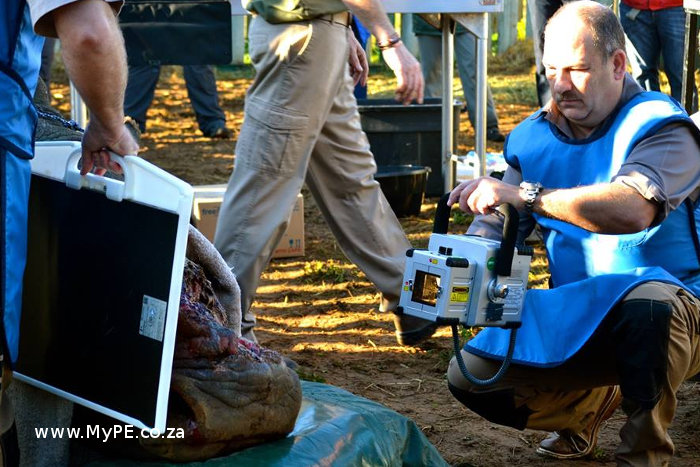
The biggest challenge currently is keeping Hope’s shield in place when most of the bone required for attachment points has been removed by the poachers. Dr Johan Marais, who is also from the Faculty of Veterinary Science, Onderstepoort, and a co-founder of Saving the Survivors said, “we took radiographs of the damaged area to ascertain if there were anchor points and enough bone integrity to attach the shield. The bone has to be healthy enough to be able to drill the shield into place, it’s the only way that we are able to make sure it stays on. In the absence of sufficient bone, we sutured the bottom part of the shield on which should keep it in place for longer.
This is to give the damaged areas a better chance to recover. Her procedure took longer than we would have liked so we have now made a mould of the shield so next time it is ready to be attached which should cut down procedure time by 45 minutes.”
“Whilst we remain positive that she will recover, we have to be realistic in our expectations of the timeframes required for Hope’s healing process. It is going to be a long journey and she has to be closely monitored at all times especially in these early stages, for any complications. From our experience we anticipate it will take at least a year to a year and a half before a full recovery can be expected. What Hope is teaching us now is invaluable. We can draw from her treatment when treating other victims of poaching with severe facial wounds.
We must be patient and give her body time to heal. We are providing her with the best medical care we have and making her as comfortable as possible,” says Marais.
Dr Will Fowlds who is also the Medivet Rhino Project co-ordinator for the Wilderness Foundation, watched over Hope’s anaesthetic on this occasion and had the following to say, “Through the work that Saving the Survivors does, this rhino, Hope, is giving victims of poaching a voice which cries out to the world for our help. She is becoming a living symbol of this poaching crisis, and an inspirational example of the fight for survival against seemingly insurmountable odds. Her struggle to claim back her life and her dignity must become our fight to change human behaviour and restore value and respect and care for all living things.”Today’s procedure and her journey ahead demands a huge team effort and our thanks go out to every member of the public who has been moved to share Hope’s story. Without your voices her struggle would be a silent one.
Thanks must go to The Wilderness Foundation, Medivet UK, Dr Johan Joubert and his team on Shamwari Game Reserve, including his incredible ground crew, led by Bruce Main, who have provided exceptional support through all procedures with Hope, and for dnata4good for their ongoing support of STS. Where there is life there is Hope.


Alan Straton
Latest posts by Alan Straton (see all)
- Embroidery or Print? EMB Designs in Durban North Checks the Artwork and Runs a Sample Before a Full Staff, School or Club Order Is Stitched - 4 November 2026
- PrintAcademy 3D in Stellenbosch Trains Teachers First, Then Learners, so School 3D Printers Get Used Beyond the First Term - 4 November 2026
- From Estate Agency Posters to Museum Panels: Laminator in Kya Sand Lists Which Jobs Call for Cold or Hot Roll Wide-Format Laminating - 4 November 2026
- Spice Jars, Sauce Bottles and Pharma Packs: Bottle Sealers in Jacobs Matches Induction Sealers and Foil Liners to the Product on the Line - 4 November 2026
- Before You Sign an ERP Quote: Bizmatics in Centurion Publishes Plain Guides on Budgets, Data Clean-up and Go-Live Week for SA SMEs - 4 November 2026
