
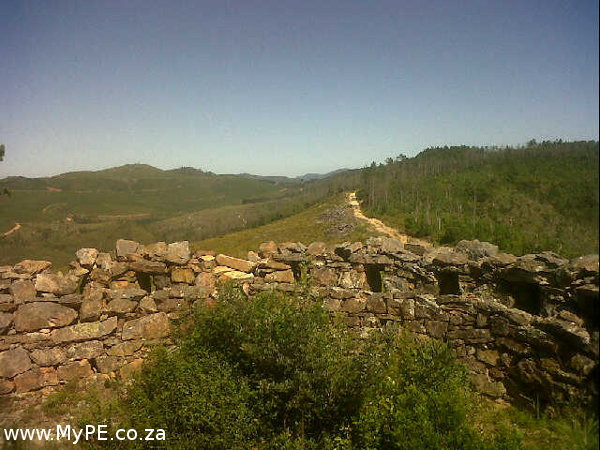
They give time to people like Stephen Moore who, on a mountain biking trip, found the time to photograph and share information about an interesting fort in the Longmore Forest overlooking the Lower van Stadens Gorge Dam.
Stephen found and shared the provenance of the fort after finding it’s history on the South African Military History Society web site. Incidentally, the SA Military History Society has an active Eastern Cape Branch that meets regularly
Richard Tomlinson, the author of the December 1995 Military History Journal explaining the history behind the Van Stadens Fort, wrote that during his travels in the Eastern Cape over past six years prior to 1995, he had come across the remains of several small stone fortifications erected by local Town Guards during the Second Anglo-Boer War (1899-1902) and felt that the existence of these interesting forts deserved to be recorded.
Tomlinson details the history behind three such sets of forts in the Knysna, Jansenville and Van Stadens Dam Forts. You can read about the Knysna and Jansenville Forts HERE.
One wonders if the builders and occupiers of the fort ever imagined that 112 years after their establishment that they would not only still be standing but also that someone would cycle past and photograph them using a telephone that he carried with him!
The history behind the Van Stadens Forts:
The provision of water to Port Elizabeth from the Van Stadens River, 35 km west of the town, was first mooted in 1862. This was an ongoing process of development, the Upper Van Stadens Dam with its intake weir, filter beds and caretaker’s cottage being completed in 1893. Construction continued early in 1899 on the provision of a pumphouse, with engine and pumping weir, about 3 km downstream from the Upper Dam complex.(1)
Despite its enthusiastic formation in February 1900 and regular drills in the Feather Market Hall, the interest of the Port Elizabeth Town Guard flagged during the year. However, the activity of Boer commandos in the Colony soon precipitated action there, as it did in other centres. At a special parade on 14 January 1901, Lt-Col E J K Priestly, Base Commandant in Port Elizabeth, called for volunteers to form another battalion, to raise a mounted company and to guard the waterworks at Van Stadens.
The volunteers for the latter duty numbered 3 officers, 8 non-commissioned officers, 86 privates, and 2 buglers. Four days later, the wagon convoy taking ammunition and baggage left Market Square with an escort of two NCOs and ten troopers, while the main body of the Guard was transported by rail to Uitenhage and then marched 24 km to the Upper Van Stadens Dam.
The Guard was divided into two, one party to protect the pumphouse and the other, the dam. The men remained at the dam for three months, building two small forts in the hills to the west and south-west. They returned to Port Elizabeth on 14 April, with the exception of two officers, a sergeant and twelve mounted men who had volunteered to stay behind. It is believed that the returnees were replaced by British troops of the 3rd Battalion Loyal North Lancashire Regiment, which had landed in South Africa on 30 March 1901 and had its headquarters in Port Elizabeth.(2) Although it is not known how long the forts and waterworks were garrisoned, the 3rd Bn Loyal North Lancashire Regiment returned to England in February 1902(3) and the Town Guard was disbanded in October of that year, five months after the end of the war.(4)
Similar in construction to the Jansenville Fort, the two Van Stadens forts have unmortared stone walls about 2 m high, although the tapered loopholes occur at only one level.
The Upper Fort is circular in plan with an external diameter of about 10 metres. In addition to an internal wall offset beneath the loopholes, it has an external batter (or slope) to the wall. The entrance on the south side is covered on the outside by a freestanding length of loop-holed screen wall. A paved walkway or firing step, 1 200 mm wide and 150 mm high, runs around the inside of the circular wall. Apart from a collapsed section of wall about 3 metres long on the west side, the fort is complete.
The Lower Fort is in the shape of a parallelogram with rounded ends and measures about 7,5 x 17 metres. The walls are 700 mm thick and also have an external batter, but no internal offset. The entrance, situated in the middle of the east wall, is protected by a projecting right-angled wall similar to the Jansenville Fort. An interesting feature is a 1 m wide and 1,2 m deep trench, which begins outside the entrance to the fort and extends 22 metres down the hill to the east to join another, U-shaped, trench at right angles; this was undoubtedly designed to provide hidden access to the fort, as this slope of the hill faces directly onto the Upper Dam and the caretaker’s cottage. Apart from a 10-metre section of the west wall and a 3-metre length at the south-east corner, which have collapsed to below the level of the loopholes, the fort is reasonably complete.
References:
- T S Bodill, ‘History of the Port Elizabeth Water Supply’ in Looking Back, Journal of the Historical Society of Port Elizabeth, Part One in Volume 21, pp 128-131; and Parts Two, Three and Four in Volume 22, pp 17-24, pp 43-7, and pp 79-81 respectively.
- A Porter, ‘The Port Elizabeth Town Guard’ in Looking Back, Journal of the Historical Society of Port Elizabeth, Volume 17, pp 122-4; The History of the Loyal North Lancashire Regiment, Chapter XXVI, pp 379-80.
- The History of the Loyal North Lancashire Regiment, Chapter XXVI, pp 379-80.
- Porter, ‘The Port Elizabeth Town Guard’, pp 122-4.


Alan Straton
Latest posts by Alan Straton (see all)
- Designer Pool Covers Urges South African Pool Owners to Prepare for Summer Weather Conditions - 5 October 2026
- How to Turn ‘Reactions’ on Linkedin Into ‘Comments’ - 4 October 2026
- Samro brings senior Leadership team to Cape Town for #MEX26 - 2 October 2026
- Serious Social Investing Conference 2026 Focuses on Doing More With Less - 2 October 2026
- How AI Is Helping Detect Eye Problems Earlier - 2 October 2026
