
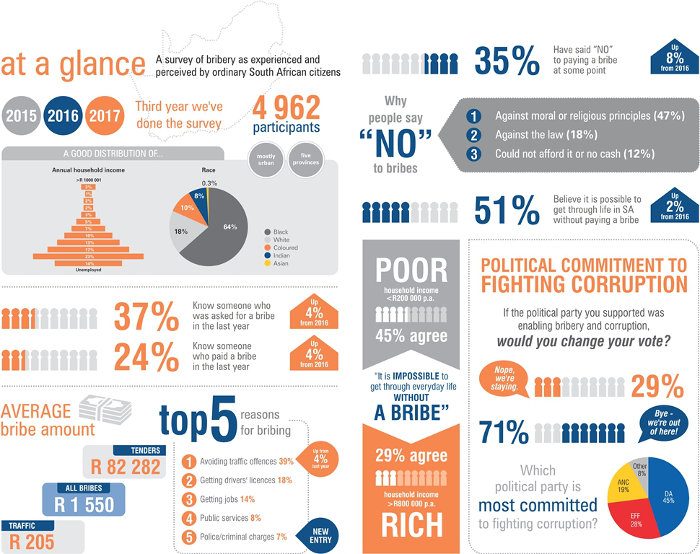
The Ethic’s Institute’s Citizen’s Bribery Survey for 2017 has concluded that 7 out of 10 people would change their vote if they perceived their political party to be enabling bribery and corruption
Key findings of the 2017 South African Citizens’ Bribery Survey include:
- 37% of respondents know someone who was has been asked for a bribe in the past year (up 4% from 2016);
- The largest proportion of bribes (57%) are traffic related (up 6% from 2016);
- 14% of bribes are for jobs (down 4% from 2016);
- The average bribe amount is R1550, down by R650 from last year;
- The average bribe amount for a tender is R82 282;
- 35% of respondents have said “no” to paying a bribe in the past (up 8% from 2016); and
- Almost half (47%) of all people who have said “no” to bribes did so because of moral or religious reasons.
Now in its third year, the Citizens’ Bribery Survey is conducted annually by The Ethics Institute with the aim of understanding how ordinary South Africans perceive and experience bribery in their daily lives, and the socio-economic factors that influence bribery.
There were 4 962 respondents to the survey, which was conducted in Gauteng, KwaZulu-Natal, Western Cape, Limpopo and the Free State. Respondents were asked questions such as “How frequently are people asked for bribes? What are these bribes for? Which political party is most committed to combating corruption? If the political party you supported was enabling bribery and corruption, would you change your vote?”
New to the survey this year is a section on leadership. Professor Deon Rossouw, CEO of The Ethics Institute, says, “In our work with individuals and organisations in recent years, we have noticed an increasingly prominent narrative about leaders’ impact on the ethical environment, and specifically that people look to leaders to role model desirable behaviour. By including a section on leadership we were able to get a clearer understanding of citizens’ actual views on this important subject.”
The survey results show that 71% of respondents (7 out of 10) would change their vote if the political party they support was enabling corruption. Respondents also perceive the DA as the party that is most committed to combatting corruption (45%), followed by the EFF (28%) and the ANC (19%). Julius Malema and Mmusi Maimane were identified as the leaders most committed to combating corruption, with 18% and 17% of mentions respectively. No other leader got more than 10% of mentions.
According to survey respondents, the top five most common types of bribes are to avoid traffic offences (39%); to obtain a driver’s licence (18%); to secure a job (14%); to receive a public service (8%); and to avoid police or criminal charges (7%). This is the first time that bribes for police matters and criminal charges are in the top five. Avoiding traffic offences has been the most common type of bribe for three years in a row.
Massmart Anti-Corruption Compliance Executive, Johann Stander says, “At Massmart we are committed to doing business the right way and have invested significantly in promoting a culture of integrity within our organisation, hence our sponsorship of the South African Citizens’ Bribery Survey.”
The survey also compared, among other things, how the different income groups experience bribery. The results show that 45% of lower-income respondents (with annual household income of less than R200 000) thought it was impossible to navigate daily life without paying a bribe, while only 29% of the higher-income group (with annual household income of more than R800 000) believe the same. Bribery for drivers’ licences was 13% higher for lower-income respondents, while higher-income respondents experienced 21% more bribery related to avoiding traffic offences.
Professor Rossouw says, “The data suggests that the poor are more impacted by bribery than the rich, which is consistent with previous years’ findings. It seems that the dividing line is at a household income of R400 000 per year. Those below that line find it significantly more difficult to avoid paying bribes. Bribes for jobs, social grants and basic services are likely to affect this segment more.”


Alan Straton
Latest posts by Alan Straton (see all)
- TrueTech Readies South African Homes and Offices for a Year-End Tech Upgrade - 2 November 2026
- Now I Understand Why Investing Is Not for the Faint of Heart - 2 November 2026
- LED-Lightbox Rental in Midrand Delivers, Sets up and Collects Light-up Letters, Numbers and Neon-Style Signs for Gauteng Weddings and Year-End Functions - 2 November 2026
- Record Numbers Walk in Step With Those Affected by Cancer - 2 November 2026
- The Carpet Stain Remover That Leaves a Bigger Problem - 2 November 2026
