
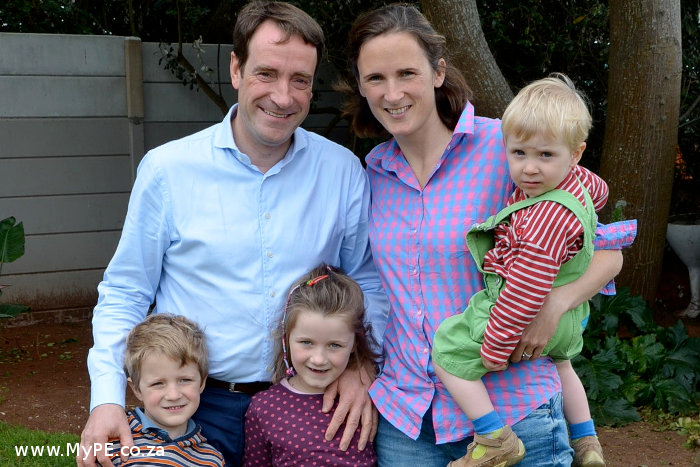
The married couple, who arrived in Port Elizabeth with their three young children last month (October), will be working closely with Nelson Mandela Metropolitan University (NMMU) and other African universities on various research projects until they return to Germany at the end of March next year.
Siebenhüner, 45, a professor of ecological economics and vice-president for graduate education and quality management at the University of Oldenburg, is working with NMMU to investigate how world environmental events, such as climate change, impact on social systems.
Meanwhile Von Möllendorff, 37, the academic coordinator of the Centre of Excellence for Educational Research Methods and Management in East and South Africa (CERM-ESA), is here to cement a collaborative project between Oldenburg University, NMMU and Moi University in Kenya, focusing specifically on diversity in the classroom.
One area of her work in this project – which will open exchange opportunities for masters and doctoral students – is to determine how well-prepared teachers are for diversity in the classroom. She said, like South Africa, Kenya had many different ethnic groups – and the education system had to take these into account. “Teachers have a role in society to prepare youngsters to deal with diversity, and to be aware of the dangers of ethnic and inter-cultural clashes. We want to see how teachers are instilling a type of education that prevents diversity-related clashes.”
She said Germany was experiencing a growing number of refugees and asylum seekers from Russia, Turkey and Arab countries. “German, the [sole] language for education, is a problem for them.”
Von Möllendorff first visited NMMU as an inter-cultural education student in 2002, conducting research on curriculum development, and has been involved in collaboration in various capacities between the two universities ever since, all funded by the German Academic Exchange Service (DAAD), and mostly focusing on teacher education.
“I’m interested in different perspectives; in getting different people together to work out different solutions and perspectives for the future, to make the world better through education, and touch learners’ lives.”
In the late 2000s, when DAAD extended these activities from education to other fields, such as sustainable sciences, renewable energy and marine and coastal issues, Siebenhüner started developing strong research ties with NMMU, initially through joint renewable energy projects, which are still ongoing.
For this visit, he is focussing specifically on collaborative environmental projects. “I am working on combining ecological and social science perspectives … It is interesting to see what climate change will bring, for example, reduced rainfall, increased wind and temperatures, and how the social systems can react to it … It’s important to link natural science with social science … We hardly have any ecosystems left that are devoid of human influence.”
As NMMU sets out to establish itself as the hub of South Africa’s marine and coastal research, it can also draw from Oldenburg University’s 30 years of experience in this area. “One of the goals of this visit is also to discuss future [joint] activities in marine and coastal research,” said Siebenhüner.
He is also looking into possible research opportunities with NMMU’s George Campus, regarding food security and organic farming.
“Science is not just about understanding how things are but how to develop solutions for improving our interactions with natural systems.”


Alan Straton
Latest posts by Alan Straton (see all)
- Dr. T Fletcher Calls for Glaucoma Checks Before the Year Closes - 13 November 2026
- PaperTrail Adds Scout AI Search to Its Document Management Software - 12 November 2026
- Wavepool Surf Tour Launches Ride the Future 2026. Let’s Go! - 12 November 2026
- Online Catalogue With Shelly Smart Automation Range and Bespoke 3D-Printed Installer Accessories - 12 November 2026
- SalePrice Workshop Outlet Publishes A, B and C Grades for Ex-Demo Machines - 12 November 2026
