
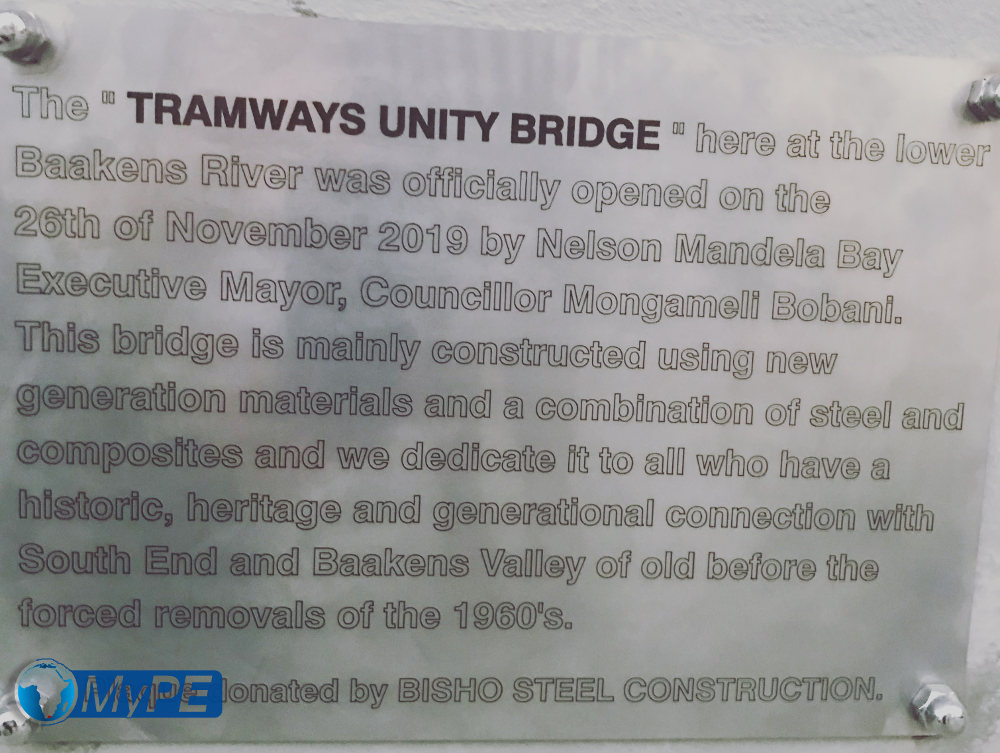
The plaque on the Tramways Unity Bridge reads:
The “Tramways Unity Bridge” here at the lower Baakens River was offically opened on the 26th of November 2019 by Nelson Mandela Bay Executive Mayor, Councillor Mongameli Bobani. This bridge is mainly constructed using new generation materials and a combination of steel and composites and we dedicate it to all who have a historic, heritage and generational connection with South End and Baakens Valley of old before the forced removals of the 1960’s.
Plaque donated by Bisho Steel Construction.
The first South End removals under the Group Areas Act of 1950 began in 1968 and were mostly complete by 1973.
The Group Areas Act was the title of three acts of the Parliament of South Africa enacted under the hand of the apartheid government’s D.F. Malan of the National Party of South Africa. The acts assigned racial groups to different residential and business sections in urban areas in a system of urban apartheid. An effect of the law was to exclude non-Whites from living in the most developed areas, which were restricted to Whites. It caused many non-Whites to have to commute large distances from their homes in order to be able to work. The law led to non-Whites being forcibly removed for living in the “wrong” areas. The non-white majority were given much smaller areas to live in than the white minority who owned most of the country. Pass Laws required that non-Whites carry pass books, and later ‘reference books’ (collquially referred to as a ‘dompas’) to enter the ‘white’ parts of the country.
The first Group Areas Act, the Group Areas Act, 1950 was promulgated on 7 July 1950, and it was implemented over a period of several years. It was amended by Parliament in 1952, 1955 (twice), 1956 and 1957. Later in 1957 it was repealed and re-enacted in consolidated form as the Group Areas Act, 1957, which was amended in 1961, 1962, and 1965. In 1966 this version was in turn repealed and re-enacted as the Group Areas Act, 1966, which was subsequently amended in 1969, 1972, 1974, 1975, 1977, 1978, 1979, 1982, and 1984. It was repealed (along with many other discriminatory laws) on 30 June 1991 by the Abolition of Racially Based Land Measures Act, 1991.
After the the Nationalist Party came to power in 1948, the City of Port Elizabeth underwent a number of extensive changes in its land use patterns through the implementation of racially-motivated segregationist legislation. This included the separation of citizens into so-called ‘White’, ‘Bantu’, ‘Coloured’ and ‘Asian’ suburbs. Apartheid legislation lay down that such areas should be set apart by buffer strips at least 100m wide. These often coincided with existing physical barriers. As a result, industrial areas such as Struandale, and natural features such as the Swartkops River and its escarpment, and pieces of empty land such as Parsonsvlei, were used to define the parameters of the city’s suburbs.
The people of South End were not the only ones affected by these new laws. Areas such as Fairview, Bethelsdorp, Central/Hill, Korsten, Salisbury Park, North End, Sidwell and Neave Township where also ‘disqualified’ in terms of the Group Areas Act of 1957 due to their multi-cultural communities. As a result, homes and businesses in these areas were also decimated by apartheid proponents at the time.
The Africans were sent to the townships on the boundaries of the city. They could choose a home in the areas known as New Brighton, Kwazakele, Zwide and Swartkops. Coloureds were given homes in Korsten, Gelvandale, Bethelsdorp, Booysens Park and Bloemendal. Indians were sent to Malabar, while Chinese people were told to move to Kabega Park. What was once a proud, multi-cultural community was completely shattered and it has never quite recovered since then. Even today, people of these different ethnic groups are still largely concentrated in the areas in which they were sent to live during the Apartheid regime, making true re-integration and harmony difficult at best.
Although the Group Areas Act was repealed in 1991, the component elements of apartheid planning have been indelibly etched into the urban fabric of Port Elizabeth. It is probable that their effects will continue to be felt for many years to come, and that their traces may never be entirely expunged from the city’s map.


Alan Straton
Latest posts by Alan Straton (see all)
- South African Artist MARTHINUS Releases Debut Single - 6 November 2026
- MARTHINUS Releases Heartfelt Debut ‘i miss us not trying’ - 6 November 2026
- LaserWeeder Hire Runs Laser Units for SA Vegetable Growers - 6 November 2026
- HandPrinter Art Runs Linocut Workshops and Beginner Kits - 6 November 2026
- Feature Equipment Adds AM.CO.ZA Tooling and Laser Spares Shelf - 6 November 2026
