
This week I got the opportunity to bob on the briny with Port Elizabeth’s Shark Research Unit headed up by Dr Malcolm Smale.
Malcolm and his merry gang have been catching and tagging sharks for while now as part of a process to better understand these magnificent denizens of the deep. As part of their research they have a custom made ‘stretcher’ that hooks onto the starboard side of a super duck and acts as a platform for any sharks that they may catch off our coastline.
These sharks are subjected to a battery of tests and have a tracking tag inserted before they are released back into the sea.
Our targeted section of coastline was the area offshore of Sidon Street, North End.
With NSRI’s intrepid ‘Maggot’ at the helm of Blue Pearl we found four likely pinnacles off of the old North End beach that showed lots of activity on the fish finder.
Malcolm and Michelle with the assistance of two students baited their traps and lowered them into the water. Our target was Ragged Tooth Sharks.
And we waited.
Then we checked the four hooks and re-baited where necessary.
And we waited.
Then we checked all the hooks and re-baited where necessary.
And we waited ………… yup – you get the picture, we waited for close on 6 hours and not a nibble. At the same time Malcolm had his telemetry reader in the water – this apparatus will ‘hear’ any tag transponder, previously inserted into a shark, that comes within 500 metres of the boat – not a peep the whole day.
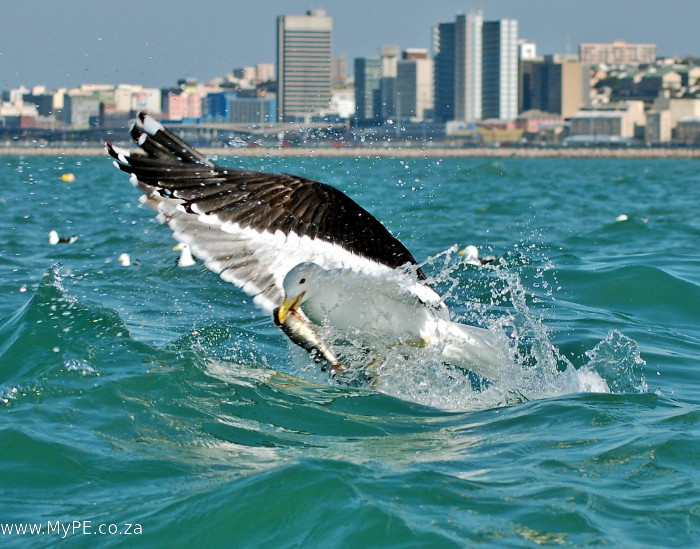
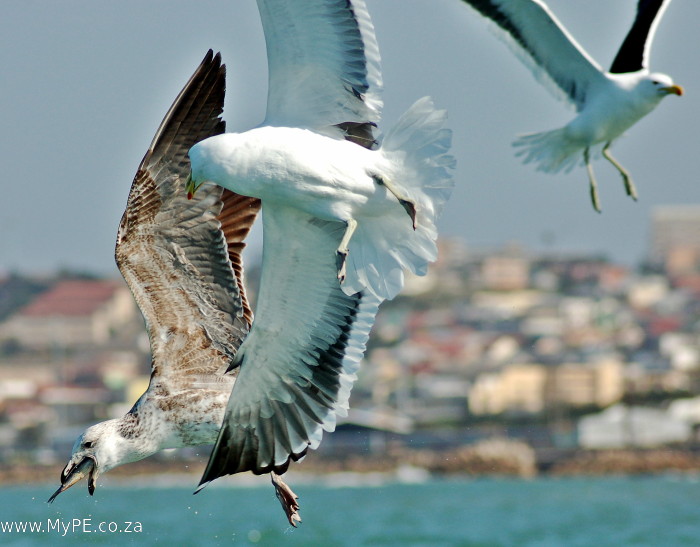
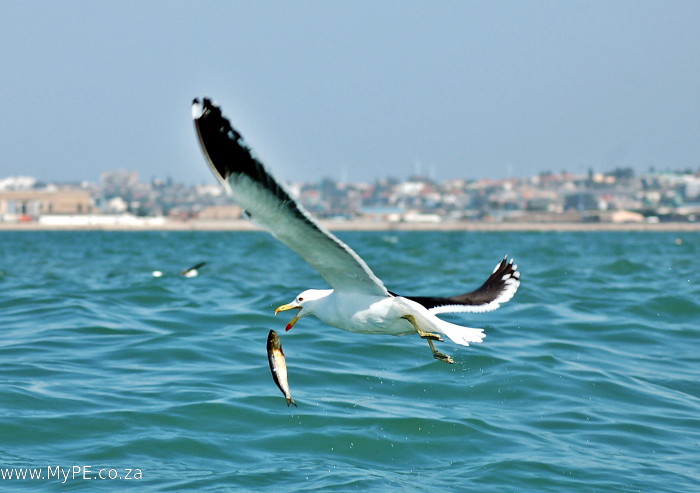
Before we upped anchor and left the area the seagulls scored a luck and got to squabble over all the leftover bait – see images below.
Conclusion: I presume that on the day the sharks had packed up and gone on Shark Conference leaving no sharks in the bay.
According to our scientists though, there are 62 sharks in the bay – somehow I suspect that that is just a Hitchikers Guide to the Galaxy number, though.
Stay tuned – we will get images and video when they go out again.
Malcom Smale and Michelle Bradshaw’s study on the movement patterns of white sharks (Carcharodon carcharias) in Algoa Bay saw a total of 59 white sharks fitted with acoustic V16 tags between March and November 2012 and early conclusions were; “Preliminary data indicates an inshore residency at selected beaches in the summer months and an offshore distribution in the winter around the Bird Island group, which is home to a breeding colony of Cape fur seals Arctocephalus pusillus pusillus. Understanding the movement and residency patterns of white sharks is critical for their management and conservation in Algoa Bay. It also provides important information which can be used to reduce the chance of encounters between bathers and sharks.”


Alan Straton
Latest posts by Alan Straton (see all)
- Just Some Tools Packs Six Clamps and a Pressure Card for Highveld Glue-Ups - 26 November 2026
- Phase Converters Sets Out How to Size a Rotary Unit From the Motor Plate - 26 November 2026
- Set-IP Puts Trade Mark Renewal Dates on a One-Page Wall Sheet for Makers - 26 November 2026
- Colour Planet Adds Catalogue Printing to Its Pinetown Litho Line - 26 November 2026
- From the Boot of a Car to Comrades Gold: 32GI, the South African Sports Nutrition Brand for Everyone - 25 November 2026
