
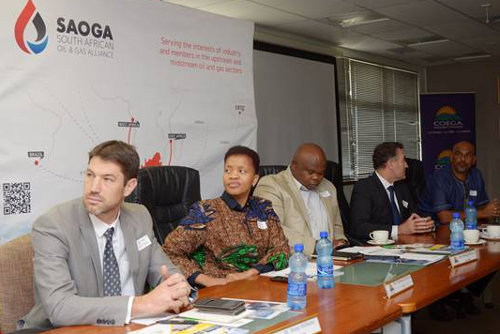
Port Elizabeth: Following the announcement by the Minister of Energy in July 2019 about Coega being the preferred location for the Liquefied Natural Gas (LNG) to Power Plant, today the Coega Development Corporation (CDC) hosted a stakeholder networking session in partnership with South African Oil & Gas Alliance (SAOGA), Petro Marine and Dormac to position the Eastern Cape as the hub for gas resources in South Africa, especially LNG.
Honourable MEC for DEDEAT, Mr. Mlungisi Mvoko in his keynote address highlighted the importance of LNG for creating socio-economic growth in terms of jobs and SMME development, to name but a few. “The Eastern Cape has the potential to create a thriving, inclusive, and a job-rich oil and gas sector. By catalyzing a gas industry alone, South Africa could see an additional 50 000 economy wide job-opportunities over 25 years, which in turn would stimulate a GDP growth of at least 1 percent from year 10”, he emphasized.
Amongst the delegates who attended the networking session was Alistair McMaster, Director of Sustainable Energy for the Department of Economic Development, Environmental Affairs and Tourism; the Managing Director of Dormac Marine and Engineering, Chris Sparg; CDC Energy Sector Manager, Sandisiwe Ncemane; as well as representatives from SAOGA: Niall Kramer, Director of SAOGA and the chairman of the SAOGA Board, Mthozami Xiphu.
The key opportunities for gas in the Eastern Cape highlighted during the discussions include the opportunity for the industry to convert natural gas as a source of fuel and feedstock to ultimately unlock new industries in the industrialization value chain.
The crucial value of the integration between the Port of Ngqura and the CDC in realizing the importation of Liquefied Natural Gas is amongst the key driving stimulus in ensuring that the first step in unlocking a gas driven economy has been met. Coega together with the Port Ngqura embody an optimal geographic location to support gas markets both to the East and West coasts of South Africa. Furthermore, Coega offers a strong integrated logistics corridor for the delivery of gas to the hinterland.
“Coega has a proven track record in delivering mega-projects, for example DEDISA Peaking Power Plant was built on-time, on budget, and within the required quality parameters, and thus demonstrating our eagerness to advance readiness for SA’s first LNG importation with the assistance of relevant stakeholders,” said CDC Energy Sector Manager, Sandisiwe Ncemane.
Coega has been undertaking extensive technical readiness work for up to 4500 MW of Gas to Power. The EC Government has supported this programme with a detailed plan for a provincial gas economy, including market analysis, logistics studies, third party (small-scale) gas localization for SMMEs and Black Industrialists, and natural gas research and decision support.
“We are at the cusp of realising a thriving gas future for the Eastern Cape and indeed South Africa. We can only unlock this potential through meaningful collaboration among all relevant public and private sector partners. We have to build the Eastern Cape we want,” concluded the Hon MEC Mlungisi Mvoko.
EDITOR: And the Reason Why?
Algoa Bay has become an important bunkering location.
Many ships anchor in the bay, receive cargo instructions, refuel and continue plying the oceans.
The attendant concerns over oil spills and pollution was highlighted recently when an oil spill resulted in many penguins and sea-birds being oiled.
At the recent feedback session on the Bunkering SAMSA said that they were confident that LNG Fuel would be replacing Marine Fuel and that this would then be a far more palatable fuel resource for the bunkering stations in the bay.
Reasons:
- LNG is a cost competitive and cleaner marine fuel.
- Liquefied Natural Gas (LNG) helps reduce local emissions, as it is virtually sulphur free and can significantly reduce particulates and NOx emissions – thus meeting the current and expected future regulatory requirements.
- LNG will help reduce greenhouse gas emissions.
The big oil companies are already investing in supply infrastructure in key global ports to serve marine customers who have chosen LNG as the cleaner fuel choice.
LNG is Widely Available:
LNG is a global commodity with 20 countries exporting to 35 importing countries. It accounts for approximately 10% of global gas consumption and represents 32% of internationally-traded natural gas. Market penetration is increasing in areas such as Latin America, the Middle East, Africa and parts of south-east Asia, while around 20 countries have plans for import terminals, facilitated by new technologies such as floating storage and regasification units (FSRUs).
The LNG market is currently heading into oversupply, with approximately 150 million tonnes per annum (Mtpa) of new export capacity due to come on line between 2015 and 2020 – a 50% increase over current capacity.
New liquefaction projects in Australia, Russia, Malaysia and Indonesia have been joined by a rush of LNG export projects in the US, stimulated by extensive shale gas developments.
There have also been structural changes in the LNG market. The expansion of the LNG trade has been accompanied by an increase in the number and diversity of LNG players in the upstream sector. There is an increase of investment in LNG solutions for transportation and changes in the marketing and trading of LNG. Small to mid-scale LNG has taken off, increasing market penetration and servicing demand from power projects in areas not covered by power grids – from surface transportation, such as trucks and trains, and from the maritime sector. And resulting from the new entrants and the added competition, a more flexible approach to LNG contracting and pricing is emerging.


Alan Straton
Latest posts by Alan Straton (see all)
- The Countdown On – Mind Matters Is Taking Over Cape Town Before Taking the Conversation Global - 28 September 2026
- BurnesSEO Study Finds South African Small Businesses Invisible in AI Search Results - 28 September 2026
- BurnesSEO Study Finds South African Small Businesses Invisible in AI Search Results - 28 September 2026
- What Causes Petechiae? When Tiny Red Spots Could Be a Sign of Something Serious - 28 September 2026
- Why Digital Equity Is South Africa’s New Frontier for Women’s Empowerment – By Matebe Chisiza-Asukile and Natasha Mboyisa - 25 September 2026
