
Former Reserve Bank Governor Tito Mboweni has called on South Africa to get real on matters of the economy, employment, capital and corruption.
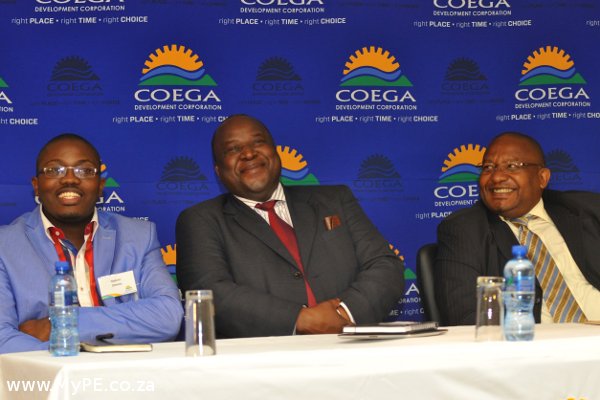
Mboweni was delivering his keynote address at the launch of the fourth edition of the Coega Development Corporation (CDC) Perspectives journal today.
“Be wary of any politician who comes to you to promise jobs. There are no jobs,” said Mboweni. “There has been a substantial change in the nature of the South African economy that we must accept and deal with.
“Despite the significant developments we have made, the problems have not gone away. In fact they have gotten worse. In my view we have reached the point where we require the most focused national attention to deal with [the problems]. We can’t be shy to approach other countries in the world that are experiencing a labour shortage and see if they can take some of our people.”
Mboweni was commenting on the declining share of the primary and secondary sectors of the economy – and the incumbent rise of the tertiary sector as major contributor to country’s gross domestic product (GDP).
“Therein lies our problem – the kind of skills required for the tertiary sector are not found amongst our people. Our education system is not producing, in the required numbers, the skills set needed for this bigger slice of the economy.”
He emphasised the urgent need for recommitment to education.
“We need a larger number of people with structured post-matric qualifications. It is clear from where I sit that the problem is not money. The budget for education is substantial enough for us to achieve our objectives. [The problem] is in the content and people’s attitudes.”
Corruption and capital were also on Mboweni’s agenda. He said that policy and lawmakers must know that the South African constitution was the supreme law of the country and no politician was above this document.
“People who draft laws sometimes forget that they might have to one day stand in front of the court and be judged by the same laws,” said the AngloGold Ashanti Chairman. “Any benefit that is not due to you is corruption.”
Mboweni called for people to acknowledge that capital is not “white monopoly capital” anymore and the nature of South African capital has shifted to embrace global and more diverse participation.
Capital nowadays includes pension funds from government, hedge funds and other investment capital from various groupings including labour unions, making it difficult to pin the origin of capital as exclusively white.
One of the contributions Perspectives can make, is to document the dynamics and changes in das kapital, said Mboweni.
Perspectives was initiated four years ago by the CDC in collaboration with Nelson Mandela Metropolitan University (NMMU) and seeks to stimulate debate among professionals, specialists and young academics on issues of industrial and economic development.
“The publication further provides a platform for engagement with the other social, political and economic policy practitioners, in the belief that these exchanges of ideas will improve opportunities for the Eastern Cape as well as for understanding the issues, challenges and observations made by officials and academics,” said Monde Mawasha, CDC executive manager of strategic solutions and member of the Perspectives editorial team. “This year’s edition provides viewpoints on real economy issues amidst an uneven recovery.”
The journal included submissions from both leading experts, economists and emerging thought leaders and academics and included the likes of Njabulo Sithebe, Ongama Mtimka, Professor Vlad Kaczynski, Professor Richard Haines, Idriss Mouchili, Ed Richardson, Amy Shelver, Vukani Nkasa, Semiyou Rafiou, David Lefutso, Thembinkosi Semwayo, Mphathu Nyewe, Siphamandla Gumbi, Lonwabo Dlepu and Nonzamo Kolo.
Haines, also on the editorial team, said this volume addresses a number of significant national, regional and international developments.
“Primarily the journal focuses on strategic national policy interventions and efforts. These include the National Growth and Development Plan, the Draft Defence Review, the increased policy and planning interest in the South African marine and maritime economy, and the relationship between increased investment in the national rail network. Other issues covered include the consideration of the implications of pending legislation on Special Economic Zones, and a revaluation of wage labour with special reference to 21st century South Africa.”
Haines added that the topics covered would have resonance in the policy circles of South Africa. “The Eastern Cape is showing the way with a focus and reflection on issues which augurs well for the future of young intellectual talent which is being nourished and accumulated by the CDC.”
He added that Perspectives played a major role in stimulating collaborative social capital in terms of analytics and research capacity.
This was endorsed by Mboweni, who closed the proceedings on a positive note saying the “ingredients for success in South Africa are there, we must just harness all the energy we have” by reviving agriculture and continuing to improve banking, manufacturing and mining.
He also indicated that overall the living standards measure (LSM) of South Africans had improved between 1994 and 2010, showing a significant growth of about 83% increase of people entering LSMs five to ten over that period.


Alan Straton
Latest posts by Alan Straton (see all)
- South African Artist MARTHINUS Releases Debut Single - 6 November 2026
- MARTHINUS Releases Heartfelt Debut ‘i miss us not trying’ - 6 November 2026
- LaserWeeder Hire Runs Laser Units for SA Vegetable Growers - 6 November 2026
- HandPrinter Art Runs Linocut Workshops and Beginner Kits - 6 November 2026
- Feature Equipment Adds AM.CO.ZA Tooling and Laser Spares Shelf - 6 November 2026
