
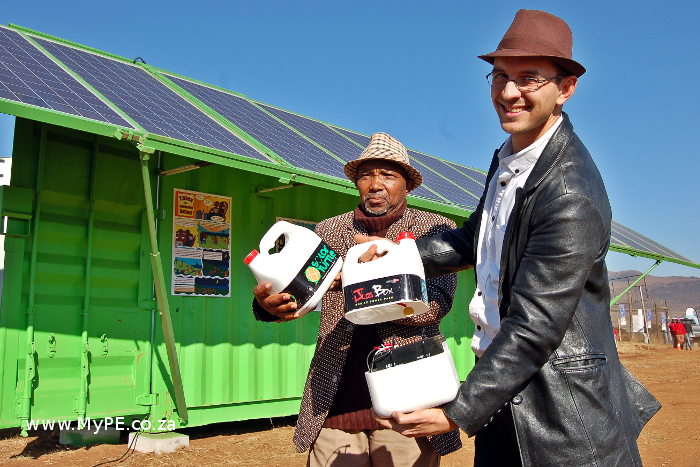
The first Solar Turtle franchisee in the Cofimvaba District, Andile Dyantyi, with James van der Walt from Solar Turtle.
As a young businessman with a social conscience I took one of my first enterprises into the townships during the late 1980’s. The philosophy was a simple one – to provide a service to township business equal to the level of service provided to business in the suburbs.
Sometimes that aim met with challenges centred around something that all suburban dwellers took for granted – the lack of electricity.
Many businesses in the townships had to run on paraffin and battery power and, without refrigeration, were unable to supply frozen goods – not too much of a problem when clients did not have power either, though.
This state of affairs led to many non-traditional businesses opening up in areas of the township that had access to electricity and running water, like battery charging stations and ice makers who thrived alongside paraffin wholesalers with trucks delivering to tanks set up in the back yards of shops on nearly every corner.
The lack of power and refrigeration also forced shoppers to do a daily shop for their protein – good for business but debilitating for consumers.
I remember one particular business man who had a bottle store, pub, shop, battery charging and ice making business all on one huge premises. His largely illegal electricity connections and unmetered water connection contributed in no small part to the heaps of cash lying around his sleeping quarters on the 1st floor overlooking his empire. To this day I wonder if our municipality has discovered the illegal water connection (jointed and dug under the road) that this man made to the main water supply that ran across the road from his premises!
It is shattering to realise that what I observed in 1985 is still true in many parts of South Africa today. Many communities are still without access to the grid and, with the current load shedding woes gripping our country, those without are once again being shoved to the back of the queue. More so in rural districts where the cost to bring electricity to a few scattered settlements is prohibitive given the centralised supply chain set up by Eskom.
On a recent trip to Cofimvaba to attend the official unveiling of three hydrogen fuel cells in the Cofimvaba district, with hydrogen canisters and hydrogen supplied for the next three years by Air Products Port Elizabeth, I met up with another young businessman with a social conscience – James van der Walt from Ugesi Gold with his Solar Turtle which won the 2014 Climate Solver award from the WWF.
A SolarTurtle is a small or micro for-profit business operating close to or inside a poor or rural community to provide the same services as a standard utility provider. Unlike standard utilities, SolarTurtles rely on renewable energy (RE) to generate the electricity sold to their customers. In this regard the turtles are very similar to many proposed off-grid providers – they do not need access to the national grid, nor do they rely on large scale generation capacity located far from the site of consumption. What differentiates SolarTurtles from other off-grid providers is its customer focus and capacity scale. SolarTurtles predominantly operate in less privileged communities, typically in rural areas, and sell electricity on a small scale. Standard providers have trouble servicing these communities for various reasons. Firstly, these communities are typically far from the national grid. Secondly, the households in these areas are often scattered far apart, sometimes over difficult terrain. Thirdly, these communities are poor, which makes it difficult to finance the infrastructure required to connect them to the grid. Fourthly, cable theft is a massive problem in South Africa. All these reasons make standard cable transmission infrastructure impractical. However this is where the SolarTurtle is unique – instead of electrical cables connecting households to the grid, they are powered by battery packs charged at the turtle then carried home.
Solar Turtle says that switching from paraffin to solar power can save households up to 75% on their lighting bill.
Solar Turtle’s aim is to service 100 villages by 2024 which, according to James’ estimate, would provide 720 000 people with access to clean energy and save 7000 tonnes of carbon dioxide by avoiding kerosene emissions.


Alan Straton
Latest posts by Alan Straton (see all)
- CDC: The ONLY Number You Require (For Now) - 30 September 2026
- Soccer Laduma Sets Out a Bonus and Deposit Guide for SA Punters This Spring - 30 September 2026
- Alu Door & Window Centre Readies Mpumalanga Homes for the Summer Storms - 30 September 2026
- If AI Can Now Do the Work, Who Checks the Work? - 29 September 2026
- UK Music Titans Marc Marot & Jeremy Marsh Join #MEX26 in Cape Town - 29 September 2026
