
Port Elizabeth’s coastline is home to living fossils that are credited with creating the living conditions in which animal life could thrive. The first marine tufa stromalites along the South African coast were first described in the early 2000’s. Ongoing research indicates that the recent discovery of numerous and closely spaced living stromatolites on the coastline south of Port Elizabeth ‘appears to be extraordinary’.
The Wikipedia definition of Stromatolites or stromatoliths is; “Layered bio-chemical accretionary structures formed in shallow water by the trapping, binding and cementation of sedimentary grains by biofilms (microbial mats) of microorganisms, especially cyanobacteria. Stromatolites provide ancient records of life on Earth by fossil remains which might date from more than 3.5 billion years ago.”
A number of these critical and ancient fossils have been identified along Port Elizabeth’s wild side coastline and are currently being studied by the NMMU Shallow Water Ecosystems Faculty. Basically these ancient one celled bacteria were responsible for the creation of the first reefs.
These bacteria – Cyanobacteria – were also ultimately responsible for one of the most important “global changes” that the Earth has undergone. Being photosynthetic, cyanobacteria (blue-green algae) produce oxygen as a by-product. Photosynthesis is the only major source of free oxygen gas in the atmosphere. As stromatolites became more common 2.5 billion years ago, they gradually changed the Earth’s atmosphere from a carbon dioxide-rich mixture to the present-day oxygen-rich atmosphere. This major change paved the way for the next evolutionary step, the appearance of life based on the eukaryotic cell (cell with a nucleus).
It has been speculated that bacteria found in these organisms were responsible for increasing the level of oxygen in the atmosphere on Earth from much less than 1% to the present day level of 21%. lt was through the oxygen generating activity of stromatolites that other animal life on Earth was able to develop.
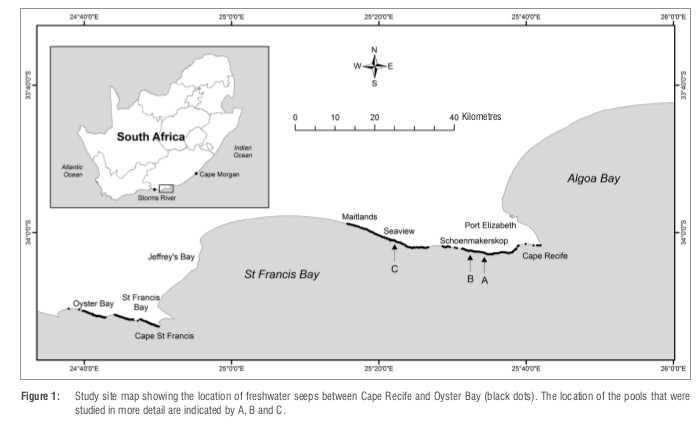
A 2014 paper published by Prof Renzo Perissinotto, the NMMU Faculty of Science Research Chair in Shallow Water Ecosystems*, highlights the occurrence of extensive fields of actively calcifying stromatolites. These stromatolites have been recorded at regular distances along a 200-km stretch of coastline, from Cape Recife in the east to the Storms River mouth in the west, with the highest density found between Schoenmakerskop and the Maitland River mouth.
My thanks to Schalk du Plooy, a PhD Botany Candidate in the DST/NRF Research Chair in Shallow Water Ecosystems at NMMU for alerting me to this wonder of nature that we have all walked past on a number of occasions and never taken notice of.
In the paper Prof Perissinotto says; “All active stromatolites are associated with freshwater seepage streams flowing from the dune cordon, which form rimstone dams and other accretions capable of retaining water in the supratidal platform. Resulting pools can reach a maximum depth of about 1m and constitute a unique ecosystem in which freshwater and marine organisms alternate their dominance in response to vertical mixing and the balance between freshwater versus marine inflow. Although the factors controlling stromatolite growth are yet to be determined, nitrogen appears to be supplied mainly via the dune seeps. The epibenthic algal community within stromatolite pools is generally co-dominated by cyanobacteria and chlorophytes, with minimal diatom contribution.”
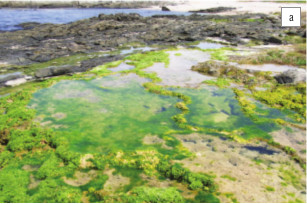
Have you ever wandered amongst the rock pools and noticed what looked like a freshwater crab near the surface? Chances are that you were gazing into one of these rimstone dams containing fresh water and if you looked deeper down you would have seen a sea crab at the bottom where the salinity is higher.
Indications are very high of large numbers of these stromatolie formed rimstone dams are found in abundance along the coast to Woody Cape and in the recently formed Sanparks Marine Protected Area. It has been a long known fact that one can walk along the seashore between Woody Cape and Bird Island and find fresh water to drink. The Alexandria dunefield is the largest dunefield in the southern hemisphere stretching over 50km of coastline and over 15 000 hectares.
The dunefield and unspoilt coastline of mainly sandy beaches is flanked by Southern Coastal Forest with species such as coast coral trees, real yellowwoods, white stinkwoods and knobthorns in abundance – no development creates perfect conditions for the seepage of fresh uncontaminated water through the dunes and into the sea. In turn creating ideal conditions for large numbers of stromatolite pools all along the shoreline.
Perissinotto notes; “Most extant tufa stromatolite deposits around the world are already protected. Those occurring on the southwest coast of Western Australia, resembling most closely the South African type, are registered as ‘Threatened Ecological Communities’ with the status of endangered ecosystems. Special ‘Ecological Water Requirements’ have been allocated to them, in order to secure their long-term sustainability. Because of threats of residential encroachment, groundwater extraction, coastal development and invasion by alien species, it would be advisable for South Africa to follow the Australian example and place all tufa stromatolite formations under statutory protection.”
* Perissinotto R, Bornman TG, Steyn P-P, Miranda NAF, Dorrington RA, Matcher GF, et al. Tufa stromatolite ecosystems on the South African south coast. S Afr J Sci. 2014;110(9/10), Art. #2014-0011, 8 pages. http://dx.doi.org/10.1590/sajs.2014/20140011
References:
- Wikipedia (Stromatolite)
- Fossil Museum
- Stromatolites – Living Representatives of the Most Ancient Organisms
- South African Journal of Science


Alan Straton
Latest posts by Alan Straton (see all)
- South African Conquers Rats on the World Stage - 30 October 2026
- Old JPG on a Memory Stick? Vectorization Studio in Observatory Redraws Faded and Low-Resolution Logos by Hand - 30 October 2026
- ReAutomated Adds Robot Palletising and Case Packing Cells to Existing South African Packing Lines Without Stripping Out the Conveyors - 30 October 2026
- From a 5 KM Sprint to an Ultra: Punisher Sets Out Its Magaliesberg Obstacle Race Formats for First Timers, Teams and Fitness Clubs - 30 October 2026
- Rotary or Dual Action? Germiston’s Polisher Lists Its Machines, Buffs and Compounds for Car Paint and Metal Finishing - 30 October 2026
