
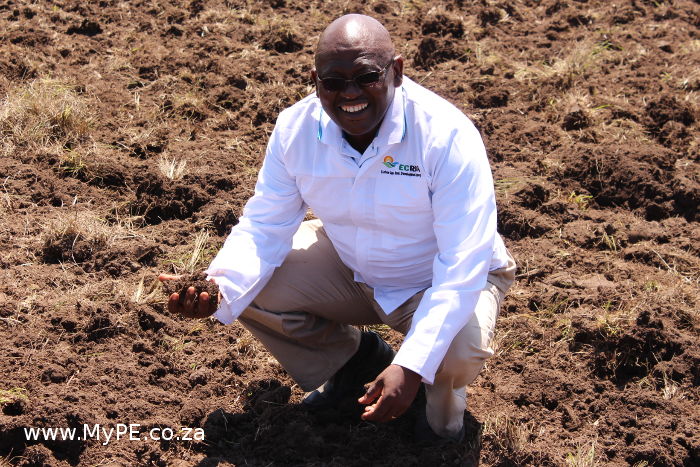
November 2, 2016: The Eastern Cape Rural Development Agency (ECRDA) says it approved a total of R14.8 million in loans to rural entrepreneurs in the 2015/16 financial year.
Actual disbursements amounted to R12.5 million while R11.8 million of this amount were ECRDA agricultural loans which went to 265 clients. In the same period, ECRDA collected R13 million in loan repayments.
Announcing the agency’s annual results, ECRDA chief executive officer Thozamile Gwanya says the majority of the loans, R5.1 million went to the Amathole, OR Tambo (R2.8 million), Chris Hani (R2.2 million)and Alfred Nzo (R1.5 million) district municipalities. A total of R299 711 went to the Karoo and R96 999 to the Nelson Mandela Bay Municipality.
“The bulk of the loan disbursements relate to agricultural loans and specifically to crop production loans. Besides the loan facility that was made for maize crop production at the Mqanduli and Ncora RED Hubs, there are also informal groups of subsistence farmers who, because of their small pockets of land are encouraged to apply as groups in order to qualify for production loans,” explains Gwanya.
“We are also equally excited with the clean audit report ECRDA received in the period under review. This means the financial statements of ECRDA were found to be without any material misstatements or any material findings on performance information or non-compliance with legislation. We are pleased that ECRDA is one of the entities that received a clean bill of health,” Gwanya says.
In 2015/16 ECRDAs funding allocation decreased from R210.8 million in the previous year to R151.6 million signalling challenges within the current economic environment. The reduced funding necessitated further streamlining of operations including ECRDAs flagship Rural Enterprise Development (RED) Hubs.
Gwanya says despite this challenge, ECRDA is pleased to report the steady progress being made by the four RED Hubs in Mqanduli, Ncora, Mbizana and Emalahleni. In 2015/16 the Mqanduli RED Hub delivered to the silos a total of only 399.31 tons of white maize from the 936ha planted in the 2014/15 season due to the drought that affected primary production. Income derived from the maize sold by the six primary cooperatives of Mqanduli RED Hub was R998 275.
The maize was sold to the Mqanduli Maize Secondary Cooperative for milling. In Mqanduli, the existing total storage silo capacity is 1.500 tons. The milling plants have had to order maize feedstock from commercial producers in order to keep samp and maize meal production going so that they can meet their off-take supply commitments to SPAR and Umtiza.
At the Ncora Red Hub, the 10 primary cooperatives organised under the Ncora Irrigation Scheme Producers Assembly Secondary Cooperative delivered 1,935 tons to the silos from the 1,003 ha planted in 2014/15. The new grain storage silo has a 2,000 ton capacity. The income generated from the sale of maize was R5 million. The bulk of the maize which was 1,759 tons was sold to Ncora Dairy because at the time of harvesting, the mill was not yet operational due to unavailability of power. Some R4.56 million was paid by Ncora Dairy to the Secondary Cooperative. The remaining 176.76 tons of maize was sold to the Secondary Cooperative which in turn paid over R459 576 to the primary cooperatives.
During the review period, the Mbizana Red Hub which has 13 primary cooperatives received 316.7 tons from the 983ha of white maize planted in 2014/15. Of this amount, some 226.5 tons was sold to the Mqanduli RED Hub. A total of R512 216 was generated from the sale of the maize. At the Emalahleni RED Hub 565 tons of grain sorghum was harvested in 2015/16 from the 829ha planted in the 2014/15. The RED Hub which has six primary cooperatives sold 472.24 tons of grain sorghum to Border Seed, OVK and PSP. The total income generated was R1.22 million.
He says planting also commenced in the third quarter of the 2015/16 financial year. At the Ncora RED Hub 306 ha of white maize were planted. However, because of the harsh drought conditions that contributed to low soil moisture levels, only 149ha germinated.
At the Mqanduli RED Hub only 165ha of white maize were planted because of the drought which preventing the planting of a larger surface area. In Mqanduli, DRDLR supported the RED Hub with Graduate Intern and production inputs for 1000ha. These production inputs were not used because of the drought and they will be utilised in the coming season.
Some 488ha of white maize were planted at the Mbizana RED Hub in the last quarter of the year. DRDLR also supported with Graduate Intern and production inputs to the Mbizana RED Hub. At the Emalahleni RED Hub no planting took place because of the drought.
“In the forestry development space, I am pleased that the Sinawo project in Mbizana is close to commercialisation. It is already selling timber to commercial forestry giant SAPPI. Sinawo is supplying timber to the SAPPI mill for paper milling. In 2015/16 the Sinawo project generated some R7 million from the sale of timber. They bought two tractors and one bakkie. In 2015/16, some 16 additional staff was employed bringing the total employee count to 208. There were also a total of 113 short-term employees.
“In 2015/16 R3.5 million was spent in Izinini where 111ha of gum trees were planted in addition to existing plantations bringing the total amount of land planted to 335ha. Five permanent jobs were created in 2015/16 bringing the total number of full-time staff to 60. In Sixhotyeni a total of R4,4 million was spent in 2015/16 while 214ha of gum were planted. A total of 39 people were permanently employed bringing to 86 the total number of full-time staff. A total of R8.5 million was spent in Gqukunqa where a total of 384ha of gum were planted bringing the total number of hectares planted to 605ha. In Mkambathi R5 million was spent and a total of 78ha of gum trees were planted bringing the total area planted to 668ha. The Mkambathi project also generated revenues of R803 949 form the sale of timber in 2015/16,” Gwanya adds.
ECRDA is also encouraged with the progress being made in the livestock development programme. For example, the farmers which ECRDA lent 30 heifers now have more than 100 cattle. This project has assisted them to improve their livestock farming practices. The Ikhephu Secondary Cooperative in Elliot in Sakhisizwe Local Municipality has already developed a feedlot. They are linking the feedlot to the abattoir in Queenstown and Cala.
They now understand the livestock development process from primary production to processing and marketing. ECRDA intends to replicate this programme to other areas to assist farmers. Among other highlights, in 2015/16 R100 000 was set aside for the programme. The livestock development programme facilitated the marketing of 1.500 livestock units in the period under review. A total of 1,322 livestock units were sold at formal markets. There were six informal auctions where a total of 146 livestock units were sold which were mainly cattle.
in Keiskammahoek which were officially launched in the last quarter of the financial year. DRDAR further instructed that this project be enlarged to its full potential and it should be duplicated in other areas. These bio digestors are owned by the communal training centre. They supply the training centre with fertiliser for their market garden and gas for food preparation as well as neighbouring households. Each bio digestor produces between 1,3 to 1,9 cubic metres of gas per digestor.


Alan Straton
Latest posts by Alan Straton (see all)
- South African Artist MARTHINUS Releases Debut Single - 6 November 2026
- MARTHINUS Releases Heartfelt Debut ‘i miss us not trying’ - 6 November 2026
- LaserWeeder Hire Runs Laser Units for SA Vegetable Growers - 6 November 2026
- HandPrinter Art Runs Linocut Workshops and Beginner Kits - 6 November 2026
- Feature Equipment Adds AM.CO.ZA Tooling and Laser Spares Shelf - 6 November 2026
