
On 6 November 2021 the Acting
Director-General of the National Department of Water & Sanitation signed
off water restrictions on the Mzimvubu-Tsitsikamma Water Management Area in the
Eastern Cape. This requires us to reduce our overall water abstraction from the
joint water sources which feed Nelson Mandela Bay by 37%. Currently the
combined storage level of local dams is less than 12% of capacity, and severe
curtailments are required: 70% from Kromme, 85% from Loerie, and 50% from
Groendal.
We have already reduced
abstraction from Loerie and Groendal Dams as required. At Kromme, comprising
Churchill and Impofu Dams, we have, over the past years, abstracted more water
than our restricted allocation. This was to meet the water demand from our
domestic, industrial and commercial customers. At current consumption,
Churchill Dam will run dry by early December 2021. To protect the little water
left in these dams, the municipality has to reduce abstraction from the Kromme
system.
Following the successful
repairs to the Churchill pipeline, we are currently re-charging the water
network. From Saturday, we will be reducing supply from the Kromme system from
±90 Ml/day to ±60 Ml/day, which is two-thirds of the volume of water previously
supplied. We will be reducing this further over the coming weeks so that we can
achieve the restricted volume of 31 Ml/day.
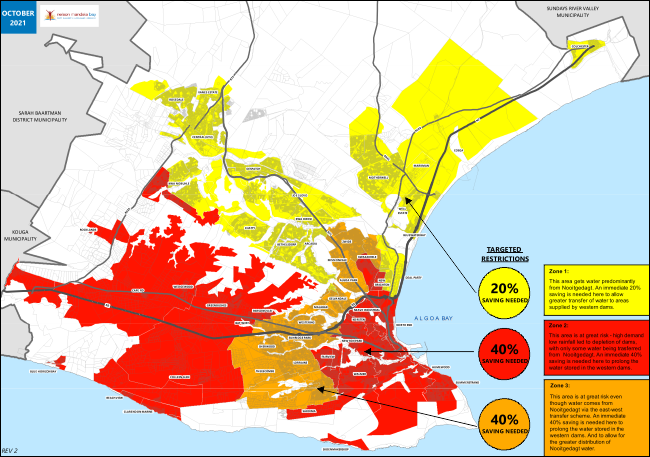
For all households in Nelson
Mandela Bay to have continuous water supply, it is now imperative that the
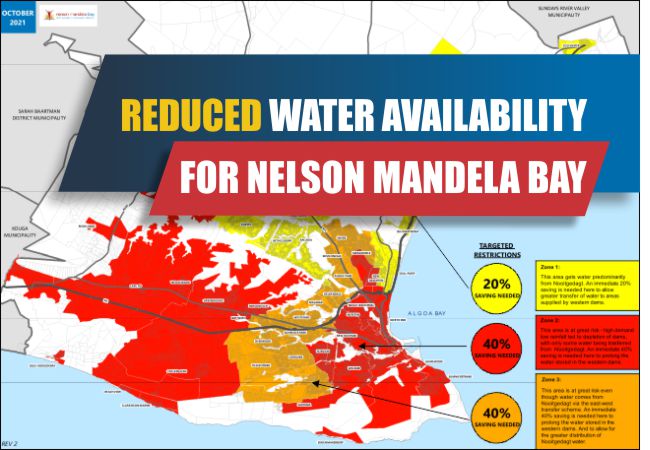
savings of 40% and 20% be implemented immediately as per Figure 1.
Figure 1: Required savings to avoid dry taps
Our bulk water supply
modelling shows that if we all play our part in implementing these water saving
measures, we will be able to extend the remaining storage in our local dams and
provide water to all consumers until May 2022. At this time, critical infrastructure
such as a transfer pump station at Chelsea Reservoir will be commissioned to
better distribute water from Nooitgedagt across the metro. The period from May
to August every year is also more favourable for the high-intensity rainfall
required to meaningfully raise local dam levels.
All preparations to avoid dry
taps continue, and if both NMBM and residents increase efforts to reduce
overall water consumption, dry taps can still be avoided. NMBM continues with
the roll-out of aggressive pressure management initiatives, fixing leaks and
replacing meters. As we move into the hot summer months, we need to
intensify our efforts to save water: spend less time in the shower and more
time in the sea!
Please visit https://www.nelsonmandelabay.gov.za/page/drought-mitigation-plans-and-projects for
all water-related information, including restrictions and FAQs as well as tips
to lower usage even further.
/
Issued by the Nelson Mandela
Bay Municipality Communications Office. For more information, please contact
Communications and Media Liaison Officer, Mthubanzi Mniki on 071 381 3779.

Port Elizabethan
Latest posts by Port Elizabethan (see all)
- Why Fewer People Are Being Convicted for Commercial Crimes - 15 May 2026
- Urgent Call for South Africa to Support and Join Global Efforts to Phase Out Fossil Fuels - 15 April 2026
- Unfenced 6 SAI Army Base Outside Makhanda Claims Another Life - 20 November 2025
- Death Toll Rises From Makhado Bus Crash - 21 October 2025
- Law Clinics Flooded as Home Affairs Blocks Asylum Seekers From the System - 15 October 2025
