
 Choosing to cook with a microwave vs oven can use from 30% to as much as 80% less energy. Microwaves use high-frequency radio waves to heat the water molecules inside food.
Microwave Energy Saving Tips:
- Defrost your food in the refrigerator instead of the microwave oven: it is more economical.
- Use your microwave oven to cook small to medium quantities of food. To cook larger portions of meat, it is better to use a conventional oven.
- Some microwaves do not heat up foods evenly. Wrap foods in plastic to hold in the steam, this will help to give even heating. Be very careful not to cover the foods too well, steam can burn you badly when you open the packet, so leave a flap open for the steam to escape.
- Cooking time is an important factor when determining energy efficiency levels. Compare cooking times when you cook the same food in the microwave, in the standard oven, on stove top elements or in a pressure cooker. You will easily see which method of cooking is more efficient depending on quantity, volume and food types.
- Follow the Manufacturers instructions to ensure that food is cooked correctly. Keep in mind that microwave recipe books give the cooking times required by the appliance used by the authors. Adjust cooking times to suit your micro- wave rating.
- Never turn your microwave on when it is empty, you could damage it.
- Keep the edges of your microwave door and its hinges clean. To wash the inside of your oven, boil a cup of water in it and then wipe the sides with a damp cloth.
Go further and save more with: Building Automation Systems / Solar PV Installations / Metering Solutions.
A Microwave takes about 1200 watts per hour for an average microwave to run.
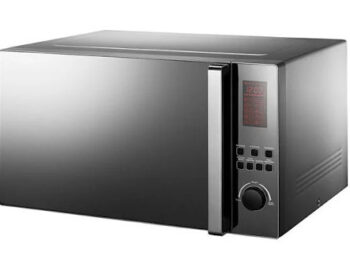
Microwaves are the most energy-efficient means of cooking, followed by slow cookers, hobs, and lastly ovens, so use your microwave as much as possible – and remember to turn it off at the wall after use to conserve even more energy (nobody uses them as a clock anyway!)
In 1947, Raytheon built the “Radarange”, the first commercially available microwave oven. It was almost 1.8 metres (5 ft 11 in) tall, weighed 340 kilograms (750 lb) and cost about US$5,000 ($57,000 in 2019 dollars) each. It consumed 3 kilowatts, about three times as much as today’s microwave ovens, and was water-cooled. The name was the winning entry in an employee contest. An early Radarange was installed (and remains) in the galley of the nuclear-powered passenger/cargo ship NS Savannah. An early commercial model introduced in 1954 consumed 1.6 kilowatts and sold for US$2,000 to US$3,000 ($19,000 to $29,000 in 2019 dollars). Raytheon licensed its technology to the Tappan Stove company of Mansfield, Ohio in 1952. Under contract to Whirlpool, Westinghouse, and other major appliance manufacturers looking to add matching microwave ovens to their conventional oven line, Tappan produced several variations of their built-in model from roughly 1955 to 1960. Due to maintenance (some units were water cooled), in-built requirement, and cost (US$1,295 ($12,000 in 2019 dollars)), sales were limited.
Japan’s Sharp Corporation began manufacturing microwave ovens in 1961. Between 1964 and 1966, Sharp introduced the first microwave oven with a turntable, an alternative means to promote more even heating of food. In 1965, Raytheon, looking to expand their Radarange technology into the home market, acquired Amana to provide more manufacturing capability. In 1967, they introduced the first popular home model, the countertop Radarange, at a price of US$495 ($4,000 in 2019 dollars). Unlike the Sharp models, a motor driven mode stirrer in the top of the oven cavity rotated allowing the food to remain stationary.
In the 1960s, Litton bought Studebaker’s Franklin Manufacturing assets, which had been manufacturing magnetrons and building and selling microwave ovens similar to the Radarange. Litton developed a new configuration of the microwave oven: the short, wide shape that is now common. The magnetron feed was also unique. This resulted in an oven that could survive a no-load condition: an empty microwave oven where there is nothing to absorb the microwaves. The new oven was shown at a trade show in Chicago, and helped begin a rapid growth of the market for home microwave ovens. Sales volume of 40,000 units for the U.S. industry in 1970 grew to one million by 1975. Market penetration was even faster in Japan, due to a less expensive re-engineered magnetron. Several other companies joined in the market, and for a time most systems were built by defence contractors, who were most familiar with the magnetron. Litton was particularly well known in the restaurant business.
Residential use
While uncommon today, combination microwave-ranges were offered by major appliance manufacturers through much of the 1970’s as a natural progression of the technology. Both Tappan and General Electric offered units that appeared to be conventional stove top/oven ranges, but included microwave capability in the conventional oven cavity. Such ranges were attractive to consumers since both microwave energy and conventional heating elements could be used simultaneously to speed cooking, and there was no loss of countertop space. The proposition was also attractive to manufacturers as the additional component cost could better be absorbed compared to countertop units where pricing was increasingly market-sensitive.
By 1972, Litton (Litton Atherton Division, Minneapolis) introduced two new microwave ovens, priced at $349 and $399, to tap into the market estimated at $750 million by 1976, according to Robert I Bruder, president of the division. While prices remained high, new features continued to be added to home models. Amana introduced automatic defrost in 1974 on their RR-4D model, and was the first to offer a microprocessor controlled digital control panel in 1975 with their RR-6 model.
1974 Radarange RR-4. By the late 1970s, technological advances led to rapidly falling prices. Often called “electronic ovens” in the 1960s, the name “microwave oven” later gained currency, and they are now informally called “microwaves”.
The late 1970’s saw an explosion of low-cost, countertop models from many major manufacturers.
Formerly found only in large industrial applications, microwave ovens increasingly became a standard fixture of residential kitchens in developed countries. By 1986, roughly 25% of households in the U.S. owned a microwave oven, up from only about 1% in 1971; the U.S. Bureau of Labor Statistics reported that over 90% of American households owned a microwave oven in 1997. In Australia, a 2008 market research study found that 95% of kitchens contained a microwave oven and that 83% of them were used daily. In Canada, fewer than 5% of households had a microwave oven in 1979, but more than 88% of households owned one by 1998. In France, 40% of households owned a microwave oven in 1994, but that number had increased to 65% by 2004.
Adoption has been slower in less-developed countries, as households with disposable income concentrate on more important household appliances like refrigerators and ovens. In India, for example, only about 5% of households owned a microwave oven in 2013, well behind refrigerators at 31% ownership. However, microwave ovens are gaining popularity. In Russia, for example, the number of households with a microwave oven grew from almost 24% in 2002 to almost 40% in 2008. Almost twice as many households in South Africa owned microwave ovens in 2008 (38.7%) as in 2002 (19.8%). Microwave oven ownership in Vietnam was at 16% of households in 2008—versus 30% ownership of refrigerators; this rate was up significantly from 6.7% microwave oven ownership in 2002, with 14% ownership for refrigerators that year.
Consumer household microwave ovens usually come with a cooking power of 600 watts and up, with 1000 or 1200 watts on some models. The size of household microwave ovens can vary, but usually have an internal volume of around 20 liters (1,200 cu in; 0.71 cu ft), and external dimensions of approximately 45–60 cm (1 ft 6 in–2 ft 0 in) wide, 35–40 cm (1 ft 2 in–1 ft 4 in) deep and 25–35 cm (9.8 in–1 ft 1.8 in) tall.
As of 2020, the majority of countertop microwave ovens (regardless of brand) sold in the United States were manufactured by the Midea Group.
Energy consumption: As of 2006, a typical microwave oven consumed more energy in standby power usage around the clock than it does on heating food.

Video: Quick Tip: The Most Energy Efficient Cooking Method
[embedded content]
More Info on Quick Tip: The Most Energy Efficient Cooking Method here: https://straton.co.za/electricity-saving-tip-microwave-oven/
Twitter: https://twitter.com/MyPE
Facebook: https://www.facebook.com/StratonElectrical/
CLICK HERE to submit your press release to MyPR.co.za.


Alan Straton
Latest posts by Alan Straton (see all)
- Can Too Much Screen Time Increase Childhood Obesity? - 20 November 2026
- Chilla Brings Mango, Watermelon and Blueberry Bubble Tea to South Africa - 20 November 2026
- Short Festive Runs Still Need Readable Batch Codes, Says Pinetown Coding Ink Supplier - 20 November 2026
- Africa Exhibitions Brings Freestanding Heritage Shows to Libraries and Museums Where Walls Stay Untouched - 20 November 2026
- Pretoria East Renal Clinic Publishes a What-to-Bring List for Specialist and Dialysis Visits - 20 November 2026
