
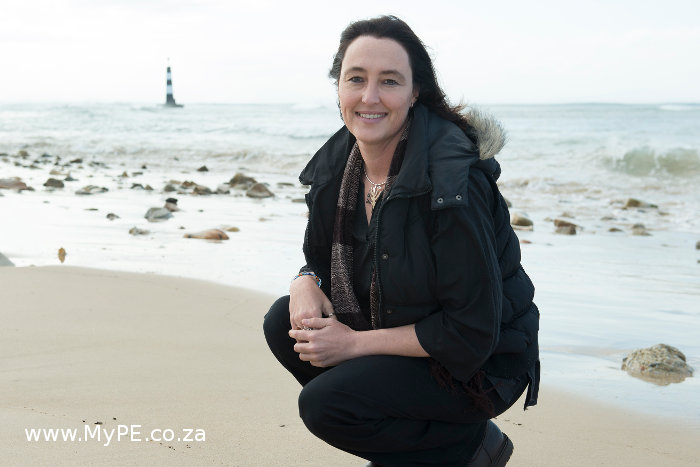
Professor Nadine Strydom – winner of Nelson Mandela Metropolitan University’s Researcher of the Year Award – is Africa’s leading expert on “little fish”, and a regular pioneer of new technologies in her field.
Her speciality – a scarce skill worldwide – is identifying fish larvae so tiny they can only be viewed under a microscope. She tracks the early life stages of fish – monitoring their movement from the sea (where fish spawn) to the surf zone (where fish larvae are part of the plankton) to estuaries (where they grow into juvenile fish) and even up-river (where marine fish make use of unique nursery areas). She also monitors the age and size at which fish start reproducing.
Why this research is so important, is that an understanding of fish larvae can help with predictions about the size of future fish populations. “It’s a well-known scientific phenomenon that the success of any fish population is underpinned by the success of the larval phase,” says Strydom, who has a doctorate in Ichthyology from Rhodes University, and a C2 research rating from the National Research Foundation.
Fisheries worldwide use eggs and larvae to predict the number of adult fish they are likely to catch two to three years down the line.
Her research on fish reproduction and early life history stages is necessary to help conservation authorities and policymakers make decisions regarding fish protection and management. In South Africa, this is critical, given that many coastal fish stocks – the kind targeted by shoreline and small boat anglers – are collapsing.
“We only have 3% of the entire population of Dusky Kob left. This is because of misaligned size restrictions related to the size at which reproduction starts [most are fished out before they have even reproduced once]; unregulated fishing in estuary nursery areas; and poor angler education on [both] the biology of the species they are fishing and the poor state of many coastal fish stocks.”
Strydom has strong research links with specialists in America, Europe and Australia, and particularly at Germany’s GEOMAR Helmhotz Centre for Ocean Research in Kiel. She has adapted a technique used at GEOMAR, which is typically used for fisheries research in the Northern Hemisphere, for ecological purposes in estuaries in South Africa.
“This technique uses RNA:DNA ratios to determine whether fish larvae are in good condition or not. The healthier the larvae, the better their survival rates will be. This has far-reaching applications for ecosystem health, especially in estuaries in South Africa that are now subject to extensive sewage pollution.
“I’m using the technique in new ways to figure out how good the different estuaries are, in terms of serving as feeding and nursery areas for the baby fish, and to test it as a pollution-monitoring tool.”
Much of Strydom’s research is also coupled to marine spatial planning. “I identify areas from where fish are spawning to areas used as nurseries and try and couple these areas together … I follow the fish larvae as they transform into juveniles and work across ecosystem boundaries.”
Because estuaries in South Africa are typically used as nurseries by many linefish species, caught recreationally and commercially, issues like industrial and sewage pollution are critical.
A recently-completed Masters student project under Strydom showed how pollution impacts young fish in the Swartkops Estuary in Port Elizabeth, many of them destined for human consumption. “The student found evidence of heavy metals and organic pollutants in the fish that pose a health risk, making it essential to understand the threats in fish nursery areas.”
Strydom is passionate about nature – marine and terrestrial – and its conservation. So in addition to producing a prolific number of articles in leading journals – nine in the last year alone (and 50 over her 15-year career) – she regularly writes stories for popular media and conducts public information sessions. She has also delivered over 40 conference presentations nationally and internationally.
“What I take very seriously about my career, is that we are all responsible for ensuring the sustainable use and conservation of marine resources. Ocean resources belong to everybody … I aim to provide correct information to ensure our resources are protected. As scientists, we may not be in a position to make the rules, but we can provide the input necessary for the rule making.”
Strydom recently co-authored a book on the identification of the larval stages of fish in east African coastal waters. With the funds raised as a spin-off from the book, she hosted training courses for academically-deserving students working in fields such as aquaculture and fish ecology in a number of African countries. “The more people we can get to work in this research field, the better they can serve ecology, fisheries and aquaculture.”
Despite her groundbreaking work, she says it remains a struggle to attract students into a field working on ichthyoplankton [fish larvae].
“Most students are drawn to other more popular animal species – the ‘warm and fuzzy’ as opposed to the ‘cold and fishy’ – to the detriment of fish research in South Africa. Many fish species are in as much trouble as other iconic mammal species but don’t receive as much attention. People order seafood in restaurants with no knowledge of the population status of what they are eating or of the effects of the fishing methods, especially trawling, on ecosystems.”
Strydom was mentored by Rhodes University fish ecologist Prof Alan Whitfield (now principal scientist at the South African Institute of Aquatic Biodiversity) during her PhD and NMMU invertebrate zooplanktologist Prof Tris Wooldridge (who has since retired) during her MSc – both world-renowned experts in their fields.
She worked for eight years as a researcher at the then JLB Smith Institute of Ichthyology in Grahamstown (now SAIAB), a hot spot for fish studies in South Africa, before joining NMMU in 2008.
Her work extends over most of the South African coastline, from small boat work in estuaries and rivers, to the nearshore ocean, including the Agulhas Current, the Agulhas Bank and the Transkei Bank, which is all large ship-based research.
“I have an absolute passion for all nature … Exploring beyond the known has always been intriguing to me … I’m also passionate about my students. Their careers and their futures are important to me so I encourage and teach my students to publish their science.”
Strydom is currently supervising four PhD, two MSc, one Honours and one post-doctoral student.


Alan Straton
Latest posts by Alan Straton (see all)
- Wavepool Surf Tour Announces First 13 Qualifiers for the 2027 World Final - 17 November 2026
- Sky Dental Sets Out a Family Dental Checklist for the December Holidays - 17 November 2026
- Sky Dental Sets Out a Family Dental Checklist for the December Holidays - 17 November 2026
- The Gold Avenue Prices Half, Quarter and Tenth Ounce Krugerrands One by One - 17 November 2026
- Nifty Gifts Helps South Africans Get ahead of Christmas Shopping Online - 16 November 2026
