
The trend cycle of the (Nelson Mandela Metropole Business Confidence Indicator) PEBCI for the year to date December 2010, continues improving slowly in line with relatively subdued economic growth during the second and third quarters of 2010, with national GDP growth registering 2.8 percent and 2.6 percent respectively in each of these quarters.
Support for the economy and the PEBCI in 2010 was provided by sound growth in household disposable income during the first three quarters of the year, which in real terms averaged 5.3 percent for the first three quarters, low and declining levels of inflation, falling interest rates, which declined to a thirty six year low, an encouraging recovery in the net wealth of households and a sharp decline in debt servicing costs which together with declining real new vehicle prices encouraged buoyant demand for, in particular, new passenger cars during 2010 an important development for the regional economy. The rate of growth in the PEBCI during 2010 was, however, undoubtedly restrained by weaker economic growth in the third quarter, ongoing high levels of household debt, a negative household savings ratio, and a manufacturing sector under pressure through October 2010 with some marginal but welcome improvement evident in the November manufacturing data.
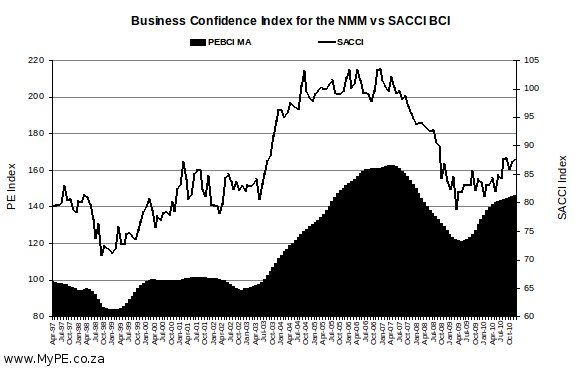
Looking ahead to 2011, current expectations suggest that the full year growth in GDP for 2010 should achieve a level of around 2.7 percent improving slightly to around 3.3 percent in 2011, an expectation supported by the Reserve bank’s leading indicator of economic activity which, having grown strongly, is currently at a high level from an historical perspective. Real retail sales were up 6.1 percent year-on-year in October 2010 and look set to continue growing slowly, inflation and interest rates are likely to remain low, household disposable income looks set to continue improving, business and consumer confidence should reflect improvement during the coming year, annual rates of growth in credit extension to the private sector and in the money supply, while still at low levels, are clearly reflecting recovery, and circumstances in the manufacturing sector should improve, as suggested by the recovery in the Kagiso PMI in November 2010 and an improvement in November 2010 with manufacturing production up 4.6 percent on November 2009.
With regard to the details of the PEBCI, the trend cycles in seven of the sub-indices reflected improvement, seven reflected deterioration and one moved sideways.
The indicators that supported the PEBCI through December included the trend cycle in the JSE all share index which continued growing through December, the trend in the rand US dollar exchange rate which strengthened further, and the trend cycle in the real value of exports which once again reflected some marginal growth. Furthermore, the trend cycle in the prime rate of interest continues declining, further supported by another interest rate reduction in November, and the trend cycle in the total new vehicle market is once again growing with new vehicle demand ending 2010 on a firm note. Finally, the underlying trend cycle in the real seasonally adjusted value of manufacturing has begun reflecting slow growth and the trend cycle in the price of gold also assisted the index.
On the downside, the level of consumer confidence in the Eastern Cape declined again during the fourth quarter of 2010 with the index falling to 12 from 15 and 20 in the third and second quarters respectively. Furthermore, the trend cycles in the real value building plans passed and in the real vale of new buildings completed in the Metro reflected decline and the trend cycle in the real value of imports continued declining through November. The trend cycle of new car sales in the metro, in contrast to the national trend in new passenger car sales, weakened marginally through November and the trend cycle of local rate of inflation reflected an increase, weighing on the index. The trend in the number of passengers arriving at the PE airport also reflected decline through December.
The trend cycle in the real value of retail sales in the Eastern Cape moved sideways through October 2010, the most recent month for which data is currently available.
Dr Neal Bruton of RGT Smart Ltd., has compiled the PEBCI on behalf of PERCCI.


Alan Straton
Latest posts by Alan Straton (see all)
- My City Loft Helps Renters Plan a January Move Into the Johannesburg CBD - 22 October 2026
- NEXA Audio Readies South African Musicians for Festive Gig Season With IEMs - 22 October 2026
- More Than 10 000 Developers Gear up for the 2026 Fnb App of the Year Hackathon - 22 October 2026
- Calling All Business Owners: Tell Us How You Made It Happen - 22 October 2026
- What Happens When Your Most Experienced Excel Employee Leaves? - 22 October 2026
