
This Zwartkops River image is courtesy of Flickr. Click on the Flickr account holder below the photograph to see more.
Image from page 72 of “Marine biological report for the year ended … and the half year ending ..” (1913)
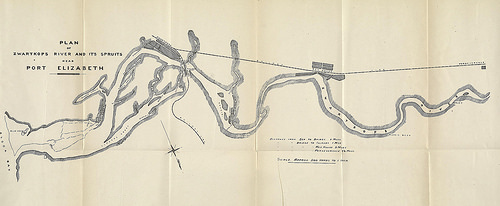
Image by Internet Archive Book Images
Identifier: marinebiological41918cape
Title: Marine biological report for the year ended … and the half year ending ..
Year: 1913 (1910s)
Authors:
Subjects: Marine biology
Publisher: Cape Town : Cape Times Ltd., Govt. printers
Contributing Library: Smithsonian Libraries
Digitizing Sponsor: Biodiversity Heritage Library
View Book Page: Book Viewer
About This Book: Catalog Entry
View All Images: All Images From Book
Click here to view book online to see this illustration in context in a browseable online version of this book.
Text Appearing Before Image:
ion, but rather an increase, of fish in the Zwartkops. It was stated, however, that there had been a falling ofi ofthe supply of fish in the Bay, as also in the neighbouringGamtoos and the Sundays Rivers. The decrease of fi.^h inthese rivers, however, was explained—in the Gamtoos, be lusea flood had brought down mud and covered the reef r themouth, and in the Sundays River, because there had beenno flood to clear away the sand bar. Salmon (Elops) andBarbel (Galeichthys) were, however, said to be scarcer in theZwartkops. Other suggestions were that an increase of fishmay be due to fewer motor launches being in the river, andthat the reappearance of mussels, which had for ten or twelveyears disappeared, had brought back the fish. Though the proposed close season for angling was consideredunnecessary, it was felt that some restrictions should be madein the form of a size limit, below which no fish were to becaught, and a committee was appointed to make suggestionsin this direction. 50.
Text Appearing After Image:
65 Before, however, these proposals assumed a definite formthe whole question again came up towards the expiry of thethree years probation, and the same conflicting statementswere urged with additional warmth and with the additionalargument, on the one hand, that the closure had resulted inan increase in number and size of fish and, on the other hand,that it had resulted in a decrease as there had been no nettingto remove the vermin from the river. Under those circumstances the only solution of the difficultywas obviously to carry out the experiments originally con-,templated, and this the Government proposed to do. At a meeting of anglers and netters at Zwartkops on the25th June, 1915, it was mutually agreed that the river shouldremain closed to netting for a period of twelve months, duringwhich regular experimental netting should be carried out.Two days later the first netting took place, and was repeatedmonthly to July, 1916. This, briefly, is the history of the question, and we ma
Note About Images
Please note that these images are extracted from scanned page images that may have been digitally enhanced for readability – coloration and appearance of these illustrations may not perfectly resemble the original work.
This image is automatically selected as it was published with this keyword/s relevant to Port Elizabeth: Zwartkops River. Please – CLICK HERE to report any ‘offensive’ images. Don’t forget to support and thank the photographer.
Submit your Port Elizabeth images here.

Port Elizabethan
Latest posts by Port Elizabethan (see all)
- Why Fewer People Are Being Convicted for Commercial Crimes - 15 May 2026
- Urgent Call for South Africa to Support and Join Global Efforts to Phase Out Fossil Fuels - 15 April 2026
- Unfenced 6 SAI Army Base Outside Makhanda Claims Another Life - 20 November 2025
- Death Toll Rises From Makhado Bus Crash - 21 October 2025
- Law Clinics Flooded as Home Affairs Blocks Asylum Seekers From the System - 15 October 2025
