
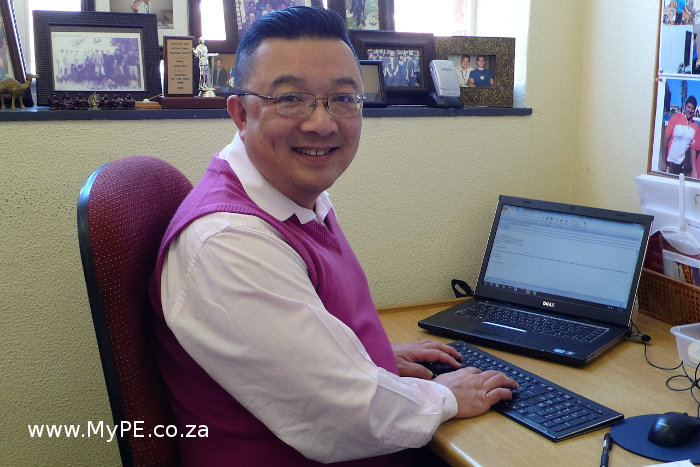
By the time Paul Tai-Hing’s students graduate, they already have an impressive amount of work experience behind them, including running small businesses, and working for established companies.
The popular Management Sciences lecturer has a teaching approach that allows his NDip and BTech students to gain as much practical work experience as possible – as part of a personal philosophy to make them “as marketable as possible by the time they leave university”.
And while they generate actual profits through their various business ventures, the former- businessman-turned-academic is also teaching them the importance of of giving back, by channelling funds raised into social projects, which in the past have included the construction of a new classroom and computer lab in a township school, and the establishment of a soup kitchen.
His novel teaching approach saw him winning NMMU’s overall “Excellent Teacher of the Year” Award at NMMU’s annual Research, Teaching and Engagement Awards ceremony on 20 September.
The award follows Tai-Hing’s Golden Key award, received at the end of last year and voted for by the students themselves, for the Faculty of Business and Economic Science’s most outstanding lecturer.
In each year of their studies, Tai-Hing assigns a project that will give his students work experience.
“Not only do they get the theoretical input in the classroom but, for me, it’s very important they gain experience of the practical application of that theory,” said Tai-Hing, 52, who is completing his doctorate in Business Management.
Tai-Hing teaches his first-years how to start a business – and then expects them to start their own. He randomly divides the massive 1 200 first-year group into teams of six – and they are expected to run their business as a partnership.
Each partnership has to sell a product – currently a glossy recipe book. The students have to order stock from an outside supplier, arrange a 30-day credit, and then make enough money through sales to cover their costs and generate profits.
“They have to come up with their own marketing plan … One group raised R15 000 for Reach for a Dream last semester, by running a stall at Baywest Mall. Another group established themselves as an entertainment business and organised a ladies’ high tea, where they sold the books, and generated extra income through the tea itself.”
The second year group, which consists of 350 students, are taught project management skills – and then have to “adopt” a needy organisation, such as an orphanage, where they can apply their skills.
“The organisation gives the students a wish list, and it is the student’s job to make their dreams come true … They have to do the work and raise the funds or get the necessary sponsors on board.
“This project helps them to hone their skills as negotiators and communicators. They do very good work and it all goes into their portfolios of evidence.”
In third year, Tai-Hing teaches business ethics and within this, in line with the University’s commitment to decolonise the curriculum, he teaches a module focusing on the management of business in Africa. “There are different leadership styles in different countries in Africa – along with different laws, and management systems.”
For their third year project, the students have to spend 120 hours working in any business, gaining practical skills while also observing how businesses are run and how conflicts are resolved.
“By the time they graduate, they have real work experience.”
Students who opt to do a fourth [BTech] year have to complete a practical project, which links with theory on “quantitative management’.
“I teach them how to make decisions based on mathematical principles – it’s all about modelling and predicting, making decisions based on predicted costings and sales, by looking at historical data to determine what will happen in the future.”
He also teaches strategic management, looking at potential risks to the business, as well as how services can be improved.
“They go into a business and observe. This year’s project is going into banks and observing queuing systems (e.g. monitoring the length of time people must wait in queues) – and then analysing this info to make recommendations to improve service.
Asked what keeps him motivated, he said “The students and all their interesting issues … Every day is a different day.”
Tai-Hing, who has lectured at NMMU for the past 16 years, spent 10 years in industry, working mostly in Human Resources and Safety and Training, at Cadbury’s and then the Cape of Good Hope Wool Combers.


Alan Straton
Latest posts by Alan Straton (see all)
- Wavepool Surf Tour Announces First 13 Qualifiers for the 2027 World Final - 17 November 2026
- Sky Dental Sets Out a Family Dental Checklist for the December Holidays - 17 November 2026
- Sky Dental Sets Out a Family Dental Checklist for the December Holidays - 17 November 2026
- The Gold Avenue Prices Half, Quarter and Tenth Ounce Krugerrands One by One - 17 November 2026
- Nifty Gifts Helps South Africans Get ahead of Christmas Shopping Online - 16 November 2026
