
Today’s posts from our featured Port Elizabeth Blogger:
Muhammad Ali: for one last time, he brings the world to a standstill:

It was political. It was poignant. It was funny, flamboyant, and, fittingly – unforgettable.
Louisville on Friday bid a final farewell to their favourite son, sending off in style a man who was born 74 years ago in the segregated suburbs, and was buried in a ceremony befitting the giant he became.
Muhammad Ali had planned his funeral in detail, requesting the presence of Bill Clinton, Billy Crystal, Will Smith and boxing’s greatest – alongside his family and 18,000 fans.
He also wanted guarantees that all faiths would be represented, hence a series of powerful speeches and performances from rabbis, a Catholic priest, Buddhist monks and a Native American chief.
“Muhammad indicated that when his time came, he wanted to use his death as a teaching method for the world,” said his wife Lonnie, speaking with assurance and poise that defied her enormous loss.
“He had grown up in segregation. He never became embittered enough to quit or engage in violence. So even in death, Muhammad has something to say.”
And his presence in the Kentucky city was overwhelming.
Dr Kevin Cosby, a preacher in Louisville, paid tribute to a civil rights champion who fought to overcome the racism and division of his time.
He was a pioneer – “the people’s champ” – said Dr Cosby, to whoops and cheers from the fired-up auditorium.
“Before James Brown said I’m black and I’m proud, Muhammad Ali said I’m black and I’m pretty,” he said in a barnstorming address.
Orrin Hatch, a Mormon Republican senator for Utah, joked: “It’s hard for this old senator to follow that.”
But, in his own way, he did: telling an anecdote about how he invited Ali to a Mormon service in Salt Lake City, only for Ali to charm everyone by handing out signed copies of a Muslim text.
Rabbi Michael Lerner turned the political heat up several degrees, launching a series of blistering political attacks.
“We will not tolerate politicians or anyone else putting down Muslims or blaming Muslims for the sins of a few,” the rabbi yelled. “We know what it is like to be demeaned.”
He was scathing about Israel, Turkish attacks on Kurdish militants, and Wall Street – telling the stunned and shouting audience: “Tell your next president, tell her!”
The cameras cut to Bill Clinton, laughing.
A Native American chief took to the stage next, providing a welcome change of pace with his mesmerising refrain, followed by Buddhist monks, drumming and chanting.
Ambassador Shabazz, Malcolm X’s daughter, gave a powerful, tearful speech, saying: “Muhammad Ali was part of a treasured fraternity, bequeathed to me by my dad.”
She told of “his grief, for not having spoken to my dad before he left. His stories – some of which can’t be repeated. He was so funny”.
Resplendent in a glittering silver hat and necklace, she continued: “A unifying topic was faith; an ecumenical faith, respect for all faiths, even if belonging to one religion or none, the gift of all faiths.
“He said: We all have the one God. We just serve him differently. Rivers, lakes, plains, they all have different names – but they mean the same thing. Doesn’t matter if you are a Muslim or Christian or Jew – when you believe in God, you should believe all people are part of one family. Because if you love God, you can’t love only some of his children.
“Having Muhammad Ali in my life somehow sustained my dad’s breath in me – 51 years longer. Until now.”
Then it was the turn of the family. Lonnie Ali told of how her husband had taken up boxing when Joe Martin, a local police officer, told a 12-year-old boy whose bicycle had been stolen that he could teach him to fight.
“America must never forget that when a cop and an inner city kid talk to each other, miracles can happen,” she said, to a standing ovation.
Billy Crystal had the audience in hysterics, telling of the 42-year friendship with a man who called him “Little Brother”.
John Ramsey, a family friend and former radio host, described Ali as “the coolest cat in the room”.
He continued: “He was good looking. He had charm. He had charisma. He had swagger, before we knew what swagger was.
“Muhammad said service to others is the rent you pay for your room here on earth. And I just want to say: ‘champ, the rent is paid in full.’”
As the day came to a close, following a remarkable 19-mile funeral procession through the streets, his daughter Rasheda summed up the man Louisville so loved.
“Daddy’s looking at us now,” she said. “And he’s saying: ‘I told you I’m the greatest.’”
Bill Clinton, the former US president, has delivered an emotional speech to a “smart”, “wise” and “tremendously fun” man to be around.
He began his speech praising a man who was determined. “He decided very young to write his own life story. He decided he would not ever be disempowered. He never got credit for being as smart as he was, then he never got credit for being as wise as he was.”
Clinton described him as a universal soldier for our common humanity. Here is some of his speech in full.
In the end, besides being a tremendously fun man to be around, I will always think of him as a truly free man of faith… Being a man of faith, he realised he was never in full control of his life. Being free, he still knew he was open to choices. It is the choices that have brought us all here today.
As the first part of his life was dominated by triumph of fights, the second part was more important because refused to be imprisoned by disease.
In the second half of his life, he perfected gifts we all have: we all have gifts of mind and heart. It’s just that he found a way to release them; large and small.
Ali never wasted a day feeling sorry for himself just because he had Parkinson’s.
As he concluded his speech, Mr Clinton was given a standing ovation.
Billy Crystal, a good friend of Ali, described their close relationship and how he called him his little brother.
“Last week when we heard the news, time stopped. It’s hard to describe how much he meant to me… He was a tremendous bolt of lightning, created by Mother Nature out of thin air. He came at the perfect moment.”
Crystal described how he and Ali first met when he performed a comedy sketch mimicking the boxer. “He seemed to glow.”
“He was funny, he was a fighter, he was beautiful – and those were his own words.”
“Here was this white kid from Long Island, mimicking the greatest of all time.”
Then Crystal powerfully concluded: “He is gone but he will never die. He was my big brother.”
(C) The Daily Telegraph, London
Listen by clicking here:


Source: BrainStorms – Ed Lunnon’s Blog.
Last night, I watched Ali’s funeral in Louisville, Kentucky, USA. – his place of birth.
I guess it was an extraordinary thing to do on a Friday night, but then Ali was an extraordinary man. As I listened to eulogy after eulogy, speech after speech, more compliments after more compliments, Presidents after actors, family after friends, I became aware of a man about whom I actually knew very little.
I knew he was a boxer.
I knew he changed his name from Cassius Clay to Muhammed Ali.
I knew he had converted to Islam.
I knew he had Parkinson’s Disease.
I did not know so much of this extra-ordinary man.
I learned so much last night. I hope you don’t mind me sharing …
~ Ali’s long struggle with Parkinson’s Disease
Muhammad Ali is being remembered not just for his legendary boxing career and his inspiring public persona, but also for the dignity and grace with which he battled Parkinson’s disease over the last three decades of his life.
He was first diagnosed with the degenerative disease in the 1984, three years after he retired from boxing.
Repeated blows to the head during his time in the ring are believed to have led to his later health problems. Ali’s physician, Dr. Dennis Cope, spoke about his condition in a “60 Minutes” interview in 1996.
“[Ali] has had a development of what’s called Parkinson’s syndrome. And from our testing on him, our conclusion has been that that has been due to pugilistic brain syndrome resulting from boxing,” Cope told CBS News’ Ed Bradley.
“All of our testing has indicated that his cognitive function, his ability to think clearly, to understand what’s going on, to really analyze situations hasn’t deteriorated at all,” Cope added. “His mind is fine.”
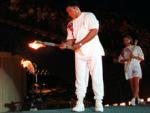

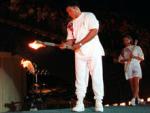
Muhammad Ali lights the Olympic flame
Muhammad Ali lights the Olympic flame during the 1996 Summer Olympic Games opening ceremony in Atlanta, July 19, 1996. AP PHOTO
But the disease took a visible toll on his body. Ali developed a tremor and speech became increasingly difficult.
When he lit the Olympic flame at the start of the 1996 summer games in Atlanta, his hand shook as he held the torch high.
Ali looked increasingly frail in recent public appearances, such as the event in October 2015 when he was honored by Sports Illustrated at The Muhammad Ali Center in his hometown of Louisville, Kentucky, along with former opponents Larry Holmes and George Foreman.
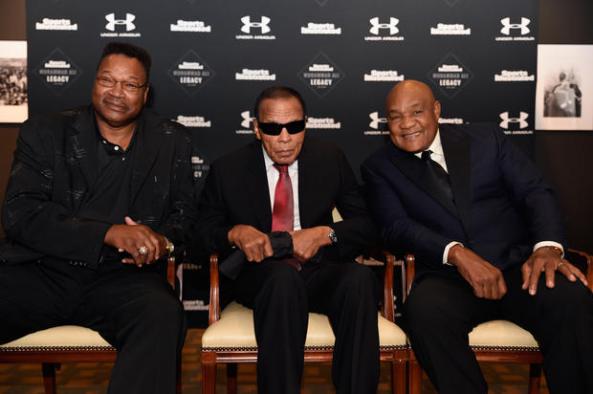
LOUISVILLE, KY – OCTOBER 01: Larry Holmes, Muhammad Ali, and George Foreman attends the Sports Illustrated Tribute to Muhammad Ali at The Muhammad Ali Center on October 1, 2015 in Louisville, Kentucky. (Photo by Stephen Cohen/Getty Images for Sports Illustrated)
gettyimages-490907926.jpg
Left to right: Larry Holmes, Muhammad Ali, and George Foreman attend the Sports Illustrated Tribute to Muhammad Ali at The Muhammad Ali Center on October 1, 2015 in Louisville, Kentucky. STEPHEN COHEN, GETTY IMAGES FOR SPORTS ILLUSTRATED
But despite the illness, his wife Lonnie Ali said the three-time world heavyweight champ never felt sorry for himself.
“He’s not one who says ‘why me?’ He’s a real champion,” she told CBS Phoenix affiliate KPHO last month. “I learn every day from this man: the courage, the strength and the grace that he lives with his illness. For most people, it would put them in bed and put covers over them. They would give up. He does not stop. He continues to live life and that’s very important.”
Before his death on Friday, Ali was hospitalized with respiratory problems, his condition complicated by advanced Parkinson’s.
Here are some questions and answers about Parkinson’s disease:
Q: What is Parkinson’s?
A: Parkinson’s is a neurologic disease that robs people of control over their movements. It typically starts with tremors, and is characterized by slow movement, a shuffling gait, stiff limbs, balance problems and slurred speech.
Q: Who gets it?
A: About 1 million Americans are living with Parkinson’s, and an estimated 4 million to 5 million people worldwide, according to the National Parkinson Foundation. It usually appears after age 60, although sometimes it can develop before age 40.
Ali was 42 when he was diagnosed with Parkinson’s in 1984. The actor Michael J. Fox was diagnosed when he was just 37.
Q: What causes it?
A: The exact cause isn’t known but Parkinson’s develops when cells that produce one of the brain’s chemical messengers, called dopamine, begin to deteriorate and die. Dopamine transports signals to parts of the brain that control movement. Parkinson’s symptoms appear after enough dopamine-producing cells die that there’s too little of this neurotransmitter in the brain.
Q: Is there a cure?
A: There is no cure but there are a range of treatments, from medications that affect dopamine levels to a surgically implanted tremor-blocking device. Patients also can benefit from physical and occupational therapy.
Q: What’s the prognosis?
A: Symptoms worsen over time, usually slowly. The severity of symptoms, and how quickly they progress, varies widely between patients. In advanced cases, people may be unable to walk or care for themselves. They also can suffer non-motor symptoms, including depression and memory and other cognitive dysfunction.
While Parkinson’s itself isn’t considered fatal, people can die from complications of the disease.
Q: What complications are of most concern?
A: Lung problems are a risk as muscle weakness impedes the ability to cough and to swallow. While any kind of pneumonia can occur, what’s called aspiration pneumonia — when bits of food or liquid land in the lungs instead of being swallowed properly — is the leading cause of death among Parkinson’s patients, said National Parkinson Foundation medical director Dr. Michael S. Okun.
CBS/AP
PS !
CBD, which is the illness with which I have been diagnosed, is also an extra-pyramidal Parkinsonism syndrome. It is normally a faster moving life-limiting illness with death resulting from pneumonia within three to five years.
I have now been ill for nine years and nine months since I first became aware of the Parkinsonism symptoms.


Source: BrainStorms – Ed Lunnon’s Blog.
Click HERE to submit your blog to be part of this daily feature.
CLICK HERE to get a daily digest of PE Goodness straight into your inbox with the MyPE Monday to Friday Newsletter.

Port Elizabethan
Latest posts by Port Elizabethan (see all)
- Why Fewer People Are Being Convicted for Commercial Crimes - 15 May 2026
- Urgent Call for South Africa to Support and Join Global Efforts to Phase Out Fossil Fuels - 15 April 2026
- Unfenced 6 SAI Army Base Outside Makhanda Claims Another Life - 20 November 2025
- Death Toll Rises From Makhado Bus Crash - 21 October 2025
- Law Clinics Flooded as Home Affairs Blocks Asylum Seekers From the System - 15 October 2025
