
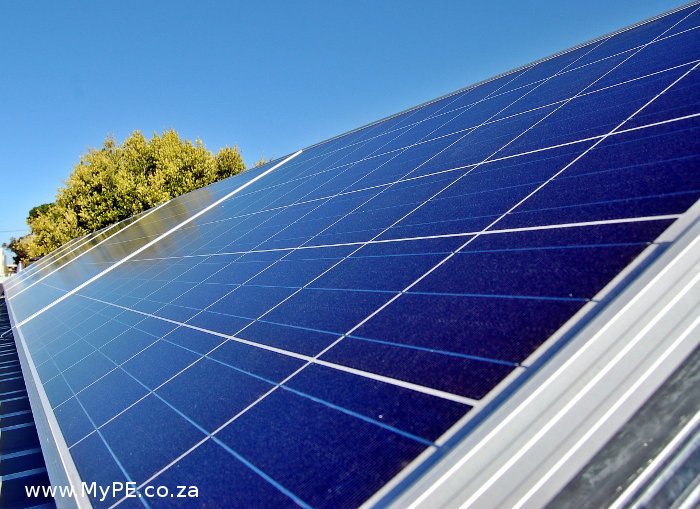
On top of tumbling prices for renewable energy components and amidst a relatively slow uptake by business and individuals government has announced a number of enhancements to incentives enabling business to make greater use of renewable energy:
- An increased energy saving tax incentive.
- Planned enhancements to an already generous accelerated depreciation of renewable energy installations.
- High Energy Users to be slapped with a levy.
What was not mentioned in the Budget was the exclusive local incentive given to all consumers within the ambit of the Nelson Mandela Bay Metropolitan Municipality in that any grid tie renewable energy installation gets credit for all energy produced on a 1 for 1 basis. Effectively allowing you to zero the amount that you pay for electricity. Any electricity generated over and above the consumer’s on site use is still pumped back into the grid. NERSA have proposed that any such electricity that is pumped back into the grid be ‘banked’ for up to a year as a further incentive.
At this stage the Nelson Mandela Bay Municipality is the only municipality allowing grid-tie AND a 1-1 credit for power generated. Municipalities like Cape Town do encourage grid-tie but on a less generous payback and with higher net meter installation costs. Certainly an incentive for someone wishing to establish their home or business in Port Elizabeth.
The tax incentive for businesses to reduce electricity demand will be more than doubled from 45c/kWh to 95c/kWh, finance minister Nhlanhla Nene announced in his medium-term budget speech on Wednesday.
This incentive will also be extended to co-generation projects.
This incentive was first introduced in November 2013 and participating businesses had to submit a year’s baseline consumption data.
In terms of the programme businesses claim tax reductions based on energy saved. In future this allowance will be funded through a recycling of revenues from the carbon tax which will be introduced in 2016.
To benefit from the incentive, companies will have to register with the South African National Energy Development Institute (Sanedi), which will administer the technical component of the incentive.
The incentive works on the basis of quantifiable energy that you have saved expressed as kwh (kilowatt hours), and for each kwh that you have saved, you will get a 95 cent tax relief.
Government is also considering enhancing the accelerated depreciation for solar photovoltaic renewable energy – currently at 50/30/20.
Large electricity users are under government’s spotlight. During a press briefing director-general of the national treasury Lungisa Fuzile said that some of these users are protected by price agreements against rising prices that encourage energy savings. Government is therefore considering a levy that would apply to users who consume more than 800 000MWh per year.
To prevent the possibility of double taxation, a credit of 5.5c/kWh could be provided for users if the price they pay is above 37c/kWh.
Government will consult with industry, the energy regulator, Eskom and other interested parties before any specific measures are proposed.
South Africa has a high level of Renewable Energy potential and presently has in place a target of 10 000 GWh of Renewable Energy. The Minister has determined that 3 725 megawatts (MW) to be generated from Renewable Energy sources is required to ensure the continued uninterrupted supply of electricity. This 3 725 MW is broadly in accordance with the capacity allocated to Renewable Energy generation in IRP 2010-2030.
Other current government initiatives in the energy efficiency realm include the Private Sector Energy Efficiency Project – an initiative to help companies – both commercial and industrial, large and small – to identify energy savings measures.
Welcoming the government’s commitment to renewable energy, Alan Straton from Straton Solar said; “These measures are making Solar Photovoltaic installations even more attractive for business. Before this new round of incentives we saw some installations that took advantage of the accelerated depreciation and introduced independent metering to tenants on the same supply, reach payback in 14 months. These additional incentives are certainly increasing the motivation for business to go green and save money.”


Alan Straton
Latest posts by Alan Straton (see all)
- Calling All Business Owners: Tell Us How You Made It Happen - 22 October 2026
- Sky Dental Puts Gum Health at the Centre of Care in Sandton - 22 October 2026
- The Gold Avenue Urges Krugerrand Holders to Avoid Private Sales to Strangers - 22 October 2026
- Soccer Laduma Urges SA Punters to Read the Terms Before They Bet This October - 21 October 2026
- Nifty Gifts Rounds up Spring Birthday Gifts and New Arrivals for Her - 21 October 2026
