
Mandisa Maya was born on the 20th of March 1964 in the Eastern Cape town of Tsolo and grew up in King William’s Town and Mthatha. She matriculated from St Johns College in Mthatha and graduated from the former University of the Transkei with a BProc degree in 1986. She went on to complete her LLB from the University of Natal in 1988 and in 1990, received her LLM from Duke University in the USA on a Fulbright scholarship.
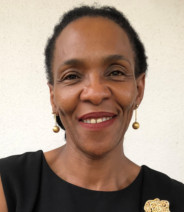
She began her legal career as an Assistant State Law Adviser in Mthatha in 1991 and in 1994, was admitted to the Transkei Bar.
Since 1999, she has served as a member of the judiciary in various capacities and in May 2006, she was appointed as a member of the Bench in the Supreme Court of Appeal. Justice Maya served as an acting judge of the Constitutional Court and was appointed as Deputy President of the Supreme Court of Appeal in 2015 and served as Acting President in 2016. In May 2017, Justice Maya became the first woman President of the Supreme Court of Appeal.
She has served as a member of the Black Lawyers Association, the National Association of Democratic Lawyers and the Commonwealth Association of Law Reform Agencies. In 2004, she founded the South African Chapter of the International Association of Women Judges and remains an active member. She holds various leadership and advisory roles in organisations such as Lawyers against Violence, the SA Institute for Advanced Constitutional; Public; Human Rights and International Law. She serves as a Commissioner on the Judicial Service Commission and as a council member on the SA Judicial Education Institute. She has served as a member and as Chairperson of the South African Law Reform Commission since 2013 and as a board member of the South African Journal on Human rights.
In 2012, Justice Maya was the recipient of the South African Women Lawyers Icon Award – honoured for the role she plays in empowering and mentoring women in both the judiciary and the broader legal profession. She has delivered 114 reported High Court judgments and 43 reported judgments in the Supreme Court of Appeal during her judicial career. These judgments span wide ranging and intricate legal issues and demonstrate her comprehensive knowledge of the law. She is held in high esteem by the legal fraternity and has a reputation for integrity and independence along with a sensitivity to the implications of gender-based violence and socio-economic inequalities in South African society.
The advocates who have appeared before her have commended her “fine grasp of a broad spectrum of the law”. According to the General Council of the Bar, Justice Maya has demonstrated a “consistent understanding of the need to balance the enforcement of constitutional rights against the need for government to be able to perform its functions efficiently”.
Justice Maya has been involved in many community-based organisation, including the Transkei Women’s Zenzele Association and the Women’s Economic Advancement Group (Pty) Ltd. In so doing, she makes a valuable and substantial contribution to the promotion of women’s rights.
Throughout her career, she has demonstrated a clear commitment to transformation and to the promotion of gender equality – taking active steps to promote gender transformation in the judiciary and in the broader legal profession. Her extra-curricular activities and particularly her community activism, reflect a deep commitment to the values of the Constitution. Through her appointment as President of the Supreme Court of Appeal, she has become a symbol of gender transformation and is an important role-player in the promotion of cultural and gender rights.
Mandisa Maya is married to Dabulamanzi Mlokoti and has three children.
For her significant contribution to the development of law in South Africa, the promotion of constitutional democracy and the protection of human rights, it is an honour for Nelson Mandela University to confer the degree of Doctor of Laws (honoris causa) on Justice Mandisa Maya.
Mandisa Maya’s Acceptance Speech:
Programme Director, Chancellor of Nelson Mandela University, Geraldine Fraser-Moleketi,
Vice Chancellor of Nelson Mandela University, Professor Sibongile Muthwa, Distinguished Guests, Graduates, Family and Friends, Ladies and Gentlemen
Good morning.
I must begin by thanking this esteemed University named after one of the most revered statesmen of our time, President Nelson Rolihlahla Mandela, for conferring such a great honour upon me. Words cannot express my astonishment and delight when I received Professor Govindjee’s letter informing me of this decision. I am from a small rural village, Xhugwala, located about 20km from Mthatha and a fraction of that distance from President Mandela’s village, Qunu. On a clear day I can see Qunu’s tree lines in the horizon because it is a mere ten minute drive from my back stoep. And I have always been extremely proud to boast wherever I went in the world that this giant among men, this iconic leader was my neighbour. And now I have been afforded this singular recognition and a truly incredible opportunity to lend my name to a great institution of learning; the only one in the whole wide world that carries his proud name and espouses his values and vision for our country, our continent and the entire world.
Next, I congratulate the graduates and their families. Attaining a university degree is a profound achievement. I know that when you join the big world of employment it will likely not feel so in the beginning. It may feel as if you know absolutely nothing. And you may on occasion even ask yourselves what the hard work you put into getting your degrees was for. But when those doubts and fears creep up on you remember that completing your degree is just the beginning of your journey into the world during which you will continuously pick up new lessons until you depart this world. This leg of your education has provided you with a foundation of valuable information into your chosen discipline and it has honed your reading and writing and critical thinking skills. Once you find your rhythm, which you will, and you can connect the dots between the theory and the practical, you will understand and appreciate the value of what you learnt in your years here. And might I add that you will also appreciate what a special, carefree and easy time it was; when all most of you had to worry about was eating, sleeping, maybe getting a date, partying, dragging yourself to class and getting good grades (for many in that order) without worrying about paying bills, juggling work and family for some, and all of life’s numerous challenges.
I have agonised a lot over what I would say to you today to give you inspiration on this momentous and joyous day. This is because you leave university, for those who have completed their studies here, and the last vestiges of your youth and innocence, to step into a world beset with massive challenges; deep poverty, hunger and disease, soaring rates of unemployment and crime. The list goes on. Our own country, which started off so well after attaining a hard won democracy, is just coming out of a very dark period caused by its plunder and corruption. No doubt it will take many years to quantify and repair the damage it has suffered. And the bulk of that tough task is going to fall on your young shoulders.
But you need not feel discouraged and despondent. This is exactly where your education comes in. As one very wise man famously observed, “education is the most powerful key which you can use to change the world”. That man was our own President Mandela. Your degrees are a major component of the key that will unlock the potential of our world which nestles in the vast opportunities in front of you, waiting to be explored, to help solve its problems. Our new President, Cyril Ramaphosa, has sounded the Thuma Mina / Send Me clarion call to all of us, to make ourselves available to serve our beloved country in any way we can. He is launching all sorts of bodies to help turn things around for this country, including the creation of jobs for you, our youth. And I watched him with amusement on TV on Monday evening launch what he calls a pack of investment lions who will hunt for investment opportunities for this country. So we also launch you, young lion cubs I will call you, during an era of great promise. And it is up to you to grab this baton and fly with it. And there is no doubt that you have the ability to do that. The whole world witnessed your courage and fortitude during your recent #feesmustfall campaign for free quality higher education. That indomitable spirit will bring about the change our world needs.
I make these forecasts with abundant confidence because I am living proof that any dream is possible with the power of education. I was born in a dusty very small Transkeian town, Tsolo, to two lowly paid teachers who both came from very humble backgrounds. They had been immensely fortunate to receive quality education from very good schools at the time and vowed to do all within their power to give their own children the same opportunity. So my siblings and I were raised on the philosophy that education, hard work, determination and self-belief and service to one’s community are the Alpha and Omega and benchmark of one’s life, the levellers of the playing field which place everyone in the world on equal footing. And it is that ethos that has enabled me to achieve everything I am and have today, in collaboration of course with my best friend, my husband Dabu who was born on this day many years ago, our children Wela, Zizi and Jama who challenge the way I think and view life every day and keep me young and many other people who helped raise and mould me.
I also speak with easy assurance because despite the turbulence and rot, you will not start from scratch as we rebuild our country. Most of the foundations of our democracy still stand firm. The observance of the rule of law, the entrenchment of the human rights culture, prioritising the realization of the legitimate needs and aspirations of the citizenry in terms of the Constitution and the law, transparency, accountability, the creation of independent and effective corruption-busting machineries to ensure good governance, have not been completely obliterated. The vision and mission of this very institution accords with the values of our Constitution, the heart of our democracy and the rule of law. Our media, civil society and other institutions and even individuals remain resolute watchdogs and have worked tirelessly to safeguard our democracy. I am also very proud to serve in a judiciary which continues to play a critical role in ensuring the observance of the rule of law and the nation’s responsibility to realize the legitimate and constitutional aspirations of its citizens in these turbulent times. This however is a collective responsibility and it cannot be overemphasized that we each have a prominent role to play in moving our country forward. And we particularly need you, our youth and future of our country, to assume a dominant role in the transformation project of our democracy.
I would like to take this opportunity to congratulate Professor Muthwa on her appointment as the Vice-Chancellor of this university. It was unthinkable not very long ago that a woman could hold such a position of authority. It has been just as exciting to also see institutions such as the University of Cape Town progress in its transformational efforts through the recent appointment of another phenomenal woman, Professor Mamokgethi Phakeng, as its Vice Chancellor. And there have been other auspicious appointments of women in the corporate and public sector recently. But that said, despite greater numbers of women graduating from institutions of higher learning than men, academia and other professions, including the judiciary, are still dominated by men. The pace to diversify our institutions and make them representative of our society has been exceedingly slow. Women in the workplace and at home across the world still have the odds stacked against them. Sexism and patriarchy remain firmly entrenched in society and that is why there are still fierce debates in this day and age, incredibly even in the new age tech world of institutions such as Microsoft and Google, about the disparate wage gap between the sexes; women being unfairly paid far less than their male counterparts for the same work. Women must still fight invisibility to be taken seriously and acknowledged as equals to their male colleagues. It is thus a rare and great privilege to be a part of this intelligent and sensitive institution that is aware of the societal benefits attaching to the empowerment of women and recognises the ability of women to participate competently in all spheres of society. And this is yet another challenge that this crop of graduates, male and female, will have to confront head on and work hard towards its elimination.
With those words I wish you success and rich blessings in your future endeavours.
Thank you.


Alan Straton
Latest posts by Alan Straton (see all)
- The Gold Avenue Prices Half, Quarter and Tenth Ounce Krugerrands One by One - 17 November 2026
- Nifty Gifts Helps South Africans Get ahead of Christmas Shopping Online - 16 November 2026
- The Diamond Box Helps Couples Plan a Summer Holiday Proposal Online - 16 November 2026
- For Holidaymakers on Dialysis, December Planning Starts Now, Says Mbombela Travel Planner - 16 November 2026
- Durban Print Room Replaces the Broken Part, Not the Whole Display - 16 November 2026
