
The South African Environmental Observation Network (SAEON), through the Department of Science Technology, will officially launch the Agulhas System Climate Array (ASCA) project today to coincide with the closure of the first ASCA deployment cruise.
The launch takes place at at the Institute for Coastal and Marine Research, Nelson Mandela Metropolitan University, Port Elizabeth. The project is launched in partnership with the Department of Environmental Affairs’ Ocean and Coasts.
The aim of the launch is to showcase to the greater community the benefits of this very large monitoring array in terms of climate research and long-term monitoring, as well as the value of scientific collaboration at the inter-governmental department level, between universities and science groups and at the international marine science community level.
ASCA project
ASCA is an international oceanographic project with partners from South Africa, the US, and the Netherlands, and funding support from the South African departments of Science and Technology (DST) and Environmental Affairs (DEA), the US National Science Foundation (NSF) and the Royal Dutch Institute for Sea Research (NIOZ).
ASCA is designed to provide long-term observations of Agulhas Current volume, heat and salt transport and its variability from mesoscale (eddies), through seasonal to inter-annual timescales. The ASCA shelf and tall moorings will extend 200 km offshore through the core of the Agulhas Current, with Current and Pressure Recording Inverted Echo Sounder measurements extending the array to 300 km offshore.
The Agulhas Current System plays a vital role in regional weather, with mean summer rainfall along the east coast related to the distance to the Agulhas Current core, as well as impacting the local biodiversity. It also critically contributes heat and salt to the Thermohaline Circulation, and thus impacts on climate variability and climate change.
Operation Phakisa
The baseline study that the ASCA project provides, will contribute to Operation Phakisa (a Sesotho word meaning “Hurry Up”). This national flagship project aims to assess how the ocean can be used to promote the South African economy.
ASCA will contribute to the initiative by providing knowledge as to how the Agulhas Current impacts marine transport, as it dominates the East coast of South Africa, and the marine protection services and governance in terms of providing data on current and temperature variability on the impacts downstream of marine protected areas and critically endangered ecosystems.
First mooring deployment cruise
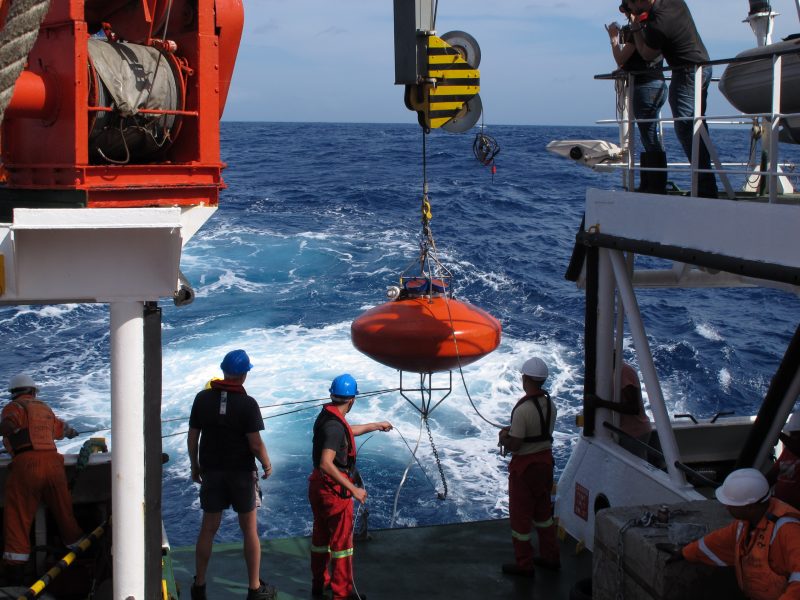
The first ASCA mooring deployment cruise that took place on board the South African Research Vessel Algoa in April 2015, saw the two shelf moorings and the first four tall moorings successfully deployed. These activities were complemented by a range of surveys along the full ASCA transect.
Due to favourable sea conditions, the mooring deployment cruise was smooth sailing. The four tall moorings and two shelf moorings were successfully parked in their rightful place on the sea floor, where they will diligently start logging data. The combination of technicians, students, vessel crew and scientific supervision made for an effective team, who made this daunting task look easy! The moorings will again be visited and retrieved in a year’s time, for downloading of data and replacing of batteries.
Putting in moorings in the Agulhas is a tricky business, because of the speed and the strength of the current. Being among the fastest ocean currents globally, it flows at a speed of about 2 m/s (up to 4/s), which translates to around 7 km/hour. For a massive body of water to move consistently at this speed, this is quite impressive and is equivalent to around 60 million bathtubs of water flowing down the East coast.
To place the moorings is an art of co-ordination between the wind, the swells, the current direction and the ship’s performance. The actual deployment starts well before the designated anchor location, so that there is enough distance for the whole cable (3 000 m in the case of mooring D) to be drawn out behind the ship, which is steaming on slowly. Then there is the critical moment when the anchor needs be released, to sink down and settle exactly on the spot marked X. The secret of successful mooring deployment lies in good preparation, good teamwork and, most of all, suitable sea conditions. The ASCA team were very fortunate to have them all!
In addition, seven surface drifters donated to SAEON by the South African Weather Service were deployed. The drifters consist of a floating ring, to which a “sock” is attached that catches the current. A transponder in the drifter sends a position update every half hour to NOAA (the National Oceanic and Atmospheric Administration [USA]), where the positions are logged.
As they are passively carried by the Agulhas Current, these drifters follow the course of the current, helping to understand the way the current is moving. The drifters are deployed under the Sentinel-1 satellite track, and will assist in ground-truthing the data, in essence ‘checking’ and correlating the accuracy of the satellite data.
Skills development
An important objective, aside from the scientific goals above, is the transfer of skills from the NIOZ and RSMAS co-principal investigators and technicians to the marine science community in South Africa to ensure the longevity of the array. The future may involve the development of new and perhaps even more complex mooring arrays within South African waters. The ability to deploy and maintain the ASCA array with capabilities developed locally, enhances South Africa’s capability of handling these.
More information on ASCA can be found at: http://asca.dirisa.org, and on Operation Phakisa at http://www.operationphakisa.gov.za/Pages/Home.aspx
 Author: Mitzi Du Plessis
Website: http://www.saeon.ac.za

Port Elizabethan
Latest posts by Port Elizabethan (see all)
- Why Fewer People Are Being Convicted for Commercial Crimes - 15 May 2026
- Urgent Call for South Africa to Support and Join Global Efforts to Phase Out Fossil Fuels - 15 April 2026
- Unfenced 6 SAI Army Base Outside Makhanda Claims Another Life - 20 November 2025
- Death Toll Rises From Makhado Bus Crash - 21 October 2025
- Law Clinics Flooded as Home Affairs Blocks Asylum Seekers From the System - 15 October 2025
