
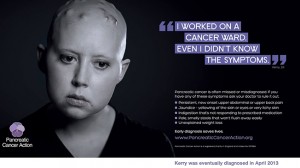
This is Kerry Harvey, aged 24 and living with metastatic Pancreatic Cancer. In the UK this week, Pancreatic Cancer Action grabbed attention with a series of terrifying ads featuring her and others with the same diagnosis.
Spokespersons from breast cancer organisations were horrified that anyone would wish for breast cancer, or compare different forms of cancer this way. Breakthrough Breast Cancer chief Chris Askew fumed, “I’ve yet to meet a man or woman with breast cancer who would consider themselves in any way fortunate to have received a diagnosis!”
Reuben Turner, whose grandfather died from pancreatic cancer, comments, “…wishing you had one form of cancer over another, or cancer instead of another disease, seems to me like the last resort of the desperate. But maybe that’s the point. Maybe these people are desperate. Desperate for attention. Desperate for funds. Desperate for a cure”.
Jenni Murray expressed similar anger as someone with a history of breast cancer, but also shared the process by which she came to understand and support PCA: “When I first saw the advert showing a picture of a ravaged, bald patient suffering from cancer of the pancreas, with the tagline ‘I wish I had breast cancer’, I felt an overwhelming sense of fury. ‘How could they make such a comparison?’ I thought, fuming at the Pancreatic Cancer Action charity that produced the image. ‘Does it really think breast cancer is a breeze? Just a bit of fun, swathed in pink ribbons?'”
Kerry Harvey denies that it can be a breeze to have breast cancer; but still affirms that if she had to have cancer at all, she would prefer that to what she has which is “almost no hope”.
This controversial statement draws attention to a crucial aspect – the illness narrative or script that follows a particular disease, shaping the way we think about it – and to some extent the way we experience it and the treatments available. The very meaning of life is represented in scripts like this, which are not made up from nothing. Instead, the stories of our lives – including stories of being diagnosed, experiencing treatment, and remission or recovery or failure – are put together like sandcastles. Variations are infinite; but all are limited by the nature of the building material we have at hand.
Like any other story, illness narratives draw the listener into the world of the central characters, setting the scene. How does Breast Cancer enter the action? Often, after a routine examination followed by more specific tests…But, go back a couple of decades or somewhere with limited health services, and the setting, the main characters and the action would look very different.
This critical difference did not emerge as a natural consequence of scientific progress. It came about because determined campaigners took action to raise funds and awareness despite public resistance to hearing the words “breast” or “cancer” at all, let alone in the same sentence (and some people still resist). Women’s health activists organised events, gathered stories, motivated for better screening and treatment, invited celebrities to speak openly about breast cancer, won corporate sponsorship, and raised yet more funds. Research efforts followed the money, and the result is a dramatic upturn in survival rates, better identification of different types of tumour, and more prevention and treatment options (as well as an explosion of pink ribbons).
In older narratives of cancer, the hero of the story was Medical Science, coming to the rescue like Superman. People still like that kind of story! But what if science doesn’t have answers? Then you might get a different story, a “chaos narrative” with no rhyme or reason, no villains and no heroes. People don’t appreciate chaos. We’d even prefer a tragic hero who accomplishes his own demise but at least makes sense. We’d rather discuss the theory that Apple boss Steve Jobs (who died of pancreatic cancer) once smoked pot, than remember an astounding man in the prime of life, with every health and financial advantage, who still couldn’t be saved.
PCA are following their shock campaign with posters informing Londoners about symptoms: pain in the upper abdomen, indigestion that won’t settle, jaundice, pale “floater” stools, unexplained weight loss. They hope the NHS will support a new drug that shows promise, and that there will be much more research. Right now, this is all they can do and it’s not much: these symptoms are caused by advanced, not early cancer.
Meanwhile the illness narratives available to women diagnosed with breast cancer have diversified in ways unthinkable even twenty years ago. Women need not be labelled by the illness. It’s possible, now, to simply say “I had treatment for breast cancer which is now finished”. More than ever before, it’s reasonable to assume that following treatment a woman will re-engage with her life, albeit in ways that reflect a deeper awareness of the fragility of health and the preciousness of time spent doing what you love with the ones you love.
What’s more, we don’t have to stick to just the one narrative. Life is complex and “multi-storied”, and so is illness. During and after cancer treatment (whether successful or not), some contemplate a “quest narrative”, in which the hero goes to the land of death or danger to find treasure or new wisdom. People with pancreatic cancer can do this too, if they have enough time. To quote Steve Jobs: “Your time is limited, so don’t waste it living someone else’s life”. That’s an important message for everyone, not just those living with cancer.
In breast cancer stories, medical science is no longer the only hero, at the centre of all the action. Today, it’s more likely that a woman will take the spotlight in her own cancer stories, not as tragic heroine or damsel-in-distress, but as part of the action in a story which features powerful expressions of hope, connection, and determination. She will also be more likely to define herself in terms of several stories that make sense of her own experience, rather than being defined by a single illness narrative in which she plays a passive role. Good doctors listen to these stories and respect them – and a thoughtful readership also pays attention.
American literacy teacher and researcher Lara Handsfield, who describes herself as “a healthy woman with breast cancer”, is using her blog to tell inspiring alternative stories of living with cancer. While chemotherapy tackles cancer cells, Lara attends to other illness related experiences such as fear, helplessness, isolation and the feeling of being set apart by cancer; and she’ll have none of it. Like living with cancer, her narrative is not simple or singular. Lara acknowledges moments of being low, of ‘woman down’, of tactical withdrawals to avoid “the demons”. The way she sees it, none of this affects her capacity for strength, which is in any case not her sole responsibility but shared with her team.
As a keen soccer player, Lara draws on sporting imagery to invite wider participation: we can all play on the team that takes the field against breast cancer. The fighting talk she prefers is feminine, personal, and ironic: she plans to give cancer an open handed slap, as often as possible. A “bitch-slap” in fact. Whack. Other women living with breast cancer have shared the frustration of being framed in metaphors of the mediaeval battlefield, of fighting alone, of solitary bravery. Who says that this imagery is the only or the best way to understand strength and courage?
Lara recently told journalist Julie Wurth: “I’ve had to shift my frame for what it means to be strong…We think being positive is being strong. Nobody gets a badge for sucking it up when you feel nauseated.” Lara: let us present you with a badge, sister. Each time someone shifts their frame and shares that encouraging discovery with others, the anti-cancer literacy of a concerned community extends.
Kerry Harvey and PCA are crying out in desperation for such a community; people who understand that it’s not what you go through, but the way you’re forced to go through it – in silence, in ignorance, in absence of hope, in the knowledge that others will follow. Pancreatic cancer doesn’t lack rich stories or strong characters, but it does lack literacy, a means to share experience, a means of hope. Breast cancer does have such a literate community. So Kerry Harvey would prefer to have breast cancer – whether others approve of her position or not; whether she makes it into the less than 5% who reach the five year milestone, or not. Wouldn’t you?
Jenni Murray concludes: “That’s why, as I continued to look at the ‘I wish I had breast cancer’ advert, I no longer felt remotely angry with Pancreatic Cancer Action…Shock tactics work. Many people who would otherwise not have thought about pancreatic cancer have been talking about it, and the advert should prompt a flurry of fundraising and awareness”.
As Lara Handsfield says, “strong is whatever it takes”. Maybe what it takes to help people with pancreatic cancer is to break down the barriers, to extend the hand of help, to recognise that “we’re all on the same team”, and to subvert any sense of rivalry between good causes. Bay Breast Care wishes PCA every success in their campaign and salutes Kerry Harvey and her colleagues for having the courage to tell their story, their way.
References:
- http://osocio.org/message/pancreatic_cancer_ad_causes_controversy/
- http://www.dailymail.co.uk/health/article-2556346/JENNI-MURRAY-Why-I-breast-cancer-sufferer-applaud-disturbing-ad.html
- http://www.news-gazette.com/blogs/there-yet/2014-02/giving-cancer-kick-you-know-where.html
- http://baybreastcare.co.za/you-wish-you-had-breast-cancer-really/

Latest posts by Sally Davies (see all)
- Memories that heal - 25 September 2014
- Don’t say these words to someone who has cancer - 18 July 2014
- About that Lump - 16 June 2014
- Free Breast Course for Nurses - 27 April 2014
- Study: Oscar, Reeva and Intimate Partner Violence, Part 6 - 27 April 2014
