
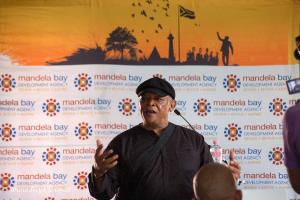
Hugh Masekela played an intimate one-night-only concert for his Port Elizabeth fans on Friday, 18 December 2015.
Here he speaks to invited guests, artists and media at the MBDA Offices in Baakens Valley on the day before his concert.
Hugh Masekela is a world-renowned flugelhornist, trumpeter, bandleader, composer, singer and defiant political voice who remains deeply connected at home, while his international career sparkles. He was born in the town of Witbank, South Africa in 1939. At the age of 14, the deeply respected advocator of equal rights in South Africa, Father Trevor Huddleston, provided Masekela with a trumpet and, soon after, the Huddleston Jazz Band was formed. Masekela began to hone his, now signature, Afro-Jazz sound in the late 1950s during a period of intense creative collaboration, most notably performing in the 1959 musical King Kong, written by Todd Matshikiza, and, soon thereafter, as a member of the now legendary South African group, the Jazz Epistles (featuring the classic line up of Kippie Moeketsi, Abdullah Ibrahim and Jonas Gwangwa).
In 1960, at the age of 21 he left South Africa to begin what would be 30 years in exile from the land of his birth. On arrival in New York he enrolled at the Manhattan School of Music. This coincided with a golden era of jazz music and the young Masekela immersed himself in the New York jazz scene where nightly he watched greats like Miles Davis, John Coltrane, Thelonious Monk, Charlie Mingus and Max Roach. Under the tutelage of Dizzy Gillespie and Louis Armstrong, Hugh was encouraged to develop his own unique style, feeding off African rather than American influences – his debut album, released in 1963, was entitled Trumpet Africaine.
What Bra Hugh Says About Hair:
Today, African women the world over spend tens of billions in dollars to acquire Brazilian, Indian, Chinese and Peruvian locks, many from heads of the dead. From a traditional perspective, the practice is macabre and ghoulish.
Skin lighteners are back in full force. The new fads and fashions are a vilification and denigration of centuries old African tradition and heritage. I am thrilled by the welcome discovery of scores of African hairstyles that are possible because the tresses are, malleable enough to sculpt into dazzling looks in all colours. On the other hand European and Asian hair only hangs downward unless fastened and clipped with all manner of pins and needles. It seems to lay so strangely on African molded features.
From my viewpoint, manipulation of African people to look down upon their natural beauty and their subsequent exploitation by international skin-lightening cream, hair extension and wig retailers is truly a tragic return to the thinking that was prevalent during my childhood, teenage and coming-of-age days when we had to listen to talk of “Kaffirhare”, “Korrelkoppe”, “Hottentotmatte”, “nappy heads”, “plantation cotton-pickin ‘Nigger’ Looks” and all other terms that mock our origins. Today we use glossier and smarter words today but they still remain demeaning.
I have registered the Hugh Masekela Heritage Foundation to (i) attempt restoring back into our lives knowledge of our historic past and researching the genealogy of every family. Also to (ii) interview every aged person 85years and older so as to capture whatever memories, wisdoms and ancient know-how they might still be able to recall. All the information will be preserved and stored in databases for access to our past.
(iii)To encourage the relearning of mother tongues, poetry, praises and literature for present and future generations to possess as a mirror against consumption by other cultures, (iv) To revive artisanship study in the areas of indigenous manufacture of household goods to elevate the study of carpentry, construction, weaving, linen manufacture, design, stone-masonry, mosaic, art, traditional music, dance and sport. Hopefully, this initiative will aid us to gradually cut down on our blatant consumership of foreign goods and cultures, subsequently turning us into a seller society instead of the buyers that we are today.
In view of all I have stated above, it would be hypocritical of me to appear in photos with people donning foreign wigs, chemically–altered hairdos, extensions, Asian, European, and South American extensions except in cases where if I refuse could result in my imprisonment, deportation or demise.
In conclusion, I do not wish to stop anybody from the choices they make or the cultures they want to serve themselves as fodder for. I am only begging not to be forced to join the dive of the lemmings or sheep over the cliff. As you can surmise by now, I have personally had a very depressing hair life. Today and everyday these days appears to be a “bad hair” day. Painfullest is to watch government officials, “celebrities”, prominent women in business, media, sports, religion and education wearing these devices with so much deep pride, aplomb and joy; especially the old grannies who are at an age where at which nobody is “looking” anymore. I’m surprised to see people of the African female community who look like themselves in newspapers, magazines, journals, television, theatre and concerts. It is as rare a sighting as seeing an albatross.
Many employment establishments will not have them. We are living a “bad hair” life. Welcome to another “bad hair” day.
I hope that the next time I mention hair, people will try to seriously consider the afore-mentioned history before getting their feathers ruffled.
Date: December 26, 2015 06:55
Click here for more: MyPE Images – MyPE (Latest images)

Port Elizabethan
Latest posts by Port Elizabethan (see all)
- Why Fewer People Are Being Convicted for Commercial Crimes - 15 May 2026
- Urgent Call for South Africa to Support and Join Global Efforts to Phase Out Fossil Fuels - 15 April 2026
- Unfenced 6 SAI Army Base Outside Makhanda Claims Another Life - 20 November 2025
- Death Toll Rises From Makhado Bus Crash - 21 October 2025
- Law Clinics Flooded as Home Affairs Blocks Asylum Seekers From the System - 15 October 2025

